

10 Birth Announcement Wording Examples for Parents That Fit Your Card
Here’s your template: “We’re overjoyed to welcome [Baby’s Name], born [Month Day, Year], weighing [X lbs, X oz]. Love, [Parents’ Names].” Use it as is or dress it up. The only real rule is this: match the wording to your family’s voice and to the card design, and always include the two essentials, name and date. Everything else is optional. Send printed cards within a few weeks of the birth; a social media post can go out sooner if you’re ready to share.
TL;DR:
- Keep the announcement brief, ideally two to six lines, and include only the essential details such as the baby’s name and birth date.
- Use a tone that matches your family’s voice, from formal to playful, and read the wording aloud to ensure it sounds natural.
- Use a consistent date and name format throughout the card, and choose layouts designed for short, personalized text.
- Save sensitive information like hospital details for close contacts and consider private sharing options for photos or extended stories.
Table of Contents
- What Should Go on a Birth Announcement?
- Birth Announcement Examples for Every Tone and Family Story
- Social Media Captions vs. Printed Card Wording
- When to Send Birth Announcements and Common Mistakes to Avoid
- Matching Your Wording to the Card Design
- Bilingual and Multilingual Birth Announcement Wording
- A Few Honest Thoughts on Getting the Wording Right
- Bring Your Wording to Life on a Card That Fits
- Sources
- FAQ
What Should Go on a Birth Announcement?
Every announcement needs two things to actually function as an announcement: the baby’s name and the date of birth. Skip either one and you’ve written a nice sentiment, not an announcement. Beyond that, you’re choosing from a menu of optional details, and the right combination depends on your card design and how much you want to share.
Most stationery guides agree that name, date, weight, and length round out the standard set, with time of birth and hospital or city location treated as nice-to-haves rather than requirements. Here’s how to think through each piece:
- Name format: A first name feels warm and personal; a full name (including any family middle name) reads more formal and works well if you’re honoring a relative.
- Date: Spell it out (“March 3, 2026”) for a traditional card, or use numerals for a modern, minimalist layout.
- Weight and length: Charming details, but skip them if your design is tight on space or if you’d rather keep things simple.
- Parents’ names: List both parents by first name, or use “and” or an ampersand between them depending on your card’s tone.
- Siblings and pets: A line like “Big sister Mia is thrilled” adds warmth, and plenty of families include the family dog too.
On privacy, leave off the street address and think twice before naming the hospital, especially if you’re mailing to a broad list. And keep the whole thing tight: most keepsake cards run two to six lines total, which is short enough to demand you choose your words with intention rather than padding them out.
Birth Announcement Examples for Every Tone and Family Story
Once you have your essentials nailed down, the fun part is finding the voice that sounds like you. Collections of example wording tend to group templates by tone, and that’s genuinely the fastest way to find something you can personalize in under five minutes. Swap in your baby’s name, pick full name or first name, and adjust the date format to match your card’s style. Here are ten categories to pull from.
- Formal and traditional. “Mr. and Mrs. James Carter joyfully announce the birth of their daughter, Charlotte Anne Carter, born on the third of March, two thousand twenty-six.” The written-out date and full names give this the weight of a classic keepsake.
- Modern and minimalist. “Charlotte Anne. 03.03.26. 7 lbs, 2 oz.” One line, three facts, done. This style leans on a strong photo to carry the emotion instead of the words.
- Playful and funny. “Alert: our household population just increased by one very loud, very small human. Meet Charlotte, born March 3, 2026.” Great for parents whose humor is part of their identity.
- Sentimental and poetic. “Our hearts grew three sizes the moment we met her. Charlotte Anne, born March 3, 2026, and already loved beyond measure.” Works especially well paired with a soft, warm-toned photo card.
- Religious and inspirational. “A gift from above has arrived. Charlotte Anne Carter, born March 3, 2026. ‘Children are a heritage from the Lord.’” For a gentler, non-denominational version, try: “Blessed and grateful. Charlotte Anne joined our family March 3, 2026.”
- Adoption and gotcha day. “Our family became complete on March 3, 2026, the day we brought Charlotte home. Adoption made her ours; love made her family.” This phrasing centers the moment of joining rather than a birth date, which fits many adoption stories more honestly.
- Twins or multiples. “Double the love arrived on March 3, 2026. Meet Charlotte Anne (6 lbs, 8 oz) and Henry James (6 lbs, 10 oz).” Listing each baby’s stats separately helps readers keep the two apart.
- Sibling-included announcements. “Big brother Owen is so proud to announce his new little sister, Charlotte Anne, born March 3, 2026.” Letting an older sibling “narrate” the announcement is a favorite among parents who want the card to feel like a family moment, not just a parent-to-parent update.
- IVF and rainbow babies. “After a long road and so much hope, we are overjoyed to welcome Charlotte Anne, born March 3, 2026. Every step was worth this.” You don’t have to name the fertility journey explicitly. A phrase like “long-awaited” or “worth every step” acknowledges it without oversharing.
- Firstborn milestone wording. “Our first, our forever. Charlotte Anne Carter arrived March 3, 2026, and changed everything.” Good for families who want the “first baby” milestone to feel front and center.
Whichever tone you pick, read it out loud once before you finalize it. If it doesn’t sound like something you’d actually say to a close friend, it’s probably too stiff or trying too hard.
Social Media Captions vs. Printed Card Wording
A printed card and a social media caption are doing two different jobs, and treating them the same is a common misstep. A card is a keepsake that lives in a drawer or a scrapbook for decades. A caption is a quick, public update that disappears into a feed within a day. That difference should shape your wording.
Captions can run shorter and looser than card copy, since the photo is doing most of the emotional work and the audience is scrolling fast. Cards, on the other hand, benefit from a complete sentence or two because someone will actually sit and read them.
- Instagram: “She’s here! Charlotte Anne, March 3, 2026. Our hearts are so full. 💕”
- Facebook (broader audience): “We are beyond thrilled to introduce Charlotte Anne Carter, born March 3, 2026, weighing 7 lbs, 2 oz. Mom, Dad, and big brother Owen are smitten.”
- Private family group text: “She’s finally here! Charlotte Anne, 7 lbs 2 oz, both doing great. Photos coming soon 💗”
Think carefully about what you reveal publicly versus privately. Save hospital names, exact room numbers, or medical details for close family and friends rather than a public post. If you want to share a full photo album, a private link (a shared album or a password-protected page) keeps extended family in the loop without putting every image in front of a public audience.
When to Send Birth Announcements and Common Mistakes to Avoid
The typical window for mailing printed birth announcements is two to six weeks after the baby arrives, though that range flexes for plenty of families, especially if there’s a NICU stay or any medical situation that needs to settle first. Nobody’s timeline is wrong here, but immediate family and close friends should generally hear the news before it appears on a public feed or a group card list.
Etiquette guidance from sources like the Emily Post Institute consistently points back to one principle: match your tone to your audience, and think before you post anything that feels too personal for a public space.
- Do notify parents, grandparents, and closest friends by call or text before anyone posts online.
- Do double-check spelling on names, especially unusual spellings or family middle names.
- Don’t share detailed medical information (a difficult delivery, NICU specifics) in a public announcement.
- Don’t mix tones within one card. A joke in line one and a solemn Bible verse in line three reads as unfinished, not personal.
- Don’t forget to proofread the date format and numbers. Typos in a keepsake card are permanent once it’s printed.
Pro Tip: Read your final wording out loud to one other person before you send it to print. A typo you’d catch on a screen is easy to miss on paper, and once it’s printed, it’s printed.
Matching Your Wording to the Card Design
Wording and layout are not separate decisions. The words you choose need to physically fit the card you’ve picked, and that means thinking about length before you fall in love with a phrase.
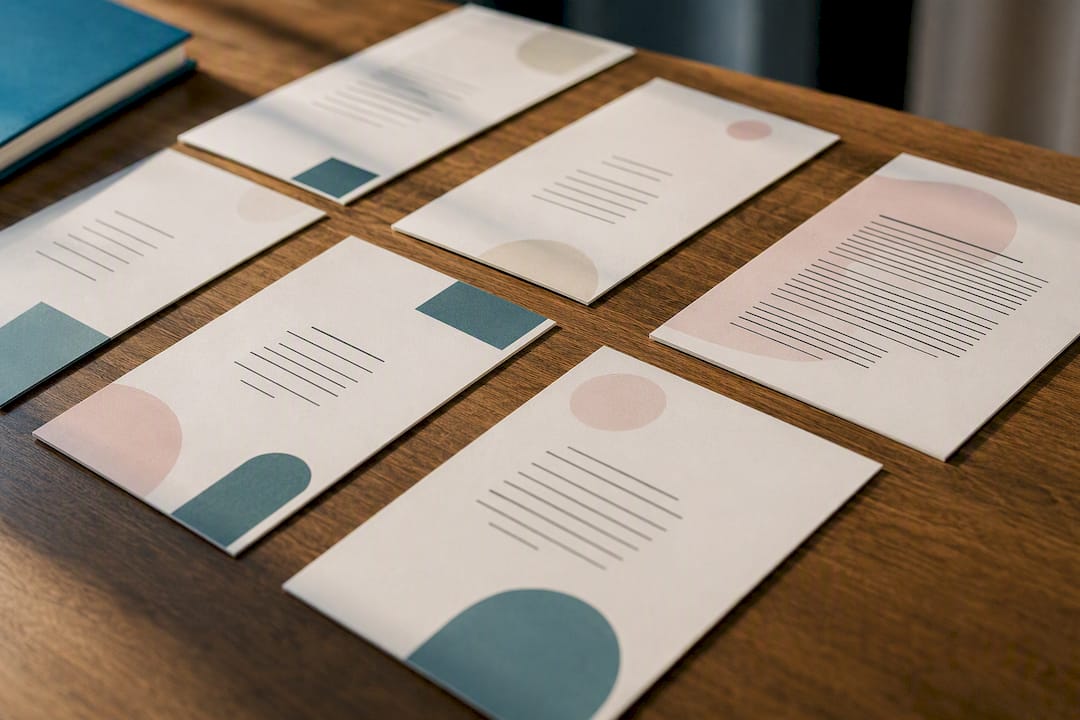
Single-photo cards ask for restraint. If your design has one large photo and a small text block, a one-line caption like “Charlotte Anne, 03.03.26” reads clean and confident. Cram in three sentences of parents’ names, weight, length, and a heartfelt quote, and the text competes with the photo instead of complementing it. Folded card formats give you more room, so you can put the essentials on the front and a fuller family message, or a sibling note, on the inside.
Name presentation matters more than people expect. A full name with a family middle name signals formality and often gets used when you’re honoring a relative. A first name alone, or a nickname, feels warmer and more casual, which fits playful or minimalist designs better than formal ones.
- Keep numeric formatting consistent: if you write the date as “03.03.26” on the front, don’t switch to “March 3, 2026” inside.
- Weigh visual balance, not just word count; a short line in a large font can fill space as well as a longer line in small type.
- Draft three versions of your wording, then drop each into a mockup at the card’s actual size before you commit.
A quick workflow works better than agonizing over word choice in the abstract: write three options, place each on a print-size mockup, and pick whichever one reads best at actual scale, not just on your phone screen. Typesetters testing wording at true scale routinely catch spacing and legibility issues that never show up when you’re just staring at a document.
Bilingual and Multilingual Birth Announcement Wording
Families with roots in more than one language often want the announcement to reflect both, and there are a few clean ways to do that without cluttering the card. The most common approach is a stacked format: the English wording on top, the second language directly below it, using the same structure and line breaks so the two versions mirror each other visually.
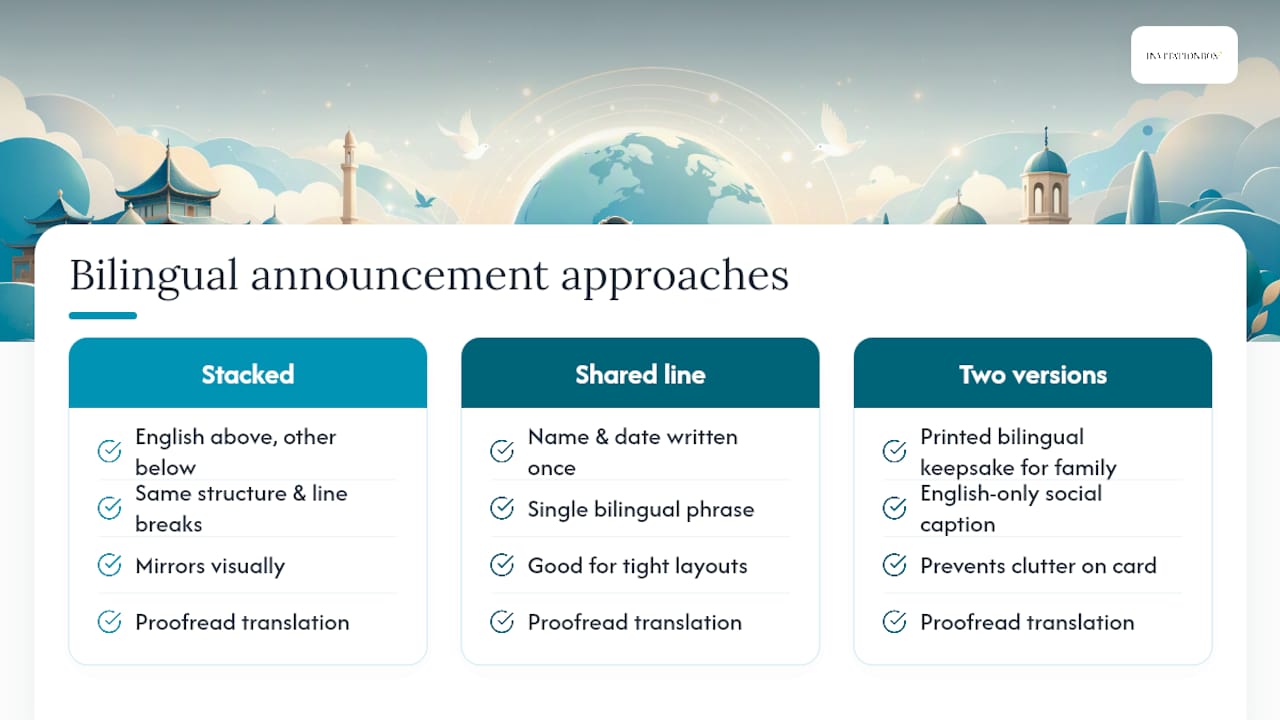
A shorter option works well on tighter layouts: write the baby’s name and date once, then add a single bilingual phrase, such as pairing “Welcome to the world” with its equivalent in a family’s heritage language. This keeps the card from feeling like two separate announcements glued together.
If grandparents or extended family are the primary audience for one language and friends for the other, consider two versions entirely: a bilingual printed keepsake for family, and an English-only caption for social media. Whatever route you choose, have a native speaker in the family proofread the translated portion. Direct translations of English phrases like “bundle of joy” often sound stiff or lose their warmth in another language, so it’s worth asking someone who can rephrase idiomatically rather than translate word for word.
A Few Honest Thoughts on Getting the Wording Right
The biggest mistake I see in birth announcements isn’t bad wording, it’s mismatched wording. A playful pun paired with a somber, formal photo layout, or a deeply sentimental line crammed onto a card with no room to breathe. The words and the design have to agree with each other before either one works.
My real advice: write three versions in different tones before you pick one, and read your favorite out loud to your partner or a close friend. If it sounds like you, it’s right. Through years of watching families work through InvitationBox’s stationery options, the ones who slow down enough to preview their wording on an actual mockup almost always end up happier with the final print than the ones who rush.
Choose the version that sounds authentic to you, not the version that sounds impressive.
— Jon
Bring Your Wording to Life on a Card That Fits
Once you’ve settled on wording, the fastest path from draft to keepsake is a template built specifically for baby announcements, not a blank document you’re formatting from scratch. There are baby announcement collections that offer customizable layouts sized for short, personal wording, so you’re not stretching one line to fill a card built for three.
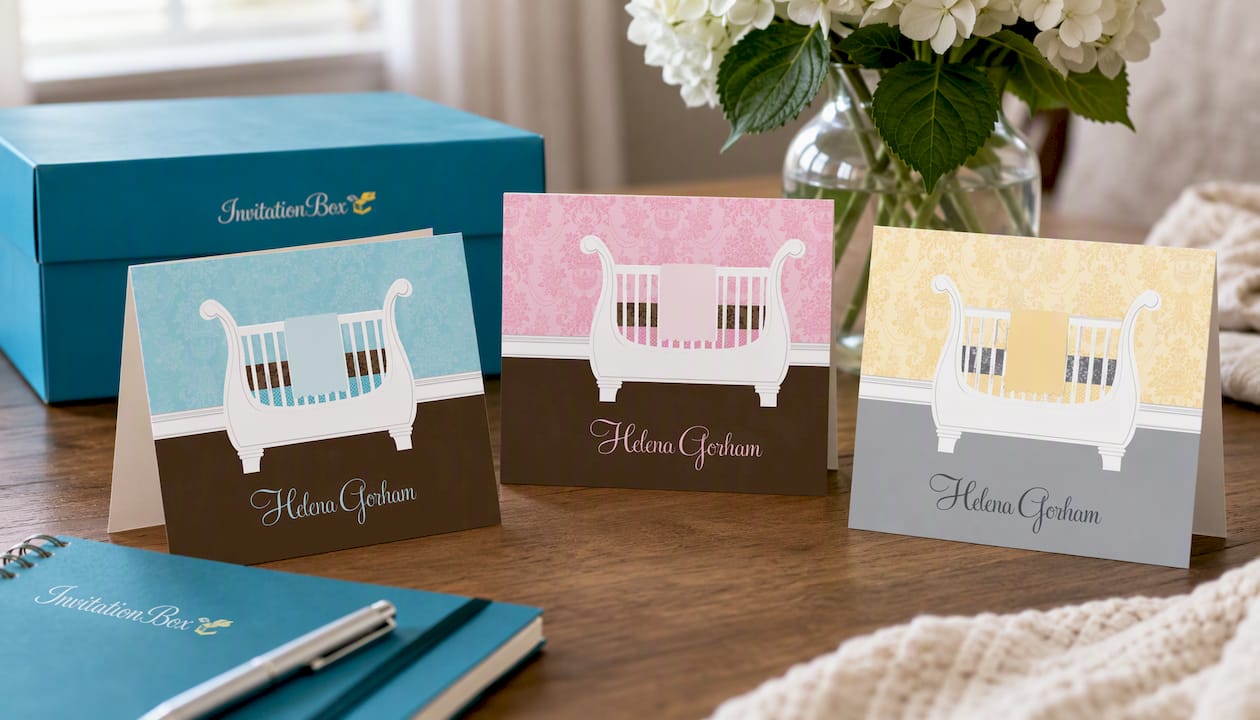
Three designs worth previewing first: the Sleigh Crib Bali & Chocolate Note Cards for a warm, neutral palette; the Sleigh Crib Pink & Chocolate Note Cards for a softer, traditional feel; and the Sleigh Crib Buttercup & Silver Note Cards if you want something brighter and a little less expected. Each one lets you drop in your chosen wording, adjust the name format, and preview the layout before you commit to print. Browse the full birth announcement and baptism invitation collection, paste in the wording you drafted above, and order a printed proof so you can see exactly how it reads at real size before the full run goes to print.
Sources
- Baby Birth Announcements: Card and Wording Ideas | Pampers
- 150+ Baby Birth Announcement Messages | MomJunction
- Template
- The Emily Post Institute: Etiquette Advice & Training — Emily Post
FAQ
How do you write a birth announcement?
Start with the two essentials: your baby’s name and date of birth, then add optional details like weight, length, or a short personal line to match your tone. Keep the whole message to two to six lines and read it aloud before finalizing.
What should I write in a baby birth announcement message?
At minimum, include the name and birth date; many families also add weight, length, and the parents’ names. The right tone, whether formal, playful, or sentimental, depends on your family’s style and the card design you’ve chosen.
How do I announce my baby’s birth on social media?
Keep social captions short since the photo carries most of the emotional weight, and save private details like hospital names or medical specifics for close friends and family instead of a public post. A caption like “She’s here! Charlotte Anne, March 3, 2026. Our hearts are so full” works well for a public feed.
What is a good way to announce the birth of a baby?
A ready-to-use template works for most families: “We’re overjoyed to welcome [Baby’s Name], born [Date], weighing [Weight]. Love, [Parents’ Names].” Adjust the tone and detail level to match either a printed keepsake card or a quicker social post.
When should I send printed birth announcements?
Most families mail printed announcements within two to six weeks of the birth, though that timeline can stretch if there’s a NICU stay or the family simply needs more time. Notify close family and friends personally before sending broader announcements or posting online.