

Book Embosser Designs for Buyers: Premade Families + Custom Checklist
Pick a premade motif when you want something beautiful and ready to ship this week, and order a custom plate when your book, your library, or your gift deserves artwork nobody else has. For most families and gift-givers, a premade design does the job perfectly, while a custom plate gives authors and collectors precise text layout and one-of-a-kind branding. Invitationbox’s Woodcut, Horseshoe, and Library stamp lines cover nearly every occasion in between.
TL;DR:
- Premade motifs are ideal for quick, budget-friendly personalization, especially for gifts and family collections, with designs suitable for small impressions and straightforward application.
- Custom embossers require high-resolution artwork and precise proofing, making them best for exact branding, signatures, or heraldic designs that need specific detail and size considerations.
- The impression diameter should match the complexity of the design; larger sizes are necessary for detailed crests or full illustrations to ensure readability and detail clarity.
- Throat depth and paper type significantly impact embossing quality; testing on similar paper is recommended to prevent faint impressions or misalignment, especially on thin or glossy pages.
- Reputable sellers provide proofing, revision rounds, and clear specifications for turnaround time, reducing common mistakes such as over-detailed artwork, inadequate testing, or ordering incompatible embosser models.
Table of Contents
- Browsing Book Embosser Designs by Style Family
- How Do Custom Book Embosser Designs Work?
- What Specs Should You Check Before Choosing an Embosser?
- Getting a Crisp Embossed Impression Every Time
- Design Ideas for Gifts, Authors, and Book Lovers
- InvitationBox.com’s Book Embosser Lineup
- Your Ordering Checklist From Design to Delivery
- Questions to Ask Before Ordering a Custom Embosser
- Common Mistakes When Choosing a Book Embosser
- What the Research Actually Tells Us About Choosing a Design
- Get Your Book Embosser Made the Way You Want It
- Sources
- FAQ
Browsing Book Embosser Designs by Style Family
Every embossed mark tells a small story about the book it belongs to, and choosing the right style family makes that story land the way you want it to, as inspired by design ideas from a Black Art Reading Nook. Think of these families less as rigid categories and more as starting points you can dress up with a name, a date, or a favorite phrase.
Monogram designs. Clean initials, sometimes framed with a simple border or a laurel sprig, work beautifully on wedding gifts, graduation presents, and cookbooks passed between siblings. They read well at small sizes because the shapes are simple, which matters more than people expect once the plate is actually pressed into paper.
“From the Library Of” designs. This is the classic ex-libris format, and it has a genuinely long history behind it. The Library of Congress holds extensive scholarship on bookplates and ownership marks, tracing a collecting tradition that stretches back centuries. If you want your personal library to feel like an actual library, this family is the one to choose.

Floral and botanical motifs. Vines, single blooms, or a wreath framing a name suit book clubs, nature lovers, and anyone gifting a journal or a favorite novel to a friend. These designs tend to look best on covers or endpapers rather than crowded title pages, since the fine linework needs room to breathe.
Animal motifs. Owls, foxes, cats, and dogs are popular for children’s books, pet lovers, and anyone who wants a bit of personality stamped into their collection. Simpler silhouettes emboss more crisply than highly detailed illustrations, a pattern that holds true across nearly every animal design on the market.
Fantasy and literary motifs. Dragons, castles, quills, and open books appeal to fantasy readers, writing groups, and teens building their first serious bookshelf. These tend to work well as a full-cover statement piece rather than a small corner mark.
Armorial and crest designs. Shields, banners, and heraldic flourishes suit family libraries, formal gifts, and readers who want their books to look like they belong in an estate library. Crests carry more visual weight, so they usually need a slightly larger impression diameter to stay legible.
Minimalist designs. A single line, a small icon, or bare initials without ornamentation fit modern readers who want the personalization understated. These are also the most forgiving option if you are stamping delicate or thin paper, since less detail means a cleaner strike.
Sellers who offer a wide range of ready-made motif families let shoppers move straight from browsing to buying without waiting on custom art, which is exactly why premade catalogs remain the fastest route to a personalized book.
How Do Custom Book Embosser Designs Work?
Custom embossing splits into two basic paths: text-only layouts and combined art-plus-text designs. Text-only plates are the simpler build. You choose a name, a monogram, or a short phrase, pick a font, and the design house arranges the layout for maximum clarity inside the plate’s diameter. Art-plus-text designs layer an icon, crest, or illustration around that text, which looks striking but demands more precision during proofing to keep everything readable.
Artwork requirements matter more than most first-time buyers realize. Vector files (AI, EPS, or high-resolution PDF) translate cleanest into a brass die because the lines stay sharp no matter how much the artwork is scaled. If you only have a raster image such as a JPG or PNG, aim for at least 300 DPI at the final print size, or the fine detail can blur once it is engraved. A reputable seller will send a digital proof before cutting the actual plate, giving you a chance to catch spacing issues, awkward line breaks, or a crest that reads too small.
Here is the general sequence for a custom order:
- Submit your text and, if applicable, your artwork file in the recommended format.
- Review the digital proof for spelling, spacing, and overall balance.
- Request revisions if the layout feels off. Most sellers allow at least one round.
- Approve the final proof before the brass plate goes into production.
- Choose your orientation. Round plates suit monograms and crests, while rectangular plates fit longer names or phrases better.
Very small plates and highly detailed artwork do not always mix well. Intricate crosshatching or thin script can lose definition once compressed into a one-and-a-half-inch die, so simplifying ornamental art before submission almost always produces a cleaner final impression.
Pro Tip: If your custom design includes fine detail, ask your design house to bold the outlines and drop any background texture. Bold, simplified shapes survive the embossing process far better than delicate line art.
What Specs Should You Check Before Choosing an Embosser?
The right design only performs well if the embosser itself matches your books. A few technical specs decide that fit more than style preference ever will.
- Impression diameter determines how much detail your design can hold. A 1.625-inch die works fine for initials or a small crest, but an elaborate armorial design needs a larger diameter, usually 2 inches or more, to stay legible.
- Throat depth controls how far the plate reaches onto a page. It is often the limiting factor for embossing near the inner margin of a title page. Pocket and handheld models typically offer around 2.4 inches of throat depth, enough for most inside covers, while desktop models often extend to 3.6 inches for larger books or oversized title pages.
- Handheld vs. desktop models come down to volume and comfort. Handheld embossers suit occasional personal use, gifting one or two books at a time. Desktop models make more sense for authors signing multiple copies, librarians processing donations, or teachers stamping a classroom set.
- Materials and durability matter for the long haul. Brass die plates hold fine engraving detail far longer than softer metals, and a metal handle typically outlasts a plastic one under repeated use.
- Paper compatibility rounds out the checklist, and it deserves its own section, because it changes the outcome more than most buyers expect.
Getting a Crisp Embossed Impression Every Time
Paper choice affects the final look of your embossed design more than the plate itself in many cases. According to Arden Paper’s embosser guidance, slightly soft, uncoated stock generally embosses more clearly than glossy coated paper, and very thin paperback pages can produce a weak, shallow strike. If you are stamping a paperback title page, test on a spare page first, or on the inside back cover, before committing to the spot you actually want marked.
Front covers, inside covers, and title pages each behave differently under pressure. Covers can usually handle a bolder, larger design, while title pages call for something smaller and centered near the top or bottom margin to avoid crowding the printed text.
Before any final impression, do a test strike on scrap paper of the same weight. This single habit catches alignment problems and pressure issues before they show up on the real page.
Pro Tip: Store your embosser plate dry and away from humidity, skip abrasive cleaners entirely, and add a drop of light lubricant to the handle’s pivot point every few months to keep the mechanism smooth.
Design Ideas for Gifts, Authors, and Book Lovers
A good design idea pairs the right motif, the right words, and the right placement for how the book will actually be used.
- Wedding gift: A monogram with the couple’s initials and wedding date, centered on the inside front cover.
- Personal library: A “From the Library Of” design with a full name, stamped on the title page.
- Author book signings: A custom plate combining the author’s signature-style logo with the book title, ideal for a small desktop embosser used at events.
- Teacher’s classroom set: A simple owl or apple motif reading “Property of Mrs. [Name]'s Class,” stamped inside the front cover of every book.
- Book club: A minimalist open-book icon with the club’s name, sized small enough for a corner stamp.
- Grandparent’s library: A floral wreath framing “From Grandma’s Bookshelf,” a warm option for family keepsakes.
- Collector’s edition: An armorial crest custom-built around a personal or family emblem, worth the extra design cost because no premade motif will match a specific heraldic detail.
- New baby keepsake book: An animal motif paired with the child’s name and birth year.
Custom art earns its price tag most clearly for signed editions, author promotional copies, and family crests. Everything else on this list works beautifully with a premade motif.
InvitationBox.com’s Book Embosser Lineup
Invitationbox built three product lines specifically to cover the range of styles readers ask for most, each suited to a different kind of book and buyer.
-
Woodcut Stamper or Embosser: A rustic, textured motif well suited to nature lovers, cabin libraries, and rugged personal collections.
-
Horseshoe Stamper or Embosser: A decorative frame shape that works nicely for keepsake gifts and celebratory occasions.
-
Library Stamper or Embosser: The classic ex-libris layout, built for anyone who wants their personal library to feel like an institution.
Every order runs through a professional design proofing process, so buyers see exactly how their text and artwork will sit on the plate before it goes into production. Invitationbox holds the proprietary Snap Stamp system, a manufacturing approach exclusive to Invitationbox and its sister sites, which underpins these embossers. The catalog spans beyond these three lines if you want to browse additional embosser styles or see how personalization choices shape the finished product. A Teacher Stamper or Embosser rounds out the lineup for classroom use.
Your Ordering Checklist From Design to Delivery
Ordering a book embosser is straightforward once you know the sequence.
- Pick your design family (premade) or start a custom art submission.
- Choose your impression size and orientation based on where you plan to stamp.
- Upload your text and artwork; vector files at final size work best, and raster images need at least 300 DPI.
- Review your digital proof carefully, checking spelling, spacing, and alignment.
- Approve the final proof or request a revision if something feels off.
- Wait for production and shipping, watching your proof email closely since most delays trace back to a missed approval step.
Questions to Ask Before Ordering a Custom Embosser
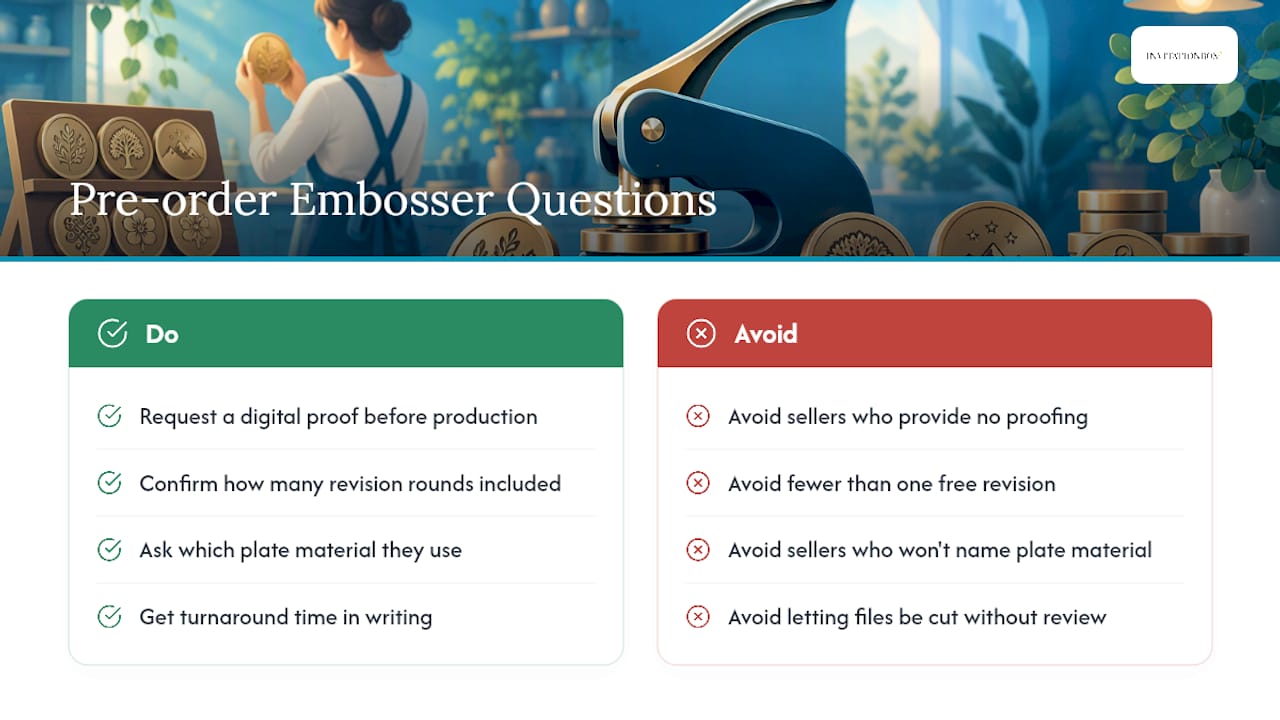
A few direct questions before checkout save most buyers from a disappointing plate. Ask whether the seller provides a digital proof before production starts, since proofing and revision workflows are standard practice among reputable sellers and their absence is a warning sign, not a shortcut worth taking.
Ask how many revision rounds are included. One free round is typical; anything less leaves no room to fix a spacing issue before the brass plate is cut.
Ask about the plate material. Brass holds fine detail far longer than softer alloys, and a seller who cannot answer this question directly may not be using quality components.
Ask about throat depth if you plan to stamp title pages or inner covers rather than just the outside cover. A 2.4-inch throat depth handles most books, but oversized volumes may need the extra reach of a desktop model.
Ask what file formats they accept and whether they will flag legibility problems in your artwork before production, rather than simply cutting whatever you send. A seller who reviews your file for potential issues is protecting your money as much as their reputation.
Finally, ask about turnaround time in writing, especially if the embosser is meant for a wedding, graduation, or another date-specific gift.
Common Mistakes When Choosing a Book Embosser
The most frequent mistake is choosing artwork that is simply too detailed for the plate size. Intricate crests and fine script look stunning on screen and then lose most of their detail once compressed into a small brass die. Simplify before you submit, not after you see a blurry proof.
Skipping the test impression is another common misstep. A plate that looks perfect on a proof sheet can still strike unevenly on your actual book paper, particularly on thin paperback stock. Always test on scrap paper matching your book’s weight before stamping the real thing.
Buyers also underestimate throat depth. Ordering a compact handheld embosser and then trying to reach a title page three inches from the spine simply will not work if the throat depth falls short.
Watch for sellers who skip the proofing step entirely and go straight to production. Without a proof, you have no chance to catch a misspelled name or a crooked layout before the plate is finished.
Last, do not assume every design scales the same across impression sizes. A crest that looks balanced at 2 inches can feel cramped or oddly spaced at 1.5 inches, so always check the size options against your specific design before finalizing an order.
What the Research Actually Tells Us About Choosing a Design
Most advice on book embossers treats premade and custom as competing choices, when they are really solving two different problems. Premade motifs solve a speed-and-budget problem. Custom plates solve a precision-and-identity problem. The mistake I see shoppers make constantly is choosing custom when what they actually wanted was speed, or choosing premade when what they actually needed was a specific crest or exact name spacing that no catalog motif could ever replicate.
The conventional wisdom oversells detail. Buyers assume more ornamentation signals more value, but the craft history behind ex-libris marks shows the opposite: the most enduring bookplate designs tend to be simple, legible, and built to survive decades of handling. A clean monogram outlives an elaborate crest that loses definition after a dozen impressions.
Prioritize legibility first, sentiment second, and decoration last. That order rarely fails.
— Jon
Get Your Book Embosser Made the Way You Want It
Invitationbox is the direct route to a personalized book embosser without piecing together design work from multiple vendors. Every custom order runs through a professional proofing process before production, and the exclusive Snap Stamp system behind these embossers is not something you will find replicated on other stationery sites.
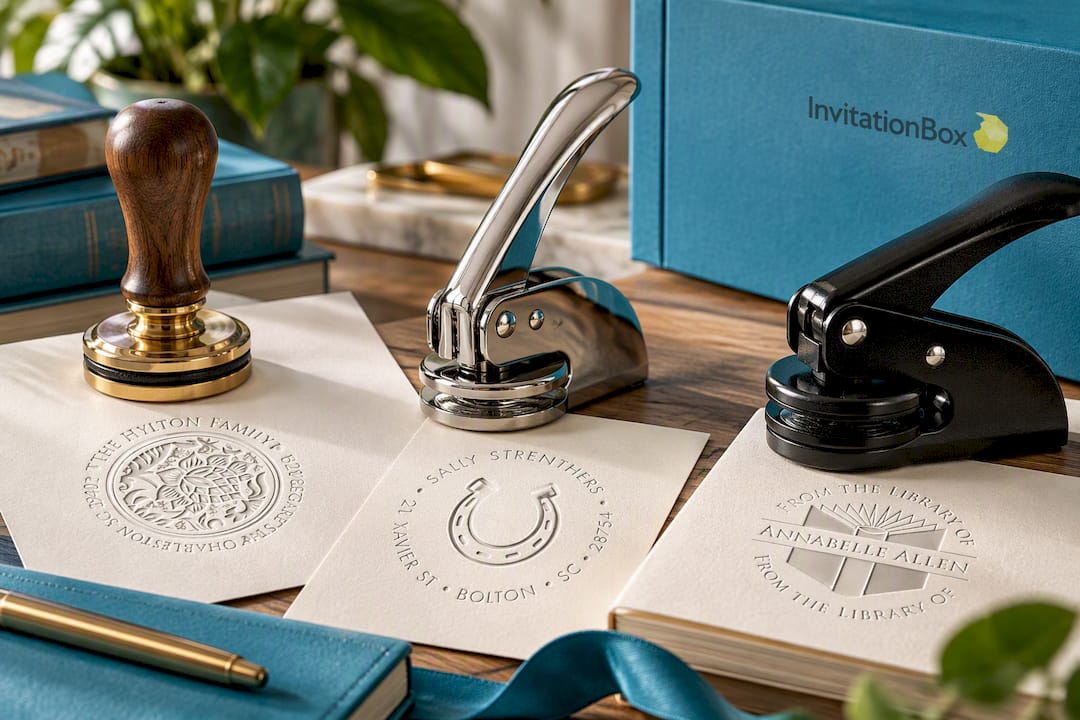
Whether you want the rustic texture of the Woodcut Stamper or Embosser, the decorative shape of the Horseshoe Stamper or Embosser, or the classic ex-libris feel of the Library Stamper or Embosser, Invitationbox’s catalog covers the design families most readers actually ask for. Browse the full stamper and embosser catalog to compare sizes and styles, or if you are shopping for a wedding season gift alongside your embosser, the wedding invitations collection and baby announcement collection pair naturally with a personalized book gift. Start your design today and approve your proof before it ever goes to production.
Sources
- A guide to the study of book-plates (ex-libris) | Library of Congress
- Embosser questions | Arden Paper
FAQ
What Are Some Creative Design Ideas for Book Embossers?
Popular ideas include monograms for wedding gifts, “From the Library Of” designs for personal collections, and animal motifs for children’s books. Custom crests work well for family libraries or signed author editions where a premade motif will not match a specific emblem.
Can I Design My Own Book Embosser?
Yes. Most sellers accept a custom text layout or a combined art-and-text design, provided you submit vector artwork or a high-resolution image. Invitationbox routes every custom order through a digital proof so you approve the exact layout before the Library Stamper or Embosser or a similar plate goes into production.
What Is the Difference Between a Book Stamp and a Book Embosser?
A book stamp uses ink to leave a colored mark on the page, while an embosser presses a raised, inkless design directly into the paper. Embossers tend to feel more formal and permanent, which is why they are the traditional choice for ex-libris marks and library ownership stamps.
Are Book Embossers Worth It?
For anyone who gifts books regularly, builds a personal library, or wants signed editions to look distinct, a book embosser is a lasting way to personalize a collection rather than a passing novelty. A premade design from Invitationbox keeps the cost modest, while a custom plate is worth the investment for one-of-a-kind crests or precise author branding.