

12 Custom Stamp Ideas Matched to Stamp Type for Stationery & Small Biz
For most stationery and small-business needs, a self-inking stamp handles everyday tasks like return addresses and packaging, rubber stamps work best for craft projects and detailed one-off designs, and wax seals or embossers bring a warm, formal touch to wedding suites and keepsakes. Pick your purpose and final size first, then prepare a clean vector or sufficiently high-resolution file before you upload anything.
TL;DR:
- Self-inking stamps are ideal for high-volume tasks like address printing and logo branding, requiring properly prepared vector or high-resolution files.
- Designs should focus on one strong element, use bold, simplified shapes, and be tested physically before full production to ensure clarity and legibility.
- Proper surface and ink type are crucial; dye or pigment ink works on paper, while fabric or textured surfaces need specific inks or heating for embossers and wax seals.
- Files must be in vector format or at least 300 DPI raster images with outlines for fonts, and artwork should maintain minimum line weights and negative space for best impressions.
- Ready-made stamp sets with built-in design rules are available for common themes like wedding or seasonal motifs, reducing the risk of design errors in the final impression.
Table of Contents
- Custom Stamp Ideas for Stationery, Gifts, and Small Businesses
- The Design Rules That Keep a Stamp Impression Crisp
- Matching Stamp Type and Ink to Your Surface
- How to Turn an Idea Into a Finished Stamp
- Where Practical Experience Backs These Ideas
- What Actually Matters When You’re Choosing a Stamp Design
- Bring Your Stamp Idea to Life Without the Guesswork
- Sources
- FAQ
Custom Stamp Ideas for Stationery, Gifts, and Small Businesses
The best custom stamp ideas start with a job to do, not a design you love in isolation. Here are a dozen ready-to-order concepts, each matched to the stamp type that actually suits it and a quick note on size and use.
-
Address stamp for envelopes. A personalized address stamp is the workhorse of any stationery drawer. Self-inking stamps sized appropriately for addresses keep names and addresses tidy across holiday cards, wedding thank-you notes, and everyday mail without re-inking every envelope.
-
Monogram or wax-seal initial. A single letter or interlocking initials feel elegant on invitation flaps and gift tags. This is where an embosser or a wax seal shines rather than a standard rubber stamp, since wax seal suppliers typically offer brass heads and multiple size options built specifically for that raised, formal texture.
-
Small-business logo mark. For packaging, receipts, and thank-you cards, a bold, simplified version of your logo works better than your full-color version. Self-inking or standard rubber stamps handle repeated use on boxes and paper bags without smearing, and small-business resources point to stamps as an affordable way to add physical branding without a print run.
-
Save-the-date mini icon. A tiny motif, a date in a simple typeface, or a decorative flourish reads well at a small scale on invitation suites. Keep it under two inches and leave breathing room around the text so it doesn’t compete with your envelope calligraphy.
-
Bookplate or ex libris stamp. Round bookplates work well when sized to comfortably fit inside a book’s front cover. High contrast between the text and background is non-negotiable here since smaller lettering gets muddy fast at that scale.
-
Loyalty punch icon. A repeat-use loyalty stamp needs to survive dozens or hundreds of impressions. Self-inking versions are the durable choice for card-stamping programs where a rubber stamp would wear down or need constant re-inking.
-
Gift tag or product-care label. Craft surfaces like kraft paper and cardstock respond well to pre-inked or pigment stamps, which tend to give crisper detail on porous materials than standard dye inks.
-
Fabric motif for napkins or tea towels. Simplified, bold shapes translate best onto fabric. Skip fine detail here and choose fabric-specific ink, since fine lines that look sharp on paper often bleed or blur on woven fibers.
-
Seasonal or holiday icon set. A packaged set of two or three small stamps (a snowflake, a pine sprig, a simple heart) gives you flexibility across cards and gift wrap all season. Keep each icon under 1.5 inches so the set stays consistent.
-
Kids’ name stamp for school supplies. Washable, non-toxic ink matters more than design complexity here. A simple name and small icon in bold lettering survives backpacks, lunchboxes, and constant handling better than anything delicate.
-
Combination text and small logo. Pairing a business name with a tiny icon works, but only if you resist cramming in extra detail. Prioritize legibility over decoration, and drop anything smaller than your minimum safe line weight.
-
Wedding stamp for invitation suites. Curated postage and stamp arrangements are a common way couples match their invitation’s color palette, and designers recommend checking the final envelope weight and dimensions before locking in stamp sizing or postage count.
Pro Tip: If you’re combining text with a small graphic, size up one notch from what feels necessary. A design that looks fine on screen at 2 inches often reads as cramped once it’s actually inked onto paper.
The Design Rules That Keep a Stamp Impression Crisp
Every custom stamp idea lives or dies on file prep, not creativity. Stamp artwork has to be pure black and white with no grays, gradients, or soft shadows, because engraving processes can’t render subtle tonal shifts the way a printer can. A gradient that looks lovely on your monitor turns into a smudged mess once it hits rubber or polymer.
A few practical thresholds matter more than most people expect:
- Keep fonts at a legible minimum size for your stamp’s dimensions; anything smaller tends to fill in with ink.
- Respect minimum line weights so thin strokes don’t disappear or clog during repeated impressions.
- Design at the stamp’s actual final size, not a scaled-up version, and print a physical test proof before you commit to production.
- Check enclosed counters (the inside of letters like “e,” “a,” or “o”) for enough negative space, or they’ll ink over into solid blobs.
Common failure point: low-resolution artwork, line weights below the safe threshold, and over-inking account for most disappointing first impressions, and all three are avoidable with a proof step.
For file formats, vector files (AI, EPS, SVG, or PDF) produce the sharpest results because they scale without losing edge quality. If vector isn’t available, raster images need to be at least 300 DPI at final stamp size, with 600 DPI preferred, and every font should be converted to outlines before upload.
Matching Stamp Type and Ink to Your Surface
Not every custom stamp idea needs the same hardware. Self-inking stamps suit high-volume, simple designs like addresses and logos. Rubber stamps handle finer detail and work well for craft and hobby projects. Pre-inked stamps trade some lifespan for sharper detail, which makes them a strong pick for anything with fine text. Wax seals and embossers exist purely for texture and formality rather than speed.
- Paper and cardstock: standard dye or pigment ink; works for nearly every idea on this list.
- Kraft paper and packaging: pigment ink holds up better against a rougher, more absorbent surface.
- Fabric: fabric-specific ink is necessary for durability, and bold, simplified artwork survives washing better than fine detail.
- Wood or leather: solvent or acrylic-based ink, since standard dye ink won’t set properly on these surfaces.
- Wax seals: no ink at all, just heat and pressure on a brass seal head.
Before ordering from any supplier, ask about test impressions, how often the ink pad needs replacing, and whether their ink is actually compatible with your chosen surface.
How to Turn an Idea Into a Finished Stamp
- Define your purpose, size, and surface first. An address stamp for envelopes has different requirements than a packaging mark for kraft boxes, and that decision drives everything downstream.
- Choose your stamp type using a simple rule: high-volume and simple designs go self-inking; fine detail and craft work go rubber or pre-inked; formal or decorative pieces go wax seal or embosser.
- Prepare your file. Vector formats (AI, EPS, SVG) are strongly preferred; raster files need at least 300 DPI at final size, and all text should be converted to outlines before upload.
- Request a proof and run a physical test impression before committing to a full production run, then revise anything that looks cramped, faint, or overinked.
Pro Tip: If you want to try a DIY approach, photopolymer craft sheets are far more forgiving than hand-carving rubber blocks, and they let you test a design’s legibility cheaply before investing in a professional order. Hand-carving works for simple, bold shapes, but keep sharp tools away from small children and always cut away from your body.
Where Practical Experience Backs These Ideas
A company with extensive experience has spent over 19 years working exclusively in personalized stationery and stamps, including a proprietary system for building self-inking designs across dozens of motifs. That kind of repetition surfaces the small mistakes that ruin a first impression, like text that’s technically legible on screen but disappears once it’s actually stamped.
A few resources worth exploring for deeper examples:
- Creative ways to use self-inking stampers for personalized stationery
- Creative ways to use self-inking stampers for personalized gifts
- How self-inking stampers transform DIY invitations
Among the products covered later, the Simple Bridal Couple Scroll design fits monogram-style wedding ideas, the Wedding Cake option suits decorative favor and menu work, and the Save the Date stamper matches invitation-suite mini-icons directly.
What Actually Matters When You’re Choosing a Stamp Design
Most guides treat custom stamp ideas as a pure creativity exercise, and that’s where they go wrong. The single biggest predictor of whether a stamp turns out well isn’t the cleverness of the concept. It’s whether the design respects the medium’s limits before it ever reaches production.
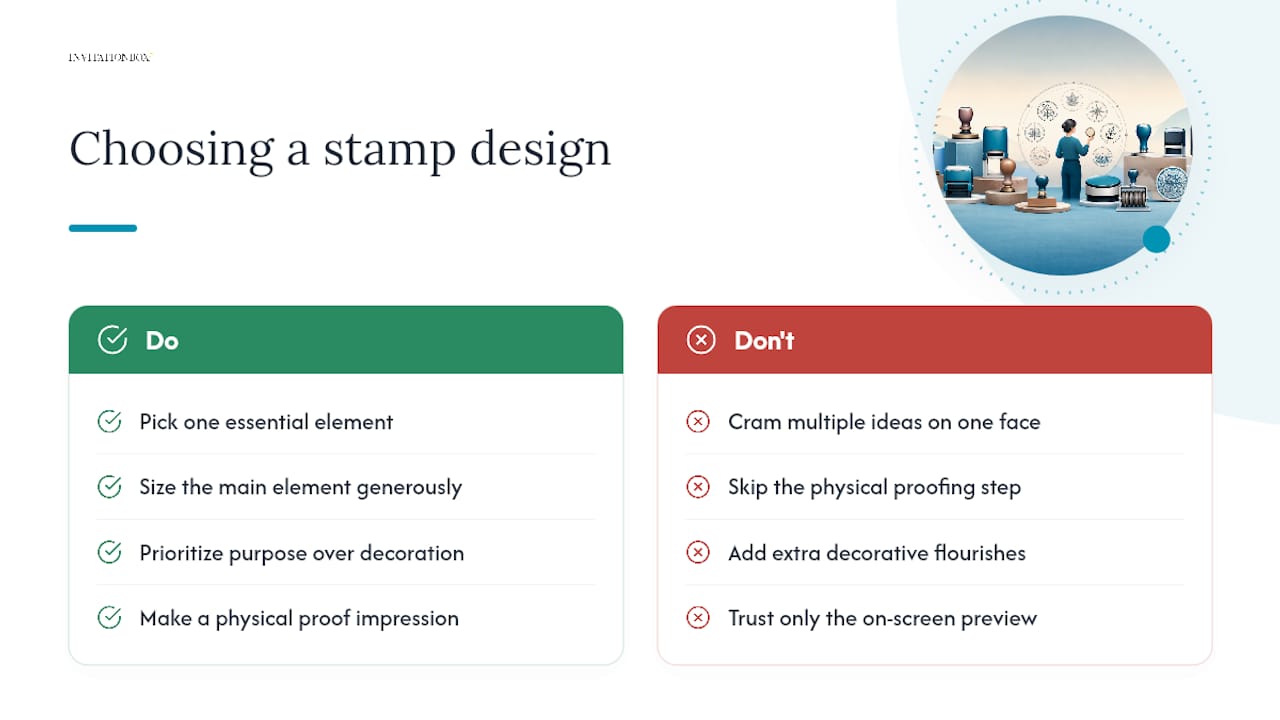
The purpose-first approach beats the “fit everything on it” instinct nearly every time. A stamp built around one strong element (a monogram, a single icon, a short line of text) almost always outperforms a busy design crammed with extra flourishes, because engraving punishes complexity in ways printing never does. If you take one lesson from this gallery, it’s this: pick your one essential element, size it generously, and resist the urge to add a second idea to the same stamp face.
Where conventional advice falls short is in treating the proof step as optional. A physical test impression catches line weights and spacing issues no screen preview ever will, and skipping it is the most common reason a “perfect” digital design turns out disappointing in ink.
— Jon
Bring Your Stamp Idea to Life Without the Guesswork
If you’d rather skip the trial-and-error of file prep and proofing, some providers build these ideas into ready-made products with the design rules already baked in. Wedding-focused pieces like the Simple Bridal Couple Scroll Stamper or Embosser handle monogram and initial-style ideas without you needing to source brass heads or test wax temperatures yourself.
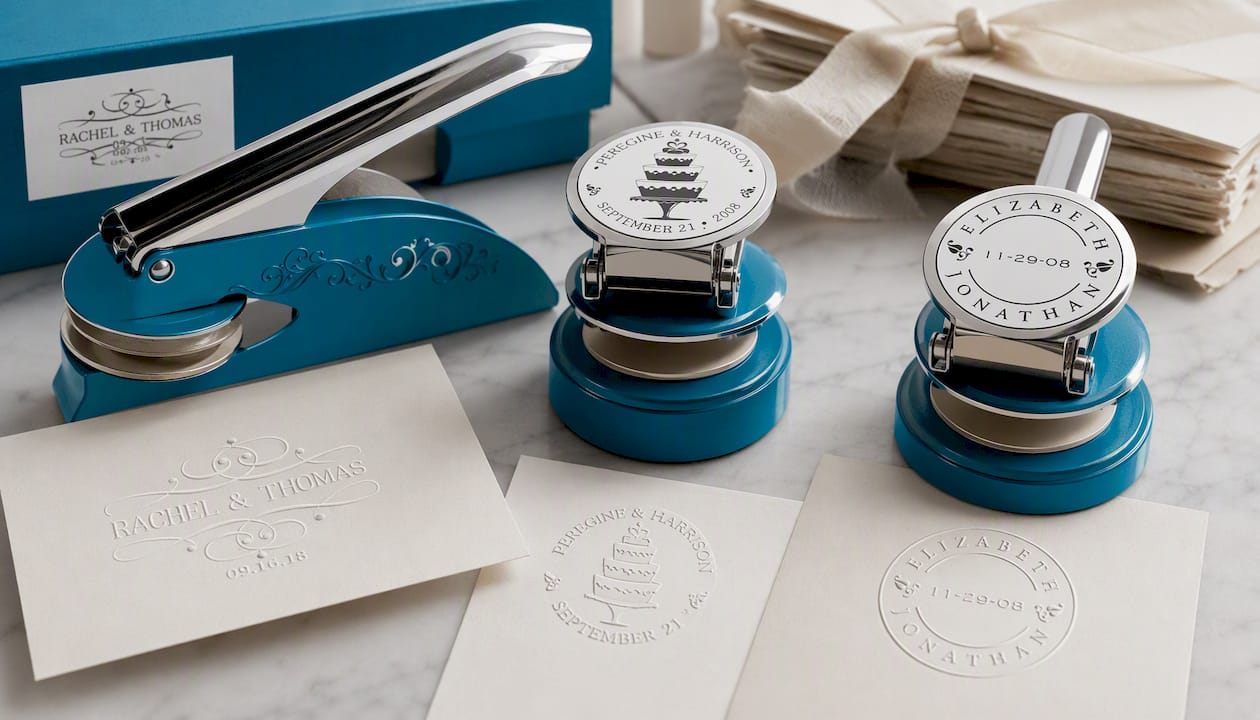
For decorative favors and menu touches, the Wedding Cake Stamper or Embosser covers that seasonal or celebratory icon concept from earlier in this guide, while the Save the Date Wedding Stamper or Embosser is built specifically for the mini-icon, invitation-suite idea. Each comes through a thorough proofing process, so the line-weight and negative-space issues covered above are already accounted for. If you’re shopping for a gift alongside your stamp order, Lembradia’s guide to gifts for creative hobby lovers pairs well with a personalized stamp as a bundled present. Browse the full stamp and embosser catalog to find the size and style that matches your idea.
Sources
- 20 Unique Wedding Stamp Ideas for Your Invitations — Brides
- How to Design a Custom Stamp: From Idea to Ink in 5 Simple Steps – Stampty
- Personalized Wedding Wax Seal Stamp | 27 Elegant Designs | Stamprints – Stamprints Global
FAQ
What are some creative custom stamp ideas?
Address stamps, monogram or wax-seal initials, small-business logo marks, bookplates, loyalty punch icons, and seasonal icon sets are all practical starting points, each suited to a different stamp type and surface.
How do I make my own custom stamp?
Define your purpose and size, choose a stamp type based on detail and volume needs, prepare a vector or 300 DPI-plus file with outlined text, then request a proof and test impression before full production.
What crafts can I make with old stamps?
Old rubber stamps can be repurposed for gift wrap patterns, fabric motifs on napkins or tea towels, and layered background textures on handmade cards, as long as the original design still holds bold, simplified shapes.
Where can I get a custom stamp made?
Reputable suppliers with verifiable business listings and customer reviews, such as those tracked through the Better Business Bureau, are worth checking before ordering, and some suppliers offer ready-made self-inking and embosser options for stationery and wedding use cases.