

Envelope Addressing Etiquette: A Complete 2026 Guide
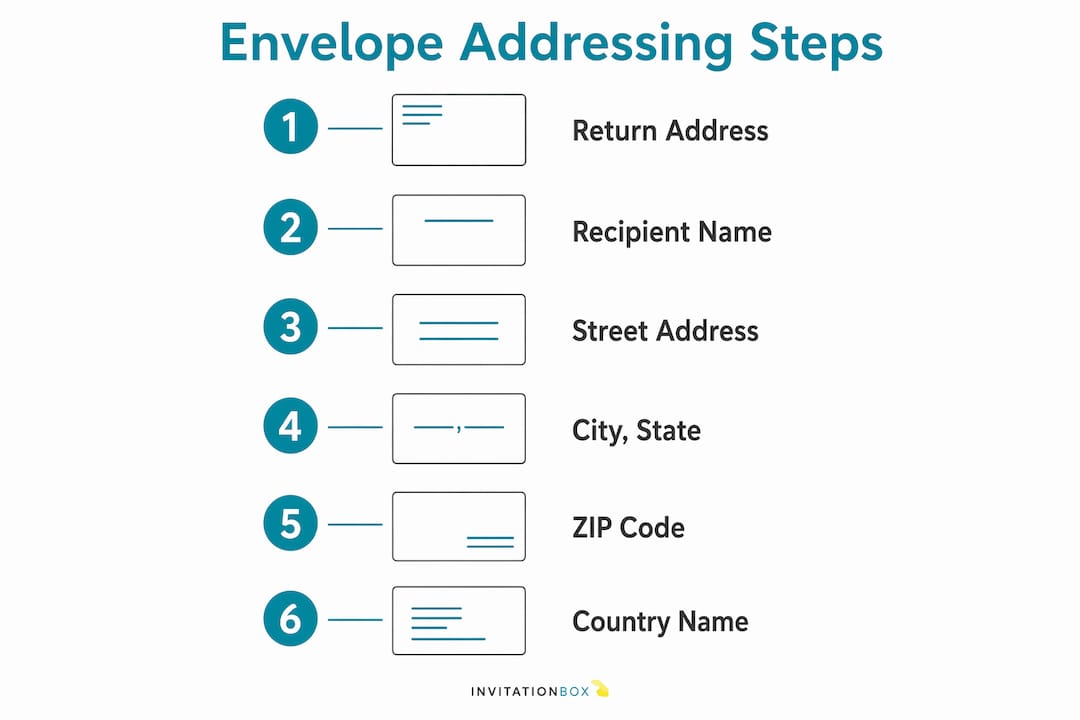
Proper envelope addressing etiquette means placing the recipient’s address centered in the lower half of the envelope, the return address in the upper-left corner, and using formal honorifics with fully spelled-out street names. USPS guidelines specify no punctuation in address lines to support automated sorting, and the ZIP+4 format for maximum precision. For wedding invitations, Emily Post recommends full formal names and titles on outer envelopes, with personal guest names reserved for inner envelopes.
Here are the core rules to keep in mind:
- Recipient address goes centered in the lower half; return address in the upper-left corner
- No punctuation in address lines (commas, periods) per USPS standards
- Spell out street types fully: Street, Avenue, Boulevard, not abbreviations
- Use ZIP+4 codes for precision (e.g., 10001-1234)
- Address married couples with both names; traditionally the husband’s name leads
- List children only on inner wedding envelopes, never on outer envelopes
- Use “Ms.” as the default for women when marital status is unknown
Envelope addressing etiquette: how to format addresses correctly
Good formatting keeps your mail moving and your recipients feeling respected. The layout is straightforward once you know the rules.
| Element | Placement | Format Notes |
|---|---|---|
| Return address | Upper-left corner (or back flap on wedding invitations) | Full name, street, city, state, ZIP |
| Recipient address | Centered, lower half | Three lines: name, street, city/state/ZIP |
| Apartment number | On line above street | Move above street line if needed to improve scanner readability or if space is limited |
| ZIP code | End of city/state line | ZIP+4 preferred (e.g., 10001-1234) |
| Punctuation | None in address lines | Omit commas and periods throughout |
| Ink color | Blue or black | Clear contrast on light envelopes only |
| Writing direction | Parallel to bottom edge | Never diagonal or vertical |
For formal mail, write addresses in clear block letters or use a printed label. Handwriting should be legible enough that a postal worker can read it at a glance. Decorations near the bottom of the envelope can interfere with USPS barcode processing, so keep that area clean.

For international guests, write the country name in English in all capital letters on the final line. The return address should include “USA” on its last line as well.
How to use honorifics and titles when addressing envelopes
Titles carry real weight in formal correspondence. Getting them right shows genuine care for your recipient.
- Mr. applies to adult men age 16 and older
- Mrs. is for married women who use their husband’s name socially
- Ms. is the default for women when marital status is unknown or irrelevant
- Miss suits younger women and girls under 18
- Mx. is the gender-neutral title for anyone who prefers it
- Dr., Judge, The Honorable take precedence over Mr. or Mrs. when applicable
- When unsure of a professional title, elevate rather than omit. If you’re uncertain whether someone holds the rank of Captain or General, use General.
- Avoid middle initials on formal envelopes. Either write the full middle name or leave it out entirely.
- Do not combine professional designations like CPA or Esquire with Mr. or Ms. on social correspondence.
Pro Tip: When you genuinely don’t know a guest’s preferred title, “Ms.” for women and “Mr.” for men are always respectful defaults. Choosing the more formal option is never the wrong call.
For couples where one partner outranks the other professionally or by military rank, the higher-ranking person’s name always comes first. A woman who holds a doctorate and is married to a non-doctor would be addressed as “Dr. Jane Kelly and Mr. John Kelly.”
Addressing wedding invitation envelopes for couples, families, and guests
Wedding invitation addressing follows its own warm, thoughtful protocol. The two-envelope system, recommended by Emily Post, separates formal outer addressing from the personal inner envelope, giving you a graceful way to define exactly who is invited.
- Outer envelope: Full formal names and titles, fully spelled-out street address, no abbreviations
- Inner envelope: First names or titles and last names only, listing each invited guest by name
- Children: List their first names on the inner envelope beneath their parents’ names. Never include children on the outer envelope, as doing so implies the whole family is invited.
- Plus-ones: Address the outer envelope to the primary guest only. On the inner envelope, write “Mr. James Smith and Guest” if the plus-one’s name is unknown.
- Unmarried couples at the same address: List both names on one line connected by “and,” such as “Ms. Nancy Fellows and Mr. Scott Dunn.”
- Avoid “and Family” unless you genuinely mean to invite every person in the household.
Pro Tip: Skip writing “No Children” anywhere on the invitation itself. Instead, address envelopes only to the parents. If needed, add a gentle note on your wedding website, such as “We respectfully request an adults-only celebration.”
The return address for wedding invitations traditionally goes on the back flap of the outer envelope, and it should belong to whoever is designated to receive responses, whether that’s the couple or the hosting family. Always include the host’s address and postage on response card envelopes. Guests should never need to supply their own stamp for an RSVP.
What 2026 USPS standards and etiquette experts say about addressing mail
USPS guidelines remain consistent: the recipient address belongs centered in the lower half, the return address in the upper-left, and no punctuation anywhere in the address block. Incomplete or illegible addresses cause delivery delays and can result in mail being returned or discarded entirely.
Etiquette experts in 2026 continue to emphasize that handwritten envelopes, done in blue or black ink on light-colored paper, remain the gold standard for formal and wedding correspondence. Printed labels are a perfectly acceptable alternative when handwriting clarity is a concern. What matters most is legibility and consistency.
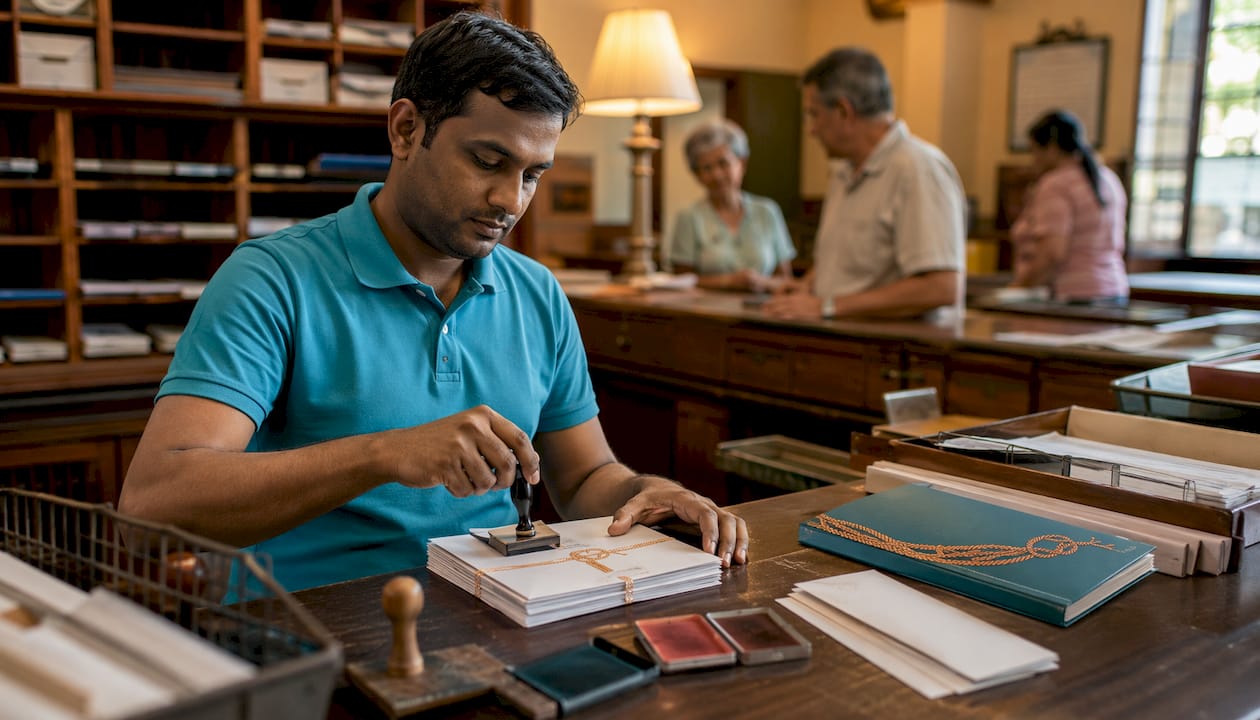
Pro Tip: Ask your post office to hand-cancel your wedding invitations rather than running them through an automatic sorter. The result is a cleaner, more elegant postmark that complements the care you’ve put into your stationery.
When you’re ready to bring all of this together, the stationery coordination across your entire event matters just as much as the addressing itself. And once the celebration wraps up, a set of wedding thank-you cards from Invitationbox lets you close the loop with the same warmth and elegance you brought to every envelope.
Key Takeaways
Proper envelope addressing etiquette combines USPS placement rules, formal honorifics, and thoughtful guest naming to create correspondence that is both deliverable and genuinely respectful.
| Point | Details |
|---|---|
| Address placement | Recipient centered in lower half; return address in upper-left corner. |
| No punctuation | Omit all commas and periods in address lines to support USPS automated sorting. |
| Honorifics matter | Use “Ms.” as the default for women; elevate professional titles like Dr. or Judge when known. |
| Wedding inner envelopes | List children and plus-ones on inner envelopes only, never on the outer envelope. |
| Spell everything out | Write Street, Avenue, and Boulevard in full; never abbreviate on formal or wedding mail. |
Recommended
- 8 Mistakes to Avoid When Designing Your Surprise Birthday Invitations – InvitationBox.com
- The Ultimate Guide to Personalizing Stationery Gifts: Tips and Tricks – InvitationBox.com
- 5 Graduation Invitation Etiquette Tips for the Modern Graduate – InvitationBox.com
- From Save-the-Dates to Engagement Party Invitations: Coordinating Your – InvitationBox.com