

Packaging Insert Ideas That Win Repeat Buyers, Try One on 100 Orders
The inserts that move the needle most are thank-you notes, discount codes, review prompts, care instructions, and small samples, in roughly that order of impact. Together they drive repeat purchases and reduce returns without adding real cost to your fulfillment process. The rest of this guide walks through specific formats, a simple framework for choosing what fits your product, and the materials and printing details that keep your inserts looking as good as your box.
TL;DR:
- Personal touches like handwritten thank-you notes and stamped messages outperform generic cards by showing genuine engagement and increasing customer loyalty.
- Discount and QR-coded coupons are highly effective in driving repeat purchases, especially when paired with small incentives or minimal friction for redemption.
- Protect your fragile products with custom-fit corrugate or molded fiber inserts, prioritizing sustainability with FSC-certified materials where possible.
- Start with one or two targeted insert types based on your customer order value, and test their effectiveness before scaling to avoid clutter and message dilution.
- Prototype inserts carefully to ensure proper fit and function, as protection and personalization have the strongest impact on customer retention and product satisfaction.
Table of Contents
- Creative Packaging Insert Ideas You Can Use This Week
- How to Choose the Right Insert for Your Product and Goal
- Structural Inserts: Materials, Trade-Offs, and Sustainable Choices
- Design and Printing Tips That Actually Convert
- Costs, Logistics, and a Simple Testing Checklist
- Publisher Spotlight: Turning These Ideas into Real Packaging
- Ask for Feedback Before You Ask for a Sale
- Interactive and Gamified Insert Concepts
- The Insert Mistake Most Sellers Make
- Put These Insert Ideas to Work with Invitationbox
- Sources
Creative Packaging Insert Ideas You Can Use This Week
You don’t need a design team or a warehouse full of extras to make your unboxing moment count. Here are the formats worth testing first, starting with the ones that cost the least and deliver the most.
- Handwritten or stamped thank-you notes. A short, personal line beats a slick printed card for small-batch sellers. Research on e-commerce packaging suggests a stamped initial or handwritten sentence can outperform a generic printed thank-you because it signals someone actually touched the order. A self-inking stamper turns this into a five-second habit instead of a chore.
- Discount cards with a single-use code. Print a unique code per card rather than one generic code for every buyer. You’ll catch resellers reusing coupons and get cleaner data on which cohort actually redeemed.
- QR-coded coupons. A QR code that lands on a pre-filled discount page removes the friction of typing a code manually. Keep the code visible underneath the QR too, since not every phone camera cooperates.
- Product samples matched to category. A skincare brand might slip in a single-use serum packet. A coffee roaster includes a two-cup sample bag of a new roast. Match the sample to something the customer would actually reorder, not whatever is sitting in a bin.
- Small branded gifts. Stickers, seed packets, or a themed collectible card tend to generate word-of-mouth and social sharing when they’re unexpected and cheap to produce.
- Review or social-share prompts with a small incentive. A card that says “leave a review, get 10% off your next order” performs better than a plain “please review us” ask.
- Care instructions and how-to guides. For anything with upkeep, tri-fold laundering steps or a use-first tip sheet reduces confused emails and, often, returns tied to misuse.
- Brand story or origin cards. A short paragraph on why you started the business builds context that a product listing can’t. Pair it with sustainable sourcing language if that’s part of your story.
- Referral cards. A code both parties can use (“give $10, get $10”) turns every package into a low-cost acquisition channel.
- Loyalty punch cards. Physical stamps or a printed grid customers fill in over multiple orders works especially well for consumables and subscription-adjacent products.
- Return label cards. Shipping-industry data shows about a third of customers want a return label included with their initial order, which makes this a small addition with an outsized effect on trust.
- Stickers and small collectables. Cheap to produce in bulk, and customers often display them, giving you a form of free, ongoing advertising.
- Seasonal or holiday-themed inserts. A limited-run card tied to a holiday or launch window creates urgency and gives you a natural excuse to email your list about it later.
Here’s a quick way to sort these by effort versus payoff:
- Lowest effort, immediate impact: stamped thank-you note, discount card, care instructions
- Moderate effort, strong loyalty payoff: referral cards, loyalty punch cards, samples
- Higher effort, brand-building payoff: origin story cards, seasonal campaigns, collectible stickers
Pro Tip: Rotate two or three inserts across different order values instead of cramming everything into every box. A $15 order doesn’t need a sample, a coupon, a story card, and a punch card. Pick the one or two that match the customer’s stage with your brand.
How to Choose the Right Insert for Your Product and Goal
Start with one question: are you protecting the product or trying to delight the customer? Fragile or high-value items need structural inserts first. Everything else is a delight-and-retain decision, and that’s where thank-you notes, discount cards, and samples earn their keep.
From there, order value should shape your choice. A $12 order can absorb the cost of a printed card, but not a full sample size. A $75 order can support a small gift, a heavier card stock, or even a stamped envelope. Match the insert’s cost to what the order can bear, not to what looks impressive.
Ask yourself these questions before finalizing a format:
- What’s the goal: a repeat purchase, a review, a referral, or fewer support tickets?
- What’s my average order value, and what can I afford per box without hurting margin?
- Does this product ship in a way that risks damage, meaning I need protection before I add anything promotional?
- How many of these do I need per month, and does that change my material or printing choice?
Layering works when the combination serves two separate goals. A care card plus a discount code makes sense because one reduces returns and the other drives a second sale. Stacking three promotional inserts on top of each other usually just creates clutter and dilutes the message.
By the numbers: Roughly a third of shoppers want a return label included with their first order. If your return rate is a pain point, that single insert may do more for retention than a discount card ever will.
Once inserts are live, track redemption rate on codes, repeat order rate over 60 to 90 days, review volume, and any direct mentions on social media. If a format shows no movement after a few hundred orders, cut it rather than let it linger out of habit.
Structural Inserts: Materials, Trade-Offs, and Sustainable Choices
Not every product needs protection, but fragile items like stampers, embossers, and glassware do. Custom-fit corrugate, foam, and molded fiber inserts add real protection and can be printed to match your branding, which often reduces damage claims and the returns that come with them.
Here’s how the common materials compare:
- Paperboard: cheapest option, fine for light items or as a simple divider between products.
- Corrugate: stronger and still affordable, good for medium-weight items that need some cushioning.
- Molded fiber: shapes to a product’s exact profile, ideal for delicate stationery pieces like stampers and embossers where scuffing is a real risk.
- Foam (PE or EVA): best cushioning for heavier or oddly shaped items, though it costs more per unit and isn’t curbside recyclable.
If sustainability matters to your customers, look for FSC-certified paperboard and corrugate and say so on the insert itself. That single certification mark does more for credibility than a vague “eco-friendly” claim.
Vendors typically advise prototyping a single sample run before committing to bulk production, which catches sizing mistakes before they turn into a pallet of unusable inserts. Custom die-cut trays make sense once you’re shipping the same fragile item repeatedly; general-purpose dividers are fine for lower-risk products or lower order volumes.
Design and Printing Tips That Actually Convert
Good insert copy tells the customer exactly what to do in one glance. Keep the call to action short: “Scan for 15% off your next order” beats a paragraph explaining your discount philosophy. Always list an expiry date and any restrictions in small print so nobody feels misled later.
- Size QR codes at least 0.8 inches square so budget phone cameras can scan them without hunting for focus.
- Use variable data printing if you’re running volume, so names or order details can be personalized without hand-lettering each card.
- A stamped signature or embossed monogram adds a tactile detail that a printed name never quite matches.
- Heavier card stock and rounded corners read as more premium, but they add cost. Spot UV accents help a logo pop without redesigning the whole card.
For production, in-house printing works fine for low volumes, local print shops are a solid middle ground, and print-on-demand vendors handle small runs of coupon cards and stickers with low minimum order quantities when you’re not ready to commit to bulk.
Pro Tip: Order a single test batch of 25 to 50 cards before you commit to 5,000. Typos and sizing errors are cheap to fix at 50 units and expensive to fix at 5,000.
Costs, Logistics, and a Simple Testing Checklist
Simple paper inserts often run a few cents each once you’re printing a few hundred at a time, while structural corrugate or foam pieces cost more per unit but scale down significantly at higher volumes. Budget accordingly before you commit to a format across every order.
- Decide who physically adds the insert during packing and store inserts near the packing station, not in a back closet, so nothing gets forgotten under order pressure.
- Spot-check a sample of boxes weekly to confirm the right insert is going into the right order, especially if you’re running more than one active campaign.
- Run an A/B test before rolling any new insert out to 100% of orders: split traffic evenly, run for at least two to four weeks, and track one metric per test.
Two tests worth running early: thank-you card against no card, measuring repeat purchase rate over 60 days, and a 10% discount code against free shipping, measuring which one drives a faster second order. With roughly a third of shoppers wanting a return label in the box, that’s a strong third test if returns are eating into your margin.
Publisher Spotlight: Turning These Ideas into Real Packaging
Nineteen years in personalized stationery has taught Invitationbox which small details customers actually notice. A From the Desk Stamper turns “thank you” into a ten-second habit on every order. A Bright Swirls Personalized Notepad tucked into a VIP order works as a loyalty gift that outlasts a discount code. The proprietary Snap Stamp system, built into stamps like the Corner Scrolls Square Stamper, lets you swap monogram motifs without buying a new stamp for every campaign. None of this requires a design department. It requires a stamp pad, a notepad box, and five minutes per batch.
Ask for Feedback Before You Ask for a Sale
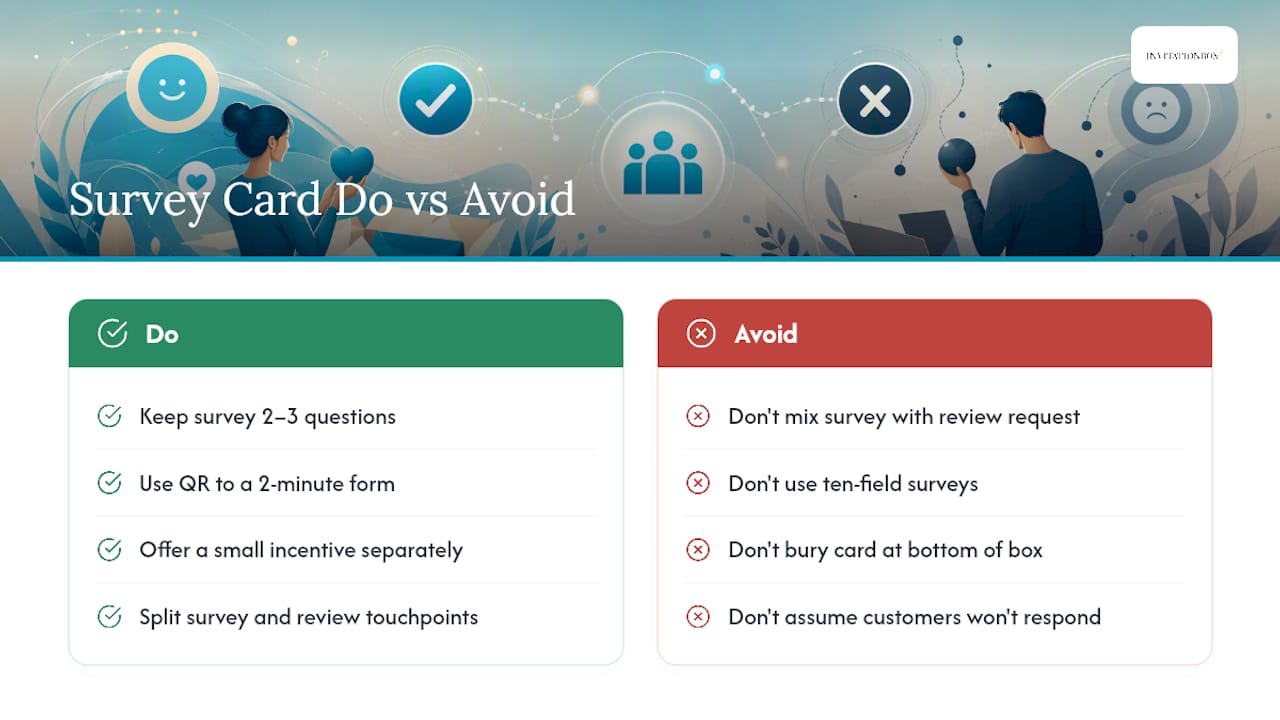
A short survey card does something a review request can’t: it catches problems before they become a bad review. Keep it to two or three questions, and use a QR code that lands on a two-minute form, not a ten-field survey nobody finishes.
The most useful questions are simple ones: “How easy was it to find what you needed?” or “What almost stopped you from buying?” Open-ended feedback like this often surfaces packaging or sizing issues you’d never catch from star ratings alone.
Offer a small incentive for completing the survey, like a discount on the next order, but keep it separate from your review-request insert. Mixing “please review us” with “please fill out this survey” in the same card usually gets you neither. Split them across two touchpoints if your order volume supports it, such as a review card in the box and a follow-up survey email a week later.
Track completion rate the same way you’d track a coupon redemption. If fewer than a few percent of customers respond, the ask is either too long or poorly placed in the box. Move it to the top of the pile, shorten it, or swap the incentive before assuming customers just don’t want to talk to you.
Interactive and Gamified Insert Concepts
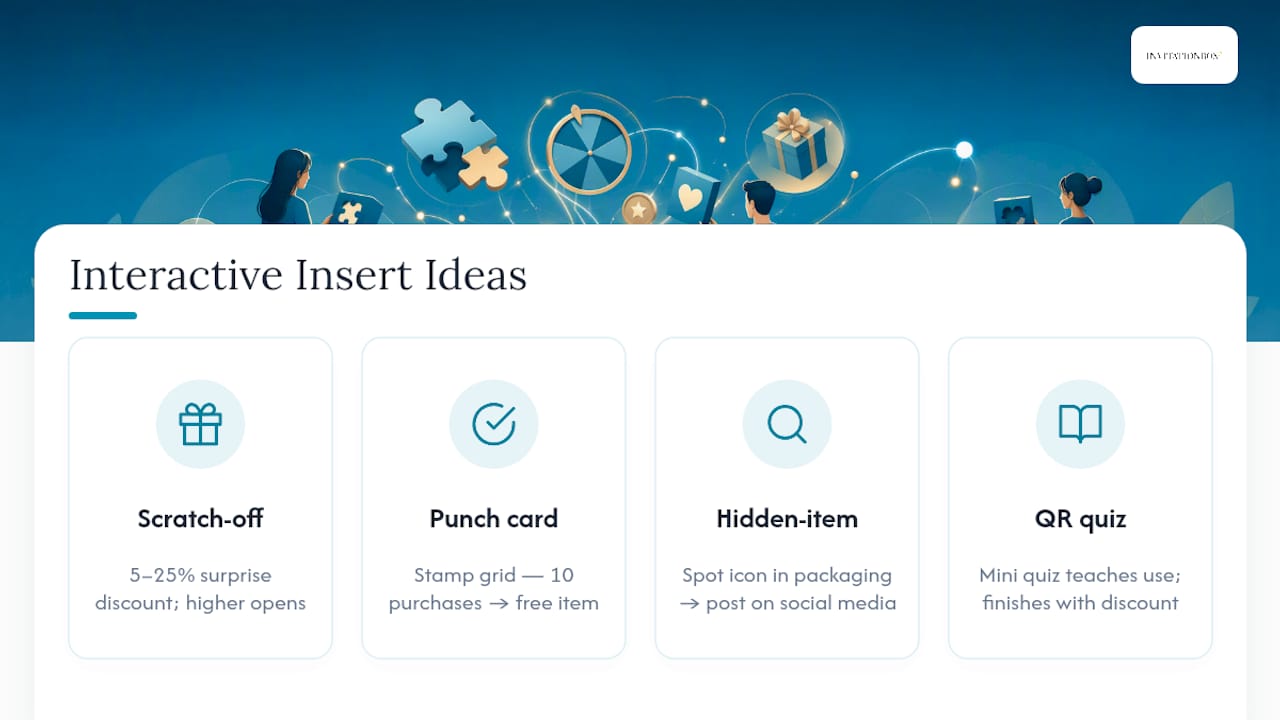
A scratch-off card revealing a discount amount between 5% and 25% creates a small moment of surprise that a flat coupon code can’t replicate. Customers open scratch-offs far more reliably than they redeem printed codes, since the mechanic itself is the hook.
Punch or stamp-based loyalty cards work well for repeat-purchase categories like coffee, skincare, or consumables. Print a simple grid, hand the customer a stamp on delivery day, and let ten purchases become a free item.
A “find the hidden item” card that asks customers to spot a small icon somewhere in your packaging and post about it on social media turns unboxing into content generation, at essentially no cost beyond the printing.
QR-linked mini quizzes about your product category, with a discount code as the reward for finishing, work particularly well for brands selling anything with a learning curve, like skincare routines or specialty foods. The quiz teaches the customer how to use what they bought while quietly reinforcing your brand voice.
None of these require app development or custom software. A well-designed card, a QR code, and a little creativity cover most of it. Keep the mechanic simple enough to finish in under a minute, since anything that feels like homework gets tossed with the packing slip.
The Insert Mistake Most Sellers Make
Most advice on packaging inserts treats every idea as equally worth doing, which is backward. The data on inserts consistently points toward personalization and protection mattering more than novelty. A stamped note or a properly sized corrugate tray does more for retention than a clever gamified card that costs three times as much to produce and confuses half your customers.
The overlooked lever is prototyping. Sellers will spend weeks designing a coupon card’s artwork and zero minutes testing whether their foam insert actually fits the box without shifting. That’s backward. Fit problems create damage, damage creates returns, and returns erase whatever the coupon was supposed to earn back.
Start with protection if your product needs it, add one personalization touch, and test before you scale to every order. Skip the urge to stack five insert types into one box. A single well-executed note plus a single well-timed offer will outperform a cluttered stack almost every time.
— Jon
Put These Insert Ideas to Work with Invitationbox
Invitationbox turns the inserts covered here into products you can order this week instead of designing from scratch. A Bright Swirls Personalized Notepad makes an easy loyalty gift for repeat buyers, while a Classic Scroll Square Stamper or the From the Desk Stamper turns handwritten thank-you notes into a repeatable, five-second step in your packing process.
If you’re building your first thank-you card, the ideas for personalizing thank-you notes walk through formats that pair well with a stamp. Browse the notepad and stamper options, pick one insert to test on your next 100 orders, and see what it does to your repeat purchase rate before rolling it out to everything you ship.
Sources
- Packaging inserts are a low-cost and versatile way to delight customers and increase customer loyalty - Shopify
- Custom packaging inserts — BoxGenie
- Product packaging inserts — Inserts Hub