

Family First: When to Send Birth Announcements (Up to Six Months)
Aim for a few weeks after your baby arrives if you want a printed announcement, but the real rule is simpler: tell your closest people first, and only send when you feel ready. Digital notices can go out the same day, while mailed cards have real etiquette room to wait, up to several months, so there is no need to rush a keepsake you’ll treasure for years.
TL;DR:
- Announcements can be sent up to six months after birth, especially if there are special circumstances like NICU stays or delayed naming decisions.
- Private notifications to immediate family should happen immediately, with close friends and extended relatives informed within one to two weeks.
- Mailed printed cards are best sent between two and six weeks after birth, allowing time for photo selection and design, or later for complicated situations.
- Overseas family members require earlier ordering and international shipping should be factored into timing, as delays are longer.
- Digital and social announcements should follow private contacts, with social media posts placed last, after close family and friends have been notified directly.
Table of Contents
- What Is the Ideal Birth Announcement Timeline?
- Who Should Hear the News First?
- Printed Cards, E-Cards, or Social Posts: Which Format Fits?
- What Belongs on a Birth Announcement (and What Doesn’t)
- How Long Does It Take to Design and Mail Announcements?
- Stationery Shortcuts That Actually Save Time
- How Do You Handle Sensitive Announcement Situations?
- How Do Separated or Blended Families Coordinate Announcements?
- What Should You Know About International Announcements?
- Why Parent Readiness Should Drive Your Timeline
- Ready to Send? Fast Birth Announcement Options
- Sources
- FAQ
What Is the Ideal Birth Announcement Timeline?
There’s no single deadline, and that’s good news for exhausted new parents. The etiquette guidance from the Emily Post Institute gives you a full six months, with one condition: your closest circle hears the news privately before anyone else does. Within that generous window, four practical stages tend to work best.
- Immediate (hours to days): A quick call, text, or voice message to grandparents, siblings, and your closest support people. This is private, not public.
- 1 to 2 weeks: A group text or small social share to close friends and extended family once you’ve caught your breath and the baby’s name feels settled.
- 2 to 6 weeks: The sweet spot for mailed announcements. It gives you time to pick photos, order cards, and let The Bump’s common guidance play out without feeling rushed.
- Up to 6 months: Perfectly acceptable for families dealing with a NICU stay, an adoption finalization, a delayed name choice, or simply needing more recovery time.
Earlier announcements feel exciting and keep everyone in the loop, but they leave less room for proofing errors or last-minute photo swaps. Later announcements cost you nothing in etiquette terms and often arrive as a welcome surprise for grandparents who assumed the moment had passed.
Who Should Hear the News First?
Think of your announcement list as three circles, a sequencing model that BabyAI’s etiquette guide uses to protect both privacy and feelings. Working through them in order avoids the awkward scenario where a coworker learns about your baby from Instagram before your own mother does.
- Inner circle: Parents, siblings, grandparents, and anyone who helped during labor or delivery. Notify them by phone or in person, immediately.
- Personal circle: Close friends, extended relatives, and coworkers you’re close with. A group text or private message within one to two weeks works well here.
- Public circle: Social media followers and the broader community. Wait until circles one and two are covered, then share publicly.
One more rule worth knowing: send a single announcement per household, and if you’ve already shared an e-card or text, you don’t owe anyone a duplicate mailed version, according to Emily Post’s guidance on announcing a new baby. If your public post lags behind your private calls by a few weeks, that’s not rude. That’s just good sequencing.
Printed Cards, E-Cards, or Social Posts: Which Format Fits?
Your channel choice should match your timeline and your audience, not the other way around. Each format carries its own trade-offs.
- Printed cards double as keepsakes, the kind grandparents tuck into a photo album, but they need real production time: design, proofing, printing, and shipping all add days before a card reaches a mailbox.
- E-cards offer nearly instant delivery with polished design options, useful when you want speed without sacrificing a personal touch, a trend The Bump notes has grown steadily popular.
- Group texts work best for your inner circle. Fast, private, and low pressure.
- Social posts reach the widest audience fastest, but they’re the least private option and should come last in your sequence.
Many families layer these: a phone call within hours, a group text within days, a public post within weeks, and a mailed card whenever the design and timing align.
What Belongs on a Birth Announcement (and What Doesn’t)
Every announcement needs two non-negotiables: your baby’s name and birth date. Everything else is optional, and that flexibility is part of what makes designing one enjoyable rather than stressful.
- Essentials: Full name, birth date.
- Nice-to-haves: Birth time, weight and length, hospital or city name, a short welcome message.
- Optional flourishes: A sibling’s name, a family motto, or a line about who the baby is named after.
Before you hit send or drop cards in the mailbox, run a quick photo check. Crop out hospital ID bands and paperwork in the background, get a quick nod from any older sibling old enough to care about being photographed, and skip geotags that reveal your hospital or home address. Keep wording simple: “We’re overjoyed to welcome [Name], born [Date], weighing [Weight]. With love, [Parents’ Names].” Sign it from both parents, or from the whole family if older siblings are part of the announcement.
Pro Tip: Draft your wording and pick your photo before the baby arrives, using a placeholder image. Swapping in the real photo later takes minutes instead of days.
How Long Does It Take to Design and Mail Announcements?
Realistic production estimates matter more than most parents realize when they’re deciding on a window. According to CardFactory’s production guide, design typically takes one to three days, printing runs three to five business days, and domestic shipping adds another three to seven days, which is exactly why the two to six week window exists in practice, not just in theory.
Five steps make the difference between scrambling and sending calmly.
- Choose your card template and confirm wording before delivery, even with a placeholder photo.
- Pre-address envelopes using your address list while you’re still pregnant.
- Swap in the real photo and birth details once you’re home and settled.
- Order with standard shipping unless you’re already past week four, then consider an expedited option.
- Do a final privacy check on the photo and wording before it goes to print.
Stationery Shortcuts That Actually Save Time
Choosing a pre-designed layout instead of building one from scratch shaves days off your timeline, since the hardest decisions (color palette, photo placement, font pairing) are already made for you. Invitationbox’s personalized stationery tips walk through matching a design style to how much time you actually have.
- Pick a template with a single photo slot if you’re short on time; multi-photo layouts take longer to arrange.
- Use a self-inking stamp for your return address so you’re not hand-addressing dozens of envelopes at 2 a.m. with a newborn on your chest.
- Choose e-cards when speed matters more than a physical keepsake, and printed cards when you have at least two weeks of runway.
- Order extras. You’ll always think of one more cousin after the box arrives.
How Do You Handle Sensitive Announcement Situations?
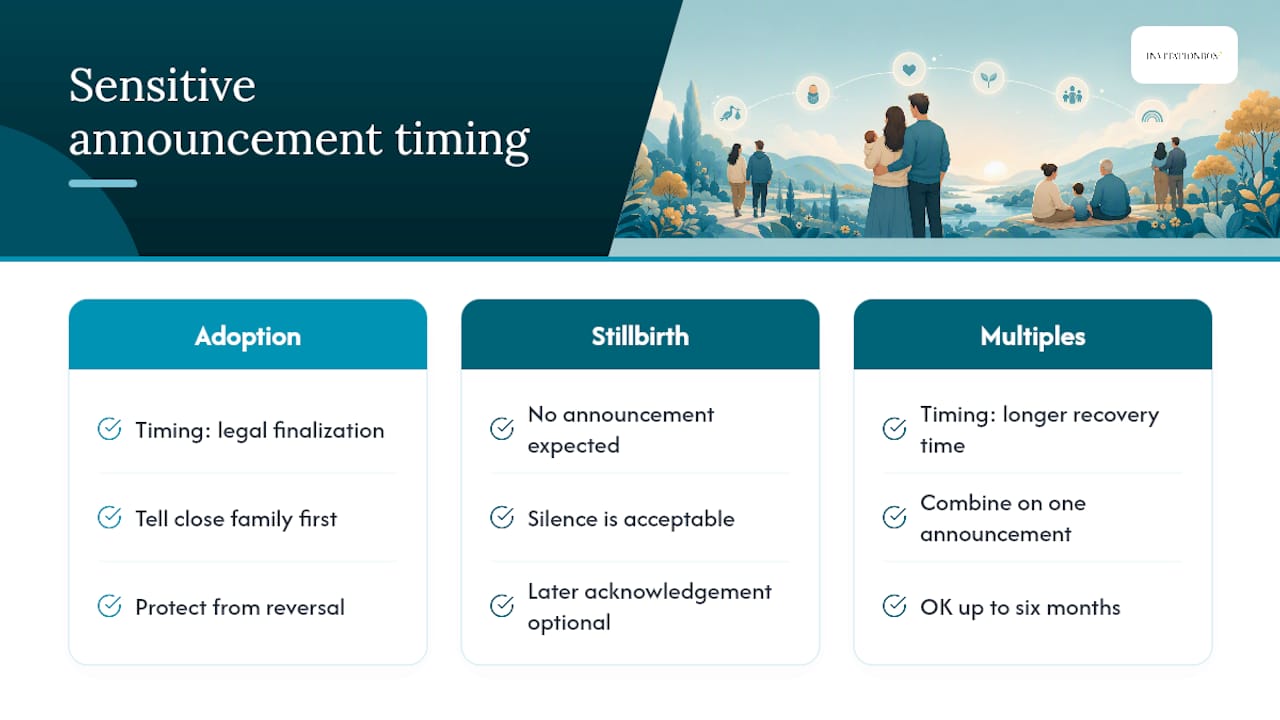
Adoption, stillbirth, and multiple births each call for their own pacing, and etiquette gives you room to move at whatever speed feels right. There’s no rulebook that overrides a family’s need for privacy or time to grieve or celebrate on their own terms.
For adoptive families, the timeline often depends on when the placement legally finalizes, not just when the child arrives home. Some parents wait until finalization is certain before announcing publicly, even if they’ve told close family immediately. That’s not deception. That’s protecting everyone from a painful reversal.
For families experiencing stillbirth or infant loss, there is no expectation of any announcement at all, and support networks generally understand that silence is sometimes the healthiest response. If a family chooses to acknowledge the loss later, on their own timeline, that choice deserves the same respect as any celebratory announcement.
Multiple births bring their own wrinkle: parents often need more recovery time, especially after a NICU stay, and combining twins or triplets onto a single announcement takes extra thought for wording and photo composition. It’s completely reasonable for a multiples announcement to land closer to the six month mark than the six week one. Nobody keeps score, and nobody should expect otherwise.
How Do Separated or Blended Families Coordinate Announcements?
Coordination, not competition, is the goal when parents live apart or a baby has stepsiblings and multiple sets of grandparents. The three-circle framework still applies, but you’ll need to agree in advance on who counts as “inner circle” from each side of the family.
A short conversation between co-parents before the baby arrives, even a text thread, saves real friction later. Decide together whether there’s one joint announcement or two versions tailored to each household, and agree on a rough date so no one finds out through a stepparent’s social post before hearing it directly. If blended families want separate cards for separate sides, that’s completely fine. Just keep the inner-circle sequencing consistent on both sides so no grandparent, on either side, learns the news secondhand.
What Should You Know About International Announcements?
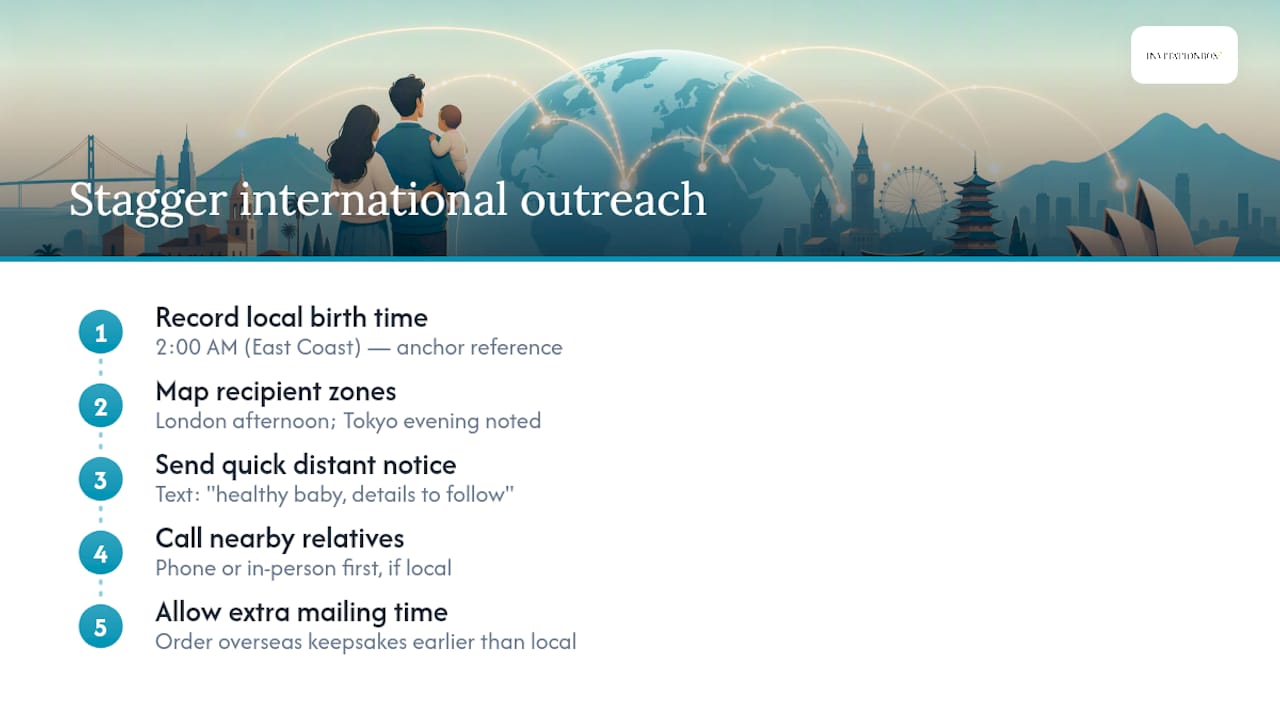
Time zones complicate the “immediate” stage more than most parents expect. A 2 a.m. birth on the East Coast might mean it’s already afternoon in London or evening in Tokyo, so a phone call that feels urgent to you could wake a grandparent on the other side of the world.
Stagger your outreach by time zone instead of blasting the same message to everyone at once. A quick text that says “healthy baby, details to follow” works well for distant relatives while you handle in-person or phone calls with anyone nearby. For mailed cards heading overseas, add real cushion to your shipping estimate. International postal delays run longer than domestic ones, so if a grandparent overseas needs a physical keepsake, order it earlier than you would for local family, even if that means designing before your six week mark rather than after.
Why Parent Readiness Should Drive Your Timeline
Etiquette around birth announcements is far more permissive than most new parents assume, and I think that permissiveness gets lost in all the “send within two weeks” advice floating around online. Six months is fair game. Prioritize your own recovery and your household’s need for privacy over anyone else’s expectation of a fast update.
A late announcement isn’t a lapse. Often, it’s a relief.
— Jon
Ready to Send? Fast Birth Announcement Options
Once you’ve settled on your timing, ordering shouldn’t be the bottleneck. Invitationbox skips the guesswork of designing from scratch. Every baby announcement template arrives pre-formatted for photos and wording, so you fill in details instead of building a layout under deadline pressure.
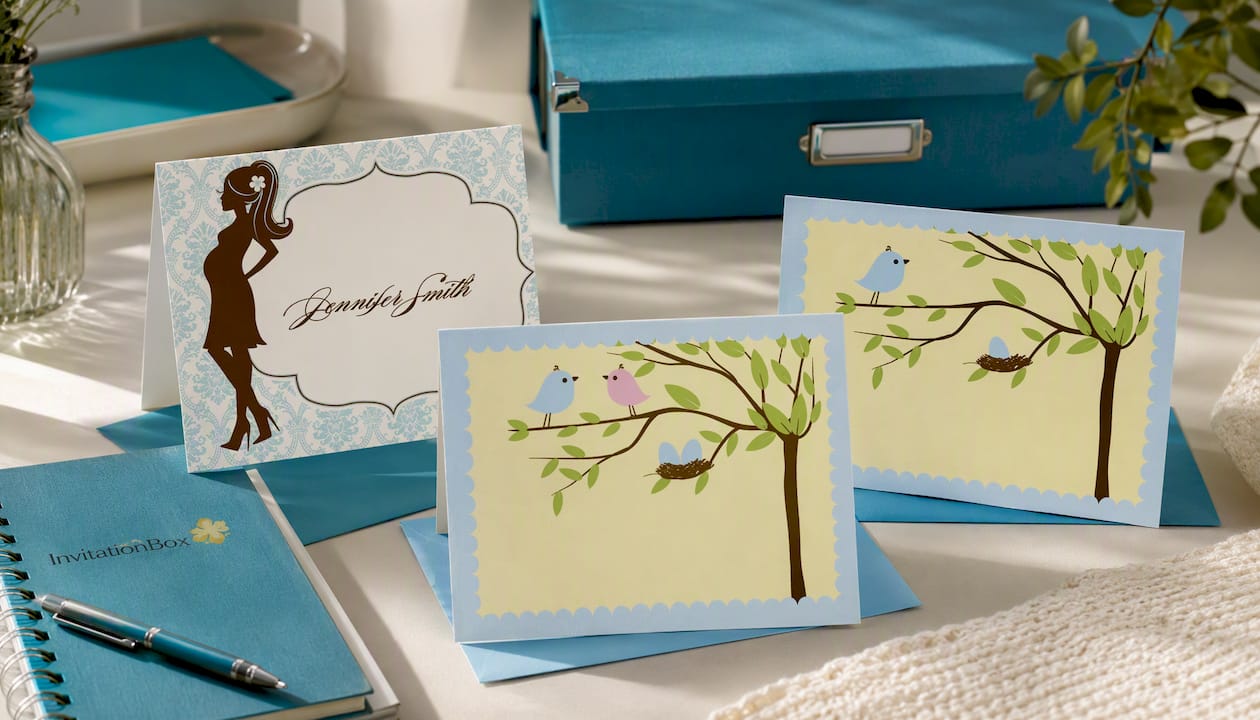
If you’re short on time, three designs are ready to personalize right now. The Damask Silhouette Bali Note Cards offer an elegant, gender-neutral layout that works whether you’re announcing early or catching up months later. Families welcoming two babies at once can turn to the Bird Tree Egg Boy Twins Note Cards, designed specifically for multiple-birth wording and photo pairing. For a classic single-baby announcement, the Bird Tree Egg Boy Note Cards deliver a clean, traditional look that prints quickly.
Pair any of these with a Snap Stamp for return addressing, and request expedited proofing if you’re mailing past the six week mark and want to catch up fast. Browse the full baby announcement collection to compare styles side by side, and order as soon as your wording and photo are locked in.
Sources
- Announcing a New Baby — Emily Post Institute
- Birth Announcement Etiquette: When To Send, What to Say — The Bump
- When to Send Baby Announcements | CardFactory blog
- Birth Announcement Etiquette: Timing, Privacy & Order — BabyAI Generator
FAQ
How Late Is Too Late for a Birth Announcement?
There isn’t a firm cutoff. Etiquette guidance from the Emily Post Institute allows up to six months, and many families send announcements well past the newborn stage without any issue. What matters more than the calendar is that your closest family already knows privately before any public version goes out.
Is Eight Weeks Too Early to Announce a Baby?
Eight weeks isn’t early at all. It actually falls right at the edge of the commonly recommended two to six week window for mailed announcements, and plenty of families send well before that. If you feel ready and your inner circle already knows, eight weeks is a perfectly reasonable time to mail.
Do Boys Typically Arrive Later Than Girls?
There’s no established medical pattern that supports this idea, and it shouldn’t factor into your announcement timeline at all. Base your timing on your own recovery, your baby’s name decision, and any special circumstances, not on your baby’s sex.
What’s the Proper Etiquette for Sending Birth Announcements?
The core rule is sequencing: notify your inner circle privately before anything goes public, and send one announcement per household rather than duplicating an electronic notice with a mailed card. Beyond that, etiquette gives you real flexibility on timing, format, and content, so choose what fits your family rather than a rigid script.
Should I Send a Printed Card if I Already Posted on Social Media?
You’re not obligated to, according to Emily Post’s guidance on announcing a new baby, which notes one announcement per household is enough. Many parents still choose to mail a printed keepsake later anyway, simply because it holds up better in a memory box than a social post does.