

Avoid RSVP Confusion: Invitations 4–6 Weeks, Announcements After Ceremony
An announcement shares the news that your graduate crossed the stage; an invitation asks someone to be there when it happens. That single distinction shapes everything from your mailing list to your wording. Invitations go out 4 to 6 weeks before the event (earlier if guests are traveling), while announcements traditionally follow the ceremony, though sending them within the same month still works.
TL;DR:
- Announcements should be sent to a broad audience and focus on celebrating the graduate without requiring RSVP or attendance.
- Invitations need to go to a smaller, targeted list of expected attendees and include detailed event logistics and response instructions.
- Send invitations four to six weeks before the event or earlier if travel arrangements are needed, while announcements are best sent after the ceremony.
- Combining an announcement and invitation is possible with clear visual and verbal separation, but avoid vague wording and unclear labeling.
- Always confirm your ticket allotment before inviting guests to avoid overpromising seats, and follow up on unconfirmed RSVPs close to the deadline.
Table of Contents
- What is the difference between a graduation announcement and an invitation?
- Who should get an announcement versus an invitation?
- When should you send graduation announcements vs invitations?
- What should go on each card, and how should you word it?
- Can you combine an announcement and an invitation?
- What’s the etiquette around gifts, RSVPs, and ticket limits?
- Why does getting this distinction right matter more than people think?
- Which note cards work best for graduation announcements?
- Sources
What is the difference between a graduation announcement and an invitation?
Think of it this way: an announcement is a warm update to your whole world, while an invitation is a specific ask directed at the people you want standing next to you that day. That difference in purpose drives every decision that follows, from who gets a card to what the card actually says.
A graduation announcement celebrates and informs. It goes to a wide circle, skips the RSVP entirely, and often includes a favorite senior photo. Nobody who receives one is expected to show up anywhere.
A graduation invitation, on the other hand, requests presence. It has to work harder. Since it’s asking someone to attend, it needs a date, a time, a location, and a clear way to respond.
- Announcement: broad list, celebratory tone, no RSVP required, photo often included.
- Invitation: narrow list, logistics-focused tone, RSVP required, full event details spelled out.
That purpose gap explains why an invitation printed with announcement-style wording tends to confuse guests, and why a photo-heavy announcement mailed like a formal invite can feel oddly formal for what’s meant to be good news.
Who should get an announcement versus an invitation?
Your mailing list should follow the purpose of the card, not the other way around. Announcements can go wide. Invitations need to stay tight.
- Announcements go to extended family, old neighbors, past teachers or coaches, family friends, and anyone in your broader social circle who would genuinely enjoy hearing the news.
- Invitations go only to people you expect to actually attend, whether that’s the commencement ceremony or the celebration afterward.
- Ceremony invitations specifically often stay limited to close family, since many schools cap the number of tickets each graduate receives, so confirm your allotment before you commit anyone to a seat.
- The safety rule: everyone who gets an invitation should also get, or already have, an announcement. The reverse never applies. Plenty of people can celebrate the news without being asked to a party.
Skipping that ticket check is one of the most common planning mistakes, so be sure to explore wedding guest experience ideas that guests remember to improve your event planning and RSVP management. Sending invitations before you know your seat count can force awkward walk-backs later.
When should you send graduation announcements vs invitations?
Timing separates these two cards almost as much as wording does, and getting it backwards creates real headaches for guests trying to plan travel.
- Invitations: mail 4 to 6 weeks before the party. Push that earlier, sometimes a save-the-date months out, if you’re inviting anyone who needs flights or hotel rooms.
- Announcements: the traditional move is to send them after the ceremony, once the news is official. Mailing within the same month is still perfectly acceptable, especially if you want to pair it with a professional cap-and-gown portrait.
- Short on time? A digital invitation with built-in RSVP tracking, or simply a phone call to close family, covers you when print turnaround won’t fit the calendar.
If your timeline is genuinely tight, tools like Evite handle a 3 to 4 week runway reasonably well for local guests, though print still wins for anyone who wants a keepsake worth framing. Our own graduation timeline guide breaks this down week by week if you want a printable checklist.
What should go on each card, and how should you word it?
The content list is where announcements and invitations diverge the most, and it’s also where most wording mistakes happen.
Invitation essentials:
- Graduate’s full name and school
- Event type (ceremony, open house, dinner)
- Date, time, and location
- RSVP method and firm deadline
- Parking, ticket, or dress-code notes if relevant
Announcement essentials:
- Graduate’s full name, school, and degree or diploma type
- A short celebratory line
- An optional photo
- An optional mention that a party is coming, without asking anyone to attend
Word choice matters more than most people expect. “You are cordially invited to celebrate with us” belongs on an invitation. “We are proud to announce the graduation of…” belongs on an announcement. Mixing those verbs is exactly how RSVP confusion starts, since ambiguous phrasing makes recipients guess whether they’re supposed to show up.
Pro Tip: If you’re sending digital invites, put the RSVP link or button above the fold and repeat the deadline in the subject line. Print cards can rely on a return card, but email needs the ask to be impossible to miss. Our wording and etiquette guide has full sample scripts for both card types.
Can you combine an announcement and an invitation?
Sometimes, yes, especially when your guest list overlaps heavily or you’re trying to save on printing costs. The trick is keeping the two functions visually and verbally distinct so nobody misreads a courtesy announcement as a party invite.
The cleanest approach, borrowed straight from etiquette guidance, is a main announcement card with a separate enclosure for the guests you actually want at the celebration. The announcement goes to everyone; the enclosure, with full party details, only goes into envelopes for invited guests.
Common pitfalls to avoid:
- Printing invitation details in tiny type at the bottom of an announcement, which almost nobody notices.
- Using soft language like “hope to see you” instead of a direct invite line.
- Forgetting to label the enclosure clearly, so it looks like a stray insert rather than the actual invitation.
A workable layout: announcement card up front, enclosure card behind it, both same size, with the enclosure using bolder type for the date and RSVP line. Our invitation layout ideas show a few enclosure formats that keep this clean.
What’s the etiquette around gifts, RSVPs, and ticket limits?
A handful of etiquette questions come up constantly, and most have simple answers once you separate announcement etiquette from invitation etiquette.
- Gifts: one gift is appropriate whether someone received an announcement or an invitation. Getting only an announcement never obligates a bigger gift, since the goal is celebration, not collection.
- Missing RSVPs: follow up with a friendly call or text a few days past your deadline. State the new cutoff clearly rather than leaving it open-ended.
- Ticket limits: if your school caps ceremony seats, a polite phone call to close family can substitute for a formal invitation when paper cards would overpromise seats you don’t have.
- Out-of-town guests: offer a livestream link if the school provides one, and give travelers as much lead time as possible.
Why does getting this distinction right matter more than people think?
Most graduation planning guides treat announcements and invitations as basically the same card with different fonts. That’s the wrong lens. The real skill here is matching the tone of the message to the size of the ask, and most families get it backwards by defaulting to whichever card feels more “official.”
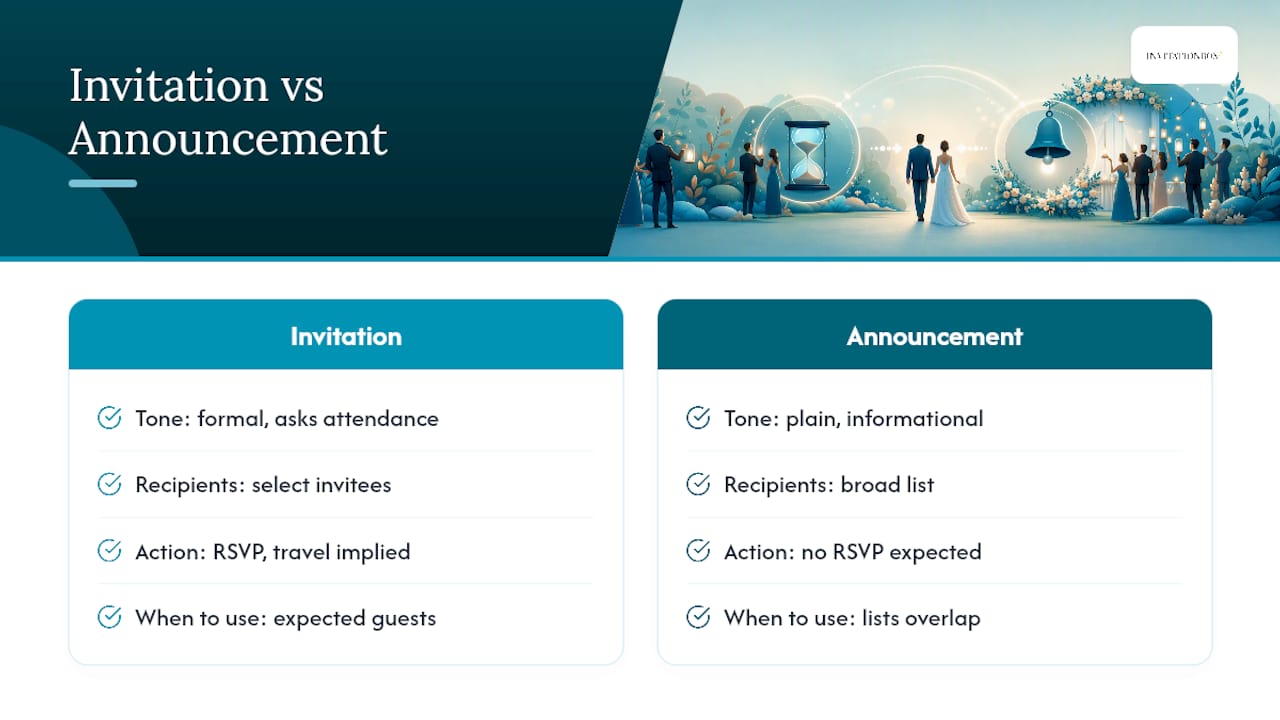
Here’s what tends to happen: parents send invitation-style wording to their entire contact list because it feels more festive, and then spend weeks fielding awkward questions from great-aunts and old coworkers about whether they’re actually expected to fly in. A plain announcement would have made everyone’s life easier, including the graduate’s.
The underrated move is treating the enclosure card format as your default whenever lists overlap even partially. It resolves the awkwardness before it starts, since clear typography and placement tell each recipient exactly what’s being asked of them. Digital tools have their place for last-minute logistics, but a printed announcement is what actually ends up in a scrapbook fifteen years later. That’s worth planning around, not treating as an afterthought.
— Jon
Which note cards work best for graduation announcements?
Once your list is sorted and your wording is locked in, the card stock itself does a lot of quiet work. A card that photographs well, holds up in the mail, and still looks sharp folded into an enclosure gives your announcement staying power beyond the mailbox.
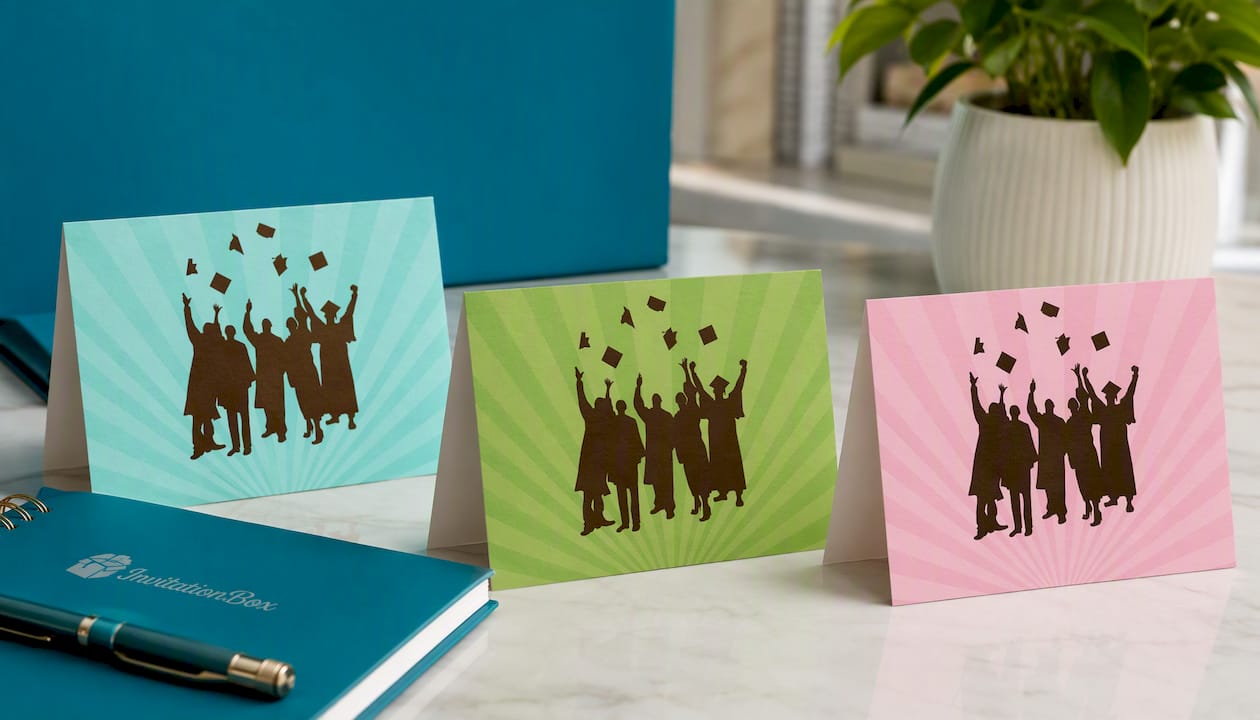
Invitationbox designed three graduation note card styles specifically for this dual role: standalone announcements or paired enclosure inserts. The Grad Caps Tropic Note Cards bring a bright, energetic palette that photographs beautifully alongside a senior portrait. The Grad Caps Olive Note Cards lean more understated, a good match for families who want the wording, not the color, to carry the celebration. The Grad Caps Pink Note Cards round out the set with a softer tone that works well for combined announcement and invitation mailings.
All three are fully customizable with your graduate’s name, school colors, and photo, and they’re sized to work as either a standalone announcement or a clean enclosure card behind a formal invitation. If your list overlaps and you’re weighing whether to combine formats, start with a design you can adapt both ways instead of ordering two separate print runs. Browse the styles, pick the one that fits your graduate’s personality, and get your order in with enough lead time to hit that 4 to 6 week invitation window.
Sources
- High School Graduation Etiquette 101
- Graduation Announcement vs Graduation Invitation: What’s the Difference?
- How To Decide: High School Graduation Invitations or Announcements?