

Envelope Sizes Guide: Every Standard US Format Explained
The #10 envelope (4.125" × 9.5") is the most common business envelope in the United States, designed to hold a standard 8.5" × 11" sheet folded into thirds. But American envelope sizing goes well beyond that single workhorse. Three distinct systems cover everything from wedding invitations to flat document mailers, and picking the wrong one means ordering the wrong product entirely.
Here’s a quick-reference snapshot of the sizes you’ll reach for most often:
- #9 (3.875" × 8.875") — reply and return mail, nests inside a #10
- #10 (4.125" × 9.5") — standard business letters, invoices, statements
- A6 (4.75" × 6.5") — greeting cards, save-the-dates, 4" × 6" photos
- A7 (5.25" × 7.25") — 5" × 7" wedding invitations and announcements
- A9 (5.75" × 8.75") — oversized invitations and large photo cards
- 6×9 (6" × 9") — brochures, newsletters, half-folded documents
- 9×12 (9" × 12") — unfolded 8.5" × 11" documents, contracts, certificates
USPS classifies any envelope up to 6.125" × 11.5" × 0.25" thick as a letter-rate piece, with First-Class postage starting at the standard First-Class letter rates. Anything larger ships as a flat, starting at higher postage rates for large envelopes.
How the three US envelope sizing systems work
American envelopes follow three separate systems, each built around a different mailing purpose. Understanding which system applies to your project saves you from ordering the wrong size entirely.

Commercial (numbered) envelopes are the long, slim envelopes you see in every office. Their numbering system dates to the 1870s and does not correspond linearly to inches or millimeters. Higher numbers mean larger envelopes, but the jump from #9 to #10 is not the same physical increment as #10 to #11. Always verify the actual dimensions rather than assuming the number tells the whole story.
Announcement (A-series) envelopes are sized to match standard US card formats, not paper sizes. An A7 fits a 5" × 7" card perfectly; an A2 fits a 4.25" × 5.5" note card. Their proportions are squarer than commercial envelopes, which matters for USPS automation eligibility.
Catalog and booklet envelopes are named by their physical dimensions in inches: 6×9, 9×12, 10×13. They hold documents flat without folding and mail as USPS flats. One distinction worth knowing: a booklet envelope opens on the long edge, while a catalog envelope opens on the short edge, making each better suited to different insertion methods.
Pro Tip: When planning a multi-piece mailing with a reply envelope nested inside, map out all three components — outer envelope, inserts, and reply envelope — before ordering. A #9 fits inside a #10 with room to spare, but an A7 insert suite with a reply card and RSVP envelope can push thickness limits fast.
- Commercial envelopes: business correspondence, invoices, direct mail
- A-series envelopes: invitations, greeting cards, photo mailers, social stationery
- Catalog/booklet envelopes: flat documents, brochures, catalogs, legal packets
Common US envelope sizes with exact dimensions
Envelope measurements follow a consistent industry standard: width is the horizontal dimension and height is the vertical dimension, with the envelope face up and flap at the top. Every size below uses that convention.
| Size | Dimensions (inches) | Dimensions (mm) | Postage class | Typical use |
|---|---|---|---|---|
| #6 3/4 | — | — | Letter | Personal checks, short letters |
| #9 | 3.875" × 8.875" | — | Letter | Reply/BRE envelope |
| #10 | 4.125" × 9.5" | 105 × 241 | Letter | Standard business mail |
| #14 (Legal) | 5" × 11.5" | — | Letter | Legal-size correspondence |
| A2 | — | — | Letter | Thank-you notes, RSVP cards |
| A6 | 4.75" × 6.5" | — | Letter | Greeting cards, invitations |
| A7 | 5.25" × 7.25" | — | Letter | Wedding invitations, 5×7 cards |
| A9 | 5.75" × 8.75" | — | Letter | Oversized announcements |
| 6×9 | 6" × 9" | — | Letter/Flat | Brochures, half-folded docs |
| 9×12 | 9" × 12" | — | Flat | Unfolded 8.5×11 documents |
| 10×13 | 10" × 13" | — | Flat | Thick packets, legal-size flat |
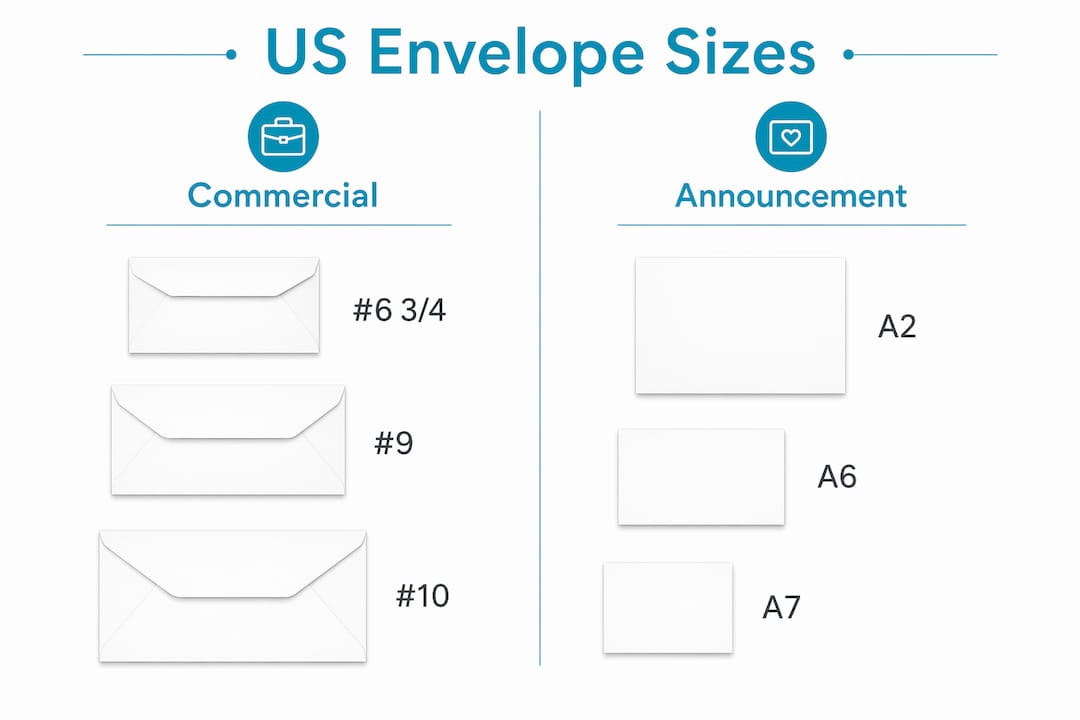
The #10 dominates American business mail because it perfectly fits a tri-folded 8.5" × 11" sheet and qualifies for First-Class letter postage. For invitations, the A7 is the go-to choice: PaperPapers, a trusted bulk paper and envelope wholesaler, confirms the A7 measures 5.25" × 7.25" and fits a standard 5" × 7" card without folding. Catalog sizes like the 9×12 and 10×13 exist specifically for documents that cannot arrive creased.
Key size highlights at a glance:
- A2 is the right choice for RSVP cards accompanying larger invitation suites
- A6 gives a little extra breathing room around a 4" × 6" photo or postcard
- 6×9 is the only catalog-style size that still qualifies for letter-rate postage when under the weight limit
- 10×13 accommodates legal-size (8.5" × 14") sheets laid flat
Postage and mailing rules that affect your envelope choice
USPS sets firm physical limits that determine whether your envelope mails at letter rate or the pricier flat rate. The minimum mailable size is 3.5" high × 5" long; anything smaller is not accepted. The maximum for letter-rate classification is 6.125" high × 11.5" long × 0.25" thick, weighing no more than 3.5 oz.
Beyond dimensions, shape matters just as much. USPS automation eligibility requires an aspect ratio (length divided by height) between 1.3 and 2.5. Square envelopes have a 1.0 ratio and are automatically nonmachinable, triggering a surcharge on every piece regardless of weight. On a large mailing campaign, that adds up quickly.
Postage at a glance (2026 USPS rates): First-Class letter from the standard First-Class letter postage (metered: metered First-Class postage rates); each additional ounce up to 3.5 oz adds charges for each additional ounce; large envelope (flat) starts at higher postage rates for large envelopes for the first ounce, plus additional charges for extra ounces on large envelopes per additional ounce.
Common mailing pitfalls to avoid:
- Exceeding the 0.25" thickness limit with multi-insert packages
- Using square envelopes without budgeting for the nonmachinable surcharge
- Sending rigid contents (coins, keys) that create uneven thickness and disqualify machine processing
- Choosing a size below 3.5" × 5", which USPS will not accept at all
What’s the difference between #8 and #9 envelopes?
The #8 and #9 are close in size but serve very different purposes, and confusing them causes real headaches in a mailing program.
| Feature | #8 (8 5/8) | #9 |
|---|---|---|
| Dimensions | — | 3.875" × 8.875" |
| Height | — | 3.875" |
| Length | — | 8.875" |
| Common use | Specialty mailings | Reply/BRE envelope |
| Fits inside #10? | Yes, with room | Yes, snugly |
Key differences worth knowing:
- The #9 is the standard reply envelope for business mail, designed to nest cleanly inside a #10 outer envelope
- The #8 5/8 is narrower and slightly shorter, used for specialty applications but rarely stocked as a default
- A #9 with a pre-printed return address and postage is called a Business Reply Envelope (BRE), a staple of billing and direct mail
- The #9’s dimensions leave just enough clearance inside a #10 to include one or two folded inserts alongside it
For most reply-mail needs, the #9 is the correct choice. The #8 5/8 appears in specific programs where a slimmer profile is needed, but it is far less common in standard office or mailing supply inventories.
How to choose the right envelope size for your mailing
Match the envelope to what’s going inside, not the other way around. Measure your contents flat before ordering, and add at least 0.25" on each dimension to allow for easy insertion.
- Tri-folded business letter (1–3 sheets): #10
- Reply envelope nested inside #10: #9
- 5" × 7" invitation or greeting card: A7 — browse wedding invitation guidance from Invitationbox for pairing tips
- 4" × 6" photo or save-the-date: A6
- Thank-you note or RSVP card: A2
- Unfolded 8.5" × 11" document: 9×12
- Thick packet or legal-size flat: 10×13
- Brochure or half-folded letter: 6×9
Pro Tip: Prioritize automation-eligible sizes whenever you’re mailing in volume. Staying within the USPS aspect ratio of 1.3 to 2.5 and keeping thickness under 0.25" qualifies your pieces for machine sorting, which can meaningfully reduce postage costs on large runs.
For personalized stationery and coordinated invitation suites, Invitationbox offers a full range of card and envelope options sized to match standard A-series formats.
How US envelope sizes compare to international standards
The US envelope system stands apart from the international ISO standard used across Europe, Asia, and most of the rest of the world. ISO envelopes are named by their paper-size compatibility: a C5 envelope holds an A4 sheet folded once, a C6 holds it folded twice, and a DL (roughly 4.33" × 8.66") holds an A4 sheet folded into thirds. None of those dimensions align neatly with American commercial sizes.
The closest international equivalent to the #10 is the DL envelope, both long and slim, both designed for tri-folded correspondence. But a DL (110 × 220 mm) is slightly narrower and shorter than a #10 (105 × 241 mm), so they are not interchangeable. If you’re mailing internationally or sourcing envelopes from overseas suppliers, always confirm dimensions in millimeters rather than relying on size names.
How envelope size affects your total mailing cost
Postage is only part of the cost equation. Envelope size influences weight, paper stock requirements, and handling fees in ways that compound quickly on larger mailings.
A larger envelope requires heavier paper to maintain structural integrity during machine sorting. A 9×12 catalog envelope typically uses 28 lb or 32 lb stock, compared to the 24 lb stock common in #10 envelopes. That added paper weight counts toward your mailing weight, which can push a piece from the first-ounce bracket into the next tier.
Nonmachinable surcharges apply to any piece that cannot be processed by automated sorting equipment, including square envelopes, pieces with clasps or strings, and anything with rigid or uneven contents. Those surcharges stack on top of the base postage rate. For a high-volume campaign, the difference between a machinable and nonmachinable design can represent a meaningful cost per piece.
Thickness also determines handling. A #10 envelope stuffed past the 0.25" limit gets bumped to flat-rate pricing even if its footprint qualifies as a letter. Planning your insert count before finalizing your envelope size prevents that kind of surprise at the post office.
Materials and window options across envelope sizes
Most standard envelopes come in white wove (smooth, bright white), kraft (natural brown), and recycled stock. White wove is the default for business and invitation mail; kraft reads as casual or eco-conscious and works well for boutique brands and handcrafted stationery.
Window envelopes are available in most commercial sizes, particularly #9 and #10. A single window on the lower left reveals the recipient’s address printed on the enclosed letter, eliminating the need to address the outer envelope separately. Double-window versions expose both the recipient and return address. Window placement follows industry conventions measured from the left edge and bottom of the envelope, so confirm your template aligns before printing.
For invitations and greeting cards, A-series envelopes often come with square flaps and side seams, which give a cleaner look when the flap is sealed. Pointed (Baronial) flaps add a formal, elegant feel suited to wedding invitations and upscale announcements. Peel-and-seal closures are available across most sizes and spare your guests the gummed-flap experience.
Key Takeaways
The #10 envelope handles the vast majority of US business mail, but matching the right size to your contents, postage class, and USPS shape rules is what keeps mailing costs predictable.
| Point | Details |
|---|---|
| Three sizing systems | Commercial (numbered), A-series (announcement), and catalog/booklet each serve distinct mailing purposes. |
| USPS letter-rate limits | Envelopes up to 6.125" × 11.5" × 0.25" thick qualify for First-Class letter postage starting at standard First-Class letter postage. |
| Automation aspect ratio | USPS requires a length-to-height ratio of 1.3 to 2.5; square envelopes at 1.0 incur a nonmachinable surcharge. |
| A7 for invitations | The A7 (5.25" × 7.25") is the standard choice for 5" × 7" wedding invitations and announcements. |
| #9 as reply envelope | The #9 (3.875" × 8.875") nests cleanly inside a #10 and serves as the standard business reply envelope. |
Ready to send something truly special? Invitationbox makes it easy to find personalized stationery that pairs beautifully with standard A-series envelopes, from heartfelt wedding invitations to joyful holiday cards. Every detail, right down to the envelope, can reflect your personal style.
Recommended
- From Save-the-Dates to Engagement Party Invitations: Coordinating Your – InvitationBox.com
- The Ultimate Guide to Personalizing Stationery Gifts: Tips and Tricks – InvitationBox.com
- Are Custom Stampers Suitable for All Occasions? – InvitationBox.com
- Elevate Your Stationery Game: How Embossing Tools Can Transform Your N – InvitationBox.com