

Notepad Sizes for Pocket, Desk, and Promos
The most common U.S. notepad sizes are six formats you’ll encounter again and again, each with a clear sweet spot:
- 3.5" × 5.5" (89 × 140 mm) — Pocket/memo: Slips into a shirt pocket or purse; great for quick grocery lists and on-the-go reminders.
- 4" × 6" (102 × 152 mm) — Compact desk: The classic index-card footprint; ideal for short meeting notes and promotional giveaways.
- 4.25" × 5.5" (108 × 140 mm) — Quarter-letter: Exactly one-quarter of a letter sheet; popular for personalized notepads and branded gifts.
- 5" × 7" (127 × 178 mm) — Mid-size: Comfortable for journaling and planners without taking up a full desk corner.
- 5.5" × 8.5" (140 × 216 mm) — Half-letter: Half a standard letter sheet; the workhorse for meeting notes, to-do lists, and desk pads.
- 8.5" × 11" (216 × 279 mm) — Letter: Full-page writing space; preferred for long-form notes, legal drafts, and desk blotters.
Key Takeaways
Choosing the right notepad size comes down to three decisions: where you’ll carry it, how much you’ll write per page, and whether your printer or binder needs a standard format.
| Point | Details |
|---|---|
| Start with portability | Pocket and 4"×6" sizes travel well; half-letter and letter stay on the desk. |
| Match size to content | Short reminders fit 3.5"×5.5"; long-form notes need 5.5"×8.5" or larger. |
| Stick to standard sizes | Standard dimensions cost less to print and reorder than custom trim sizes. |
| Watch the A4 vs. Letter gap | A4 is 6 mm narrower and 18 mm taller than U.S. Letter — templates are not interchangeable. |
| Invitationbox for custom pads | Invitationbox offers personalized notepads in popular U.S. sizes with low minimums and ready-to-use templates. |
Table of Contents
- What are the standard notepad sizes?
- Which notepad size fits your real-world use?
- How to choose the right notepad size
- Standard sizes vs. custom notepad dimensions
- U.S. Letter vs. ISO A-series: what actually changes
- Binding styles, paper weight, and print-ready specs
- Paper types and environmental choices that affect your size decision
- Notepad sizes for specific professional contexts
- A perspective on how size shapes the writing experience
- Personalized notepads from Invitationbox, ready in your size
- Sources
What are the standard notepad sizes?
Every size above has a name, a millimeter equivalent, and a job it does best. The Thesize confirms these measurements and adds helpful A-series equivalents for international reference.
A few specialty formats round out the picture:
- Small sticky-style pads mimic the Post-it footprint and work well for short reminders on monitors or refrigerators.
- Legal pads (8.5" × 14") add three inches of vertical space over letter, giving attorneys and writers more room per page.
- Composition-style pads (9.75" × 7.5") echo the classic composition notebook and suit students or writers who prefer a slightly wider landscape feel.
- A5 (148 × 210 mm ≈ 5.8" × 8.3") sits close to half-letter and is the go-to for European-style planners and bullet journals.
Which notepad size fits your real-world use?
Matching the right notepad dimensions to how you actually use the pad saves you from carrying something too bulky or running out of space mid-thought.
- Everyday carry (EDC): The 3.5" × 5.5" pocket size slips into any pocket without a bulge. If you write in large letters, bump up to 4" × 6" so each page stays useful.
- Desk and meetings: Half-letter (5.5" × 8.5") is the sweet spot. It fits a standard desk organizer, holds a full page of bullet points, and stacks neatly in a bag.
- Conferences and trade-show giveaways: The 4" × 6" and 5.5" × 8.5" formats perform best as promotional giveaways because they balance logo visibility with pocketability.
- Journaling and planners: The 5" × 7" mid-size gives you enough room for daily entries without the weight of a full letter pad. A5 works equally well if you prefer metric-friendly layouts.
- Legal and long-form notes: Legal pads (8.5" × 14") are the professional standard for attorneys, journalists, and anyone who writes in long continuous passages.
- Sketching and architectural drafts: Letter (8.5" × 11") or larger gives you the margin space to annotate drawings. Landscape orientation on a half-letter pad also works well for quick thumbnail sketches.
Pro Tip: If your handwriting runs large, treat each size one step smaller than the label suggests. A half-letter pad used by a large-handed writer fills up at roughly the same rate a pocket pad does for someone with compact script. Test one page before ordering a bulk run.
Stationery and productivity sources note that moving to a smaller pad, such as A5 or A6, can sharpen focus and encourage concise notes — a real advantage for mobile workers who review notes on the go.
How to choose the right notepad size
Start here: if you need something portable, go 4" × 6" or smaller. If you need full-page writing space at a desk, go half-letter or letter. Everything else is refinement.
Work through this checklist before you order:
- Portability. Will the pad live in a bag, pocket, or on a desk? Pocket and compact sizes (up to 4" × 6") travel well. Half-letter and letter stay on the desk.
- Content per page. Long meeting agendas or legal notes need half-letter minimum. Quick reminders fit on a 3.5" × 5.5" without wasted space.
- Binding and stacking. Top-bound pads stack flat in drawers. Spiral pads fold back on themselves but add thickness. Choose based on how you store and ship.
- Printing compatibility. If you plan to print a template on the pad, stick to letter or half-letter so your printer’s paper tray handles it without custom feeds.
- Budget and quantity. Standard sizes cost less per unit because press sheets nest efficiently. Larger quantities also drop the per-pad price significantly.
For print-ready files, keep these specs in mind:
- Bleed: Add a small margin on every edge beyond the trim line.
- Safe area: Keep text and logos inside the trim line by a safe distance.
- Resolution: High resolution for crisp logos and type.
- Paper weight: Use weights suitable for everyday memo pads and premium gift notepads.
Pro Tip: Order a short run of 25–50 pads in your chosen size before committing to 500 or more. Checking the physical pad in your hand reveals binding issues, paper feel, and logo placement problems that a PDF proof simply cannot show. Invitationbox’s personalized notepad ordering guide walks you through the file-prep steps.
Standard sizes vs. custom notepad dimensions
Standard sizes save money. PrintPlace confirms that common sizes like 4" × 6", 5.5" × 8.5", and 8.5" × 11" are more cost-effective to produce because finishing equipment is already calibrated for them and sheets nest without waste on the press.
Custom dimensions change the math in several ways:
- Press efficiency drops. An odd trim size leaves more paper waste per press sheet, raising material cost.
- Finishing setup adds time. Cutting and padding equipment must be reset, which adds setup fees.
- Minimum order quantities rise. Most printers require larger minimums for custom sizes to offset setup costs.
- Reorder ease decreases. A custom size from one printer may not match exactly at another, complicating future reorders.
Choose a custom size only when a specific brand shape or product fit genuinely requires it — a square notepad for a square logo, for example, or a narrow 3.5" × 8" format designed to sit beside a keyboard.
Pro Tip: When specifying a custom size to a printer, always state the finished (trim) size, not the bleed size. Write it as “Finished size: 3.5” × 8", bleed to 3.625" × 8.125"." Include crop marks in your file so the cutter operator has a clear reference.
U.S. Letter vs. ISO A-series: what actually changes
ISO 216 defines A4 as 210 × 297 mm (approximately 8.27" × 11.69"), which is narrower and taller than U.S. Letter (8.5" × 11"). The difference is about 6 mm in width and 18 mm in height — small enough to look identical on a screen, large enough to cause clipping when you print a Letter template on A4 paper.
Practical compatibility tips:
- Templates: Always build your notepad template to the exact finished size you ordered. A Letter template will clip on an A4 pad and vice versa.
- Binders and folders: U.S. three-ring binders are sized for Letter paper. A4 sheets are slightly too tall and will buckle at the top.
- International document exchange: If your notes will be shared with colleagues in Europe or Asia, an A5 pad keeps your handwritten pages compatible with their A4 filing systems.
The Gentleman Stationer’s comparison of U.S. and international paper conventions is a good read if you regularly work across both systems.
Binding styles, paper weight, and print-ready specs
The binding you choose affects how the pad feels in hand, how it ships, and how pages tear away.
- Top-bound glued pads: The most common format. Pages tear cleanly from the top and the pad lays flat on a desk.
- Side-bound pads: Better for left-handed writers or landscape layouts; the binding sits on the left edge.
- Spiral-bound: Pages fold back fully, making the pad compact when open. Adds thickness to the stack.
- Perforated tear-off: A perforation line near the top lets you remove pages cleanly without a ragged edge.
- Saddle-stitch booklet style: Stapled through the spine; suited to multi-section planners rather than simple memo pads.
Orientation matters too. Portrait binding on the top edge suits vertical writing. Landscape orientation with a left-side or top spiral works well for sketching and wide tables.
Paper weight shapes the writing experience significantly:
For print-ready files: set bleed to 0.125" on all sides, keep live content 0.125" inside the trim line, and export at 300 dpi. Supplying a PDF/X-1a file avoids most color and font issues at the printer.
Paper types and environmental choices that affect your size decision
The paper stock you choose interacts with size in ways that affect both feel and sustainability. Heavier stocks add noticeable weight to larger pads — an 80 lb letter pad feels substantial in a bag, while the same stock on a 4" × 6" pad barely registers.
FSC-certified stocks signal responsible forestry and are a common request for corporate giveaway pads. Chlorine-free papers reduce processing chemicals and are worth requesting for premium gift notepads.
Coated stocks add a smooth surface that photographs and logos print crisply on, but they resist ballpoint and gel pens. Uncoated stocks absorb ink better and feel more natural for handwriting — the right choice for most notepad formats. If your pad will be used with fountain pens, a 70 lb or heavier uncoated stock prevents bleed-through on both sides of the page.
Smaller pads waste less paper per unit, which matters if you’re ordering large quantities for a promotional campaign. A 4" × 6" pad uses roughly one-quarter the paper of a letter pad at the same page count — a meaningful difference at 1,000-unit minimums.
Notepad sizes for specific professional contexts
Different professions have settled on specific formats for good reasons, and working with those conventions rather than against them saves time.
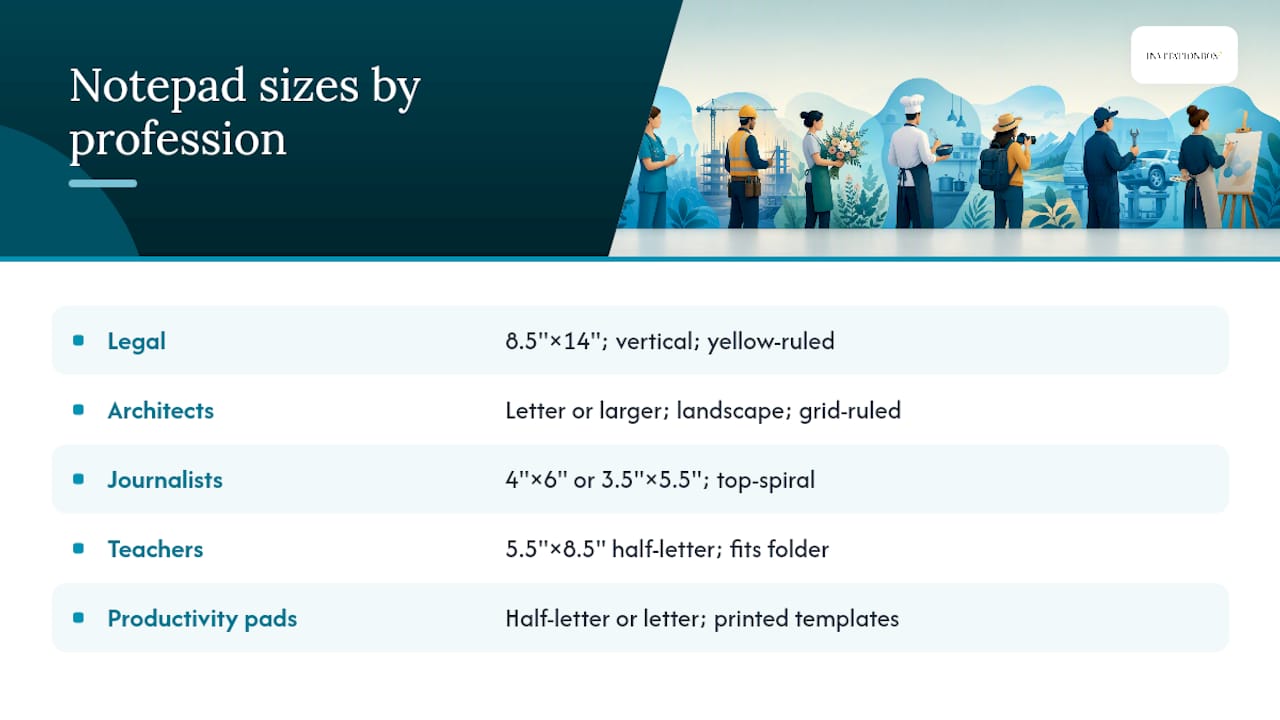
Legal professionals rely on the 8.5" × 14" legal pad because depositions, contract reviews, and case notes often run long. The extra three inches of vertical space means fewer page turns during a hearing. Yellow ruled paper remains the traditional choice, though white legal pads are increasingly common in modern offices.
Architects and designers often prefer letter-size or larger pads in landscape orientation. The wider horizontal field suits thumbnail sketches, section drawings, and annotation-heavy diagrams. Grid-ruled paper (4 or 5 squares per inch) helps maintain proportion without a ruler.
Journalists and reporters have long favored the 4" × 6" or 3.5" × 5.5" reporter’s notebook — narrow enough to hold in one hand while writing with the other. Top-spiral binding lets the pad flip back on itself cleanly.
Teachers and trainers gravitate toward half-letter (5.5" × 8.5") pads for lesson planning. The size fits a standard folder and holds enough content for a full class outline without the bulk of a letter pad.
For productivity-focused desk use, a personalized half-letter or letter pad with a printed template — daily priorities, meeting agenda, to-do columns — turns a blank notepad into a structured workflow tool.
A perspective on how size shapes the writing experience
Most size guides stop at dimensions and use cases. What they skip is the subtler truth: the size of a notepad shapes how you think on the page, not just how much you write.
A pocket pad forces brevity. When you have only 3.5" × 5.5" of space, you instinctively edit before you write. That constraint is a feature, not a limitation — it’s why reporters and field researchers have carried small pads for generations. The physical boundary creates mental clarity.
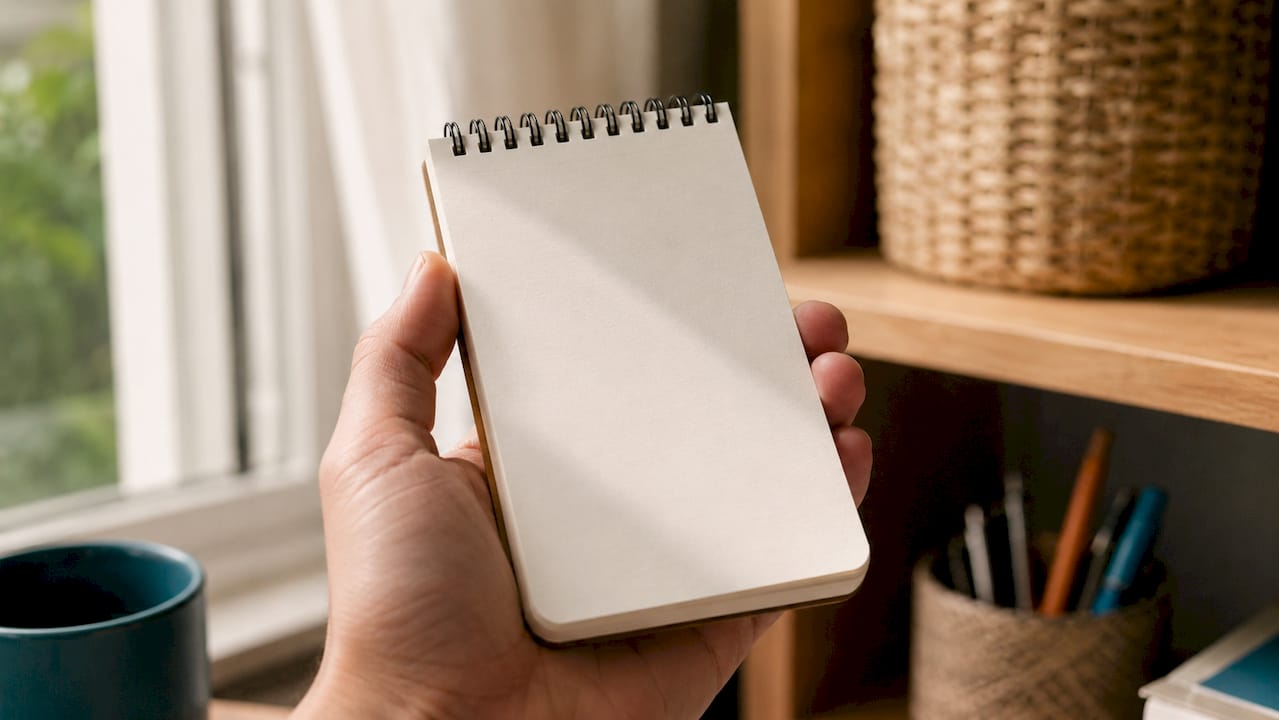
A full letter pad does the opposite. The open space invites sprawl, which is exactly what you want for brainstorming, legal drafts, or any task where premature editing kills good ideas. The size signals permission to think expansively.
The mistake most people make is choosing a size based on what looks professional rather than what matches their actual writing behavior. A beautiful leather-bound letter pad sitting mostly blank on a desk is less useful than a worn 4" × 6" pad filled with real notes. Size is a tool. Pick the one that fits the hand reaching for it.
Personalized notepads from Invitationbox, ready in your size
Invitationbox offers custom notepads in the sizes that matter most — from compact 4" × 6" giveaways to half-letter desk pads — with low minimums and bleed-safe templates you can use right away.
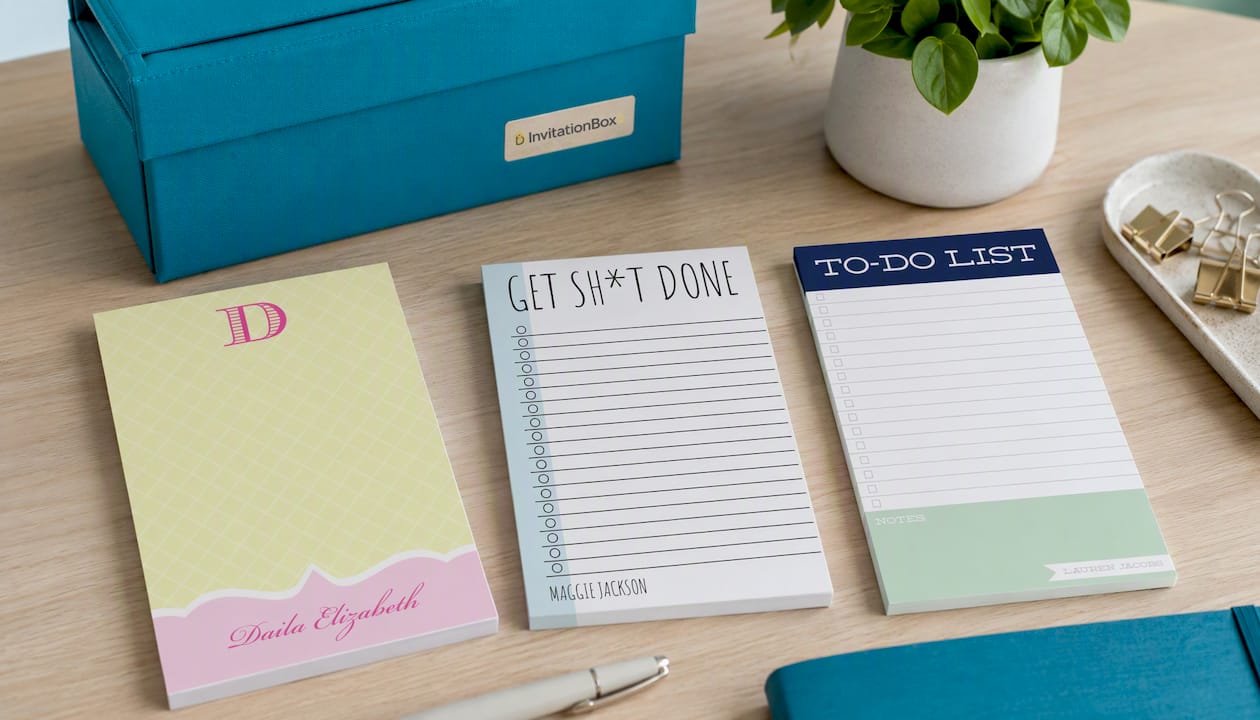
Three ready-to-order favorites that ship quickly:
- The Green Diagonal Initial Personalized Notepad brings a polished monogram design to a desk-friendly format — a thoughtful gift or a refined personal stationery choice.
- The Get Sh*t Done Notepad pairs bold typography with a task-focused layout, perfect for the half-letter size that fits every meeting bag.
- The Bold To-Do List Notepad gives you a structured daily checklist in a clean, modern design that works beautifully as a desk pad or a personalized gift.
To order a sample, request a bleed-safe template, or ask about custom dimensions, visit Invitationbox and use the product page’s customization tool or contact the team directly.
Sources
Short, vetted links for exact dimensions, templates, and deeper reading:
- Standard Memo and Notepad Sizes: Use Case Guide
- Thesize
- Standard Notepad Sizes | PrintPlace
- How to choose the right notepad size: A4, A5, A6, A7 and DL compared | InPrintGroup