

Rehearsal Dinner Invitations Etiquette: Your Full Guide
The groom’s parents traditionally host the rehearsal dinner, though modern couples often take the reins themselves. Send invitations three to six weeks before the wedding, always after the main wedding invitations have gone out. A quick formal sample: “Mr. and Mrs. James Hartley request the pleasure of your company at a dinner in honor of Emily and Thomas, Friday, the fourteenth of June, at seven o’clock in the evening.” A casual version: “Join us for dinner the night before the big day! Friday, June 14th at 7 PM — The Hartley Family.”
Every rehearsal dinner invitation needs at least these three things:
- Host line (who is giving the dinner)
- Couple’s names and event date, time, and location
- RSVP method and deadline
Pro Tip: Send rehearsal dinner invitations only after your wedding invitations are in the mail. Sending them first confuses guests about which event is the main celebration.
Table of Contents
- What is a rehearsal dinner and who should attend?
- Who traditionally hosts and pays for the rehearsal dinner?
- Who gets invited to the rehearsal dinner?
- When should you send rehearsal dinner invitations?
- Wording templates you can copy right now
- Common etiquette questions about rehearsal dinners
- Choosing between paper and digital invitations
- Mistakes to avoid when sending rehearsal dinner invitations
- Key Takeaways
- The detail most couples overlook
- Ready to order your rehearsal dinner stationery?
- Useful sources for further reading
What is a rehearsal dinner and who should attend?
The rehearsal dinner is the warm, celebratory meal that follows the ceremony rehearsal, typically held the evening before the wedding. Its purpose is practical and personal at once: it gives the wedding party a chance to run through the ceremony, then gather around a table to relax, reconnect, and celebrate together before the big day.
The core guest list, as Emily Post advises, includes the wedding party and their partners, the officiant and their partner, and immediate family members from both sides. Readers, ushers, and anyone else with a role in the ceremony belong here too.
One distinction worth knowing: a rehearsal dinner is not the same as a welcome party. A welcome party is a broader, more casual gathering that extends an invitation to all out-of-town guests, often held the same evening. If you want to include extended family, friends who traveled far, or a larger crowd, a welcome party is the right vehicle. The rehearsal dinner itself stays intimate by design.
Who traditionally hosts and pays for the rehearsal dinner?
Traditionally, the groom’s family hosts and pays for the rehearsal dinner. That tradition has softened considerably, and today the couple, both families together, or even close friends may step into the host role. The guiding rule remains consistent regardless of who pays: whoever is hosting should appear on the invitation’s host line. Emily Post is clear that the host line clarifies both the RSVP point of contact and who guests should thank.
Here are host-line examples for common arrangements:
- Bride’s parents hosting: — Mr. and Mrs. William Torres request your company at a dinner in honor of…
Pro Tip: When two families split the cost, list both families on the host line rather than choosing one. It avoids hurt feelings and reflects the reality of who made the evening possible.
Design consistency between your rehearsal dinner invites and wedding stationery is entirely optional. Matching suites look polished, but a slightly different tone on the rehearsal invite can actually signal to guests that this is a more relaxed, intimate evening. WeddingWire notes that couples can choose to match or intentionally differ, depending on the stationer and desired feel.
Who gets invited to the rehearsal dinner?
Start with everyone who will be at the rehearsal itself, then build outward thoughtfully. The Knot recommends beginning with the wedding party and immediate family, then considering out-of-town guests based on your budget and venue size.
A numbered approach helps keep the list manageable:
- Must-invite core: — Wedding party (bridesmaids, groomsmen, flower girls, ring bearers), the officiant, ceremony readers, and ushers.
For destination weddings, the rehearsal dinner often expands into a welcome event that includes all traveling guests. Greenvelope advises labeling the invitation clearly in this case so guests understand whether they are being invited to a rehearsal dinner or a broader welcome gathering. The distinction matters for their expectations and attire.
When your rehearsal dinner guest list differs from your full wedding guest list (which it almost always does), send separate rehearsal dinner invitations rather than enclosing a single insert for everyone. Addressing makes it clear who is invited.
When should you send rehearsal dinner invitations?
The timing rule is simple: rehearsal dinner invitations go out after your wedding invitations, never before. Sending them first creates confusion about which event is the main celebration.
Emily Post recommends a send window of three to six weeks before the wedding. Greenvelope suggests three to five weeks. Let’s Get Rehearsed advises approximately four weeks before the rehearsal dinner itself. These ranges overlap comfortably, and the sweet spot for most couples is four to five weeks out.
| Delivery method | Best send window | Notes |
|---|---|---|
| Mailed paper invites | 3–6 weeks before wedding | Allows time for printing, mailing, and RSVP collection |
| Insert card in wedding suite | Same time as wedding invites | Only works when rehearsal guest list matches wedding list |
| Designed e-invite | 3–6 weeks before wedding | Faster turnaround; ideal for smaller or last-minute lists |
| Informal digital notice (text/email) | 3–6 weeks before wedding | Acceptable for very close family and wedding party only |
Including rehearsal dinner details inside the wedding invitation suite as an insert card works only when the guest lists are identical, which is rare. For most couples, a separate mailing is the cleaner, clearer choice. For timing guidance on coordinating multiple pre-wedding invitations, planning ahead by at least six weeks gives you enough runway for all of them.
Wording templates you can copy right now
These templates cover the most common tones and host arrangements. Adapt names, dates, and details to fit your event.
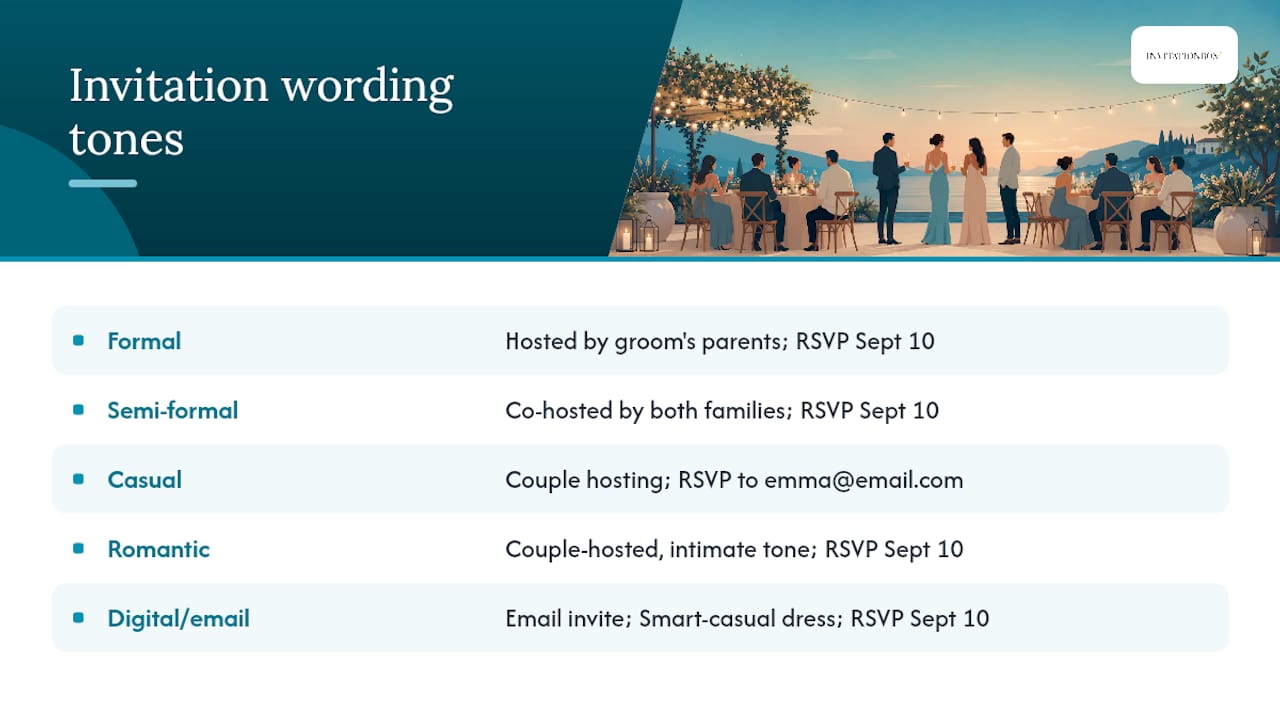
Formal (hosted by groom’s parents): Mr. and Mrs. Robert Harrington request the pleasure of your company at a rehearsal dinner in honor of Claire and Matthew, Friday, the twentieth of September, at seven o’clock in the evening. The Rosewood Club, 412 Elm Street, Charleston, South Carolina. Kindly reply by September 10th to margaret.harrington@email.com.
Semi-formal (both families co-hosting): The families of Olivia Park and James Nguyen invite you to join them for dinner the evening before the wedding. Friday, September 20th at 7:00 PM. The Rosewood Club, 412 Elm Street, Charleston, SC. RSVP by September 10th: (555) 867-5309.
Casual (couple hosting): We’re getting married tomorrow — come celebrate with us tonight! Join Emma and Luca for dinner on Friday, September 20th at 7 PM. Rosewood Club, 412 Elm Street, Charleston. RSVP to emma@email.com by September 10th.
Romantic (couple-hosted, intimate tone): Before we say “I do,” we’d love to share a meal with the people who mean the most to us. Emma and Luca invite you to dinner on Friday, September 20th at 7:00 PM. Rosewood Club, 412 Elm Street, Charleston, SC. Please reply by September 10th.
Digital/email format: Subject: You’re invited — Rehearsal Dinner for Emma & Luca We’d love to have you join us the night before the wedding for dinner and celebration. Friday, September 20th at 7:00 PM at Rosewood Club, 412 Elm Street, Charleston, SC. Dress: Smart casual. Please RSVP by September 10th by replying to this email or visiting [wedding website link].
For wedding invitation wording that matches the tone of your rehearsal dinner invite, keeping a consistent voice across your stationery suite creates a cohesive, memorable experience for guests.
Common etiquette questions about rehearsal dinners
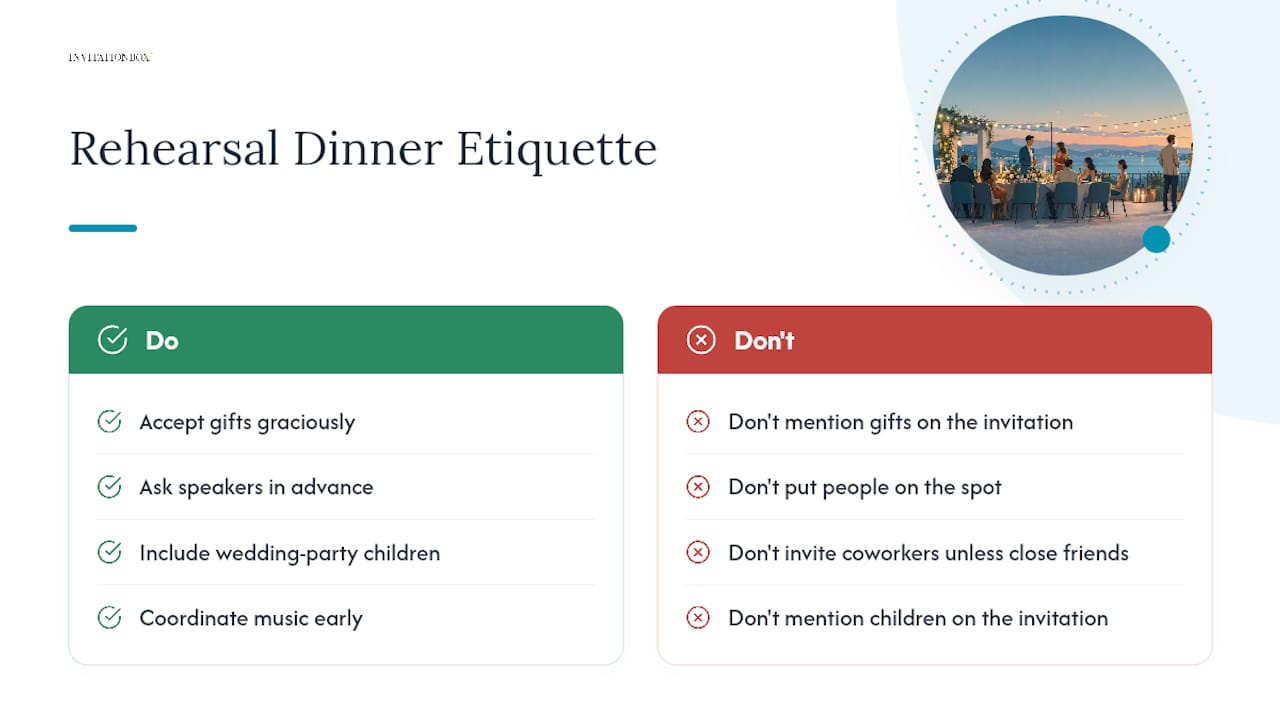
Should guests bring gifts? Gifts are not expected at the rehearsal dinner. The event is a celebration and a thank-you to the wedding party, not a gift-giving occasion. If guests bring something, accept graciously, but do not mention gifts on the invitation.
Who gives toasts? The host traditionally opens with a welcome toast. After that, the floor is open to the wedding party, parents, and close friends. Keep toasts shorter and more personal than wedding reception speeches. If you want specific people to speak, ask them in advance rather than putting them on the spot.
Should children attend? This depends on the venue and the tone you want. Children in the wedding party (flower girls, ring bearers) are typically included. Siblings of the couple are usually invited. Beyond that, it is a personal call. If children are not invited, address envelopes to adults only and do not mention children on the invitation.
What about extended family or coworkers? Aunts, uncles, and close family friends are a warm addition when space and budget allow. Coworkers are generally not included unless they are also close personal friends of the couple.
Pro Tip: If you are planning live music or entertainment for the rehearsal dinner, coordinating with a band or DJ early frees up your mental bandwidth closer to the wedding. Resources like Alex Levin Music’s guide to finding a wedding band or DJ walk through the process clearly.
Choosing between paper and digital invitations
Paper invitations carry warmth and formality that a text message simply cannot replicate. They also serve as keepsakes, which matters to many families. For older guests or a formal venue, mailed paper invites are the right choice. Let’s Get Rehearsed confirms that digital invitations are fully acceptable for rehearsal dinners, particularly for smaller or last-minute guest lists.
| Format | Best for | Lead time needed |
|---|---|---|
| Printed flat card | Formal dinners, older guests, keepsake value | 3–6 weeks for design, print, and mail |
| Insert card in wedding suite | Identical guest lists only | Same as wedding invite timeline |
| Designed e-invite | Small lists, eco-conscious couples, tight timelines | 3–6 weeks ahead of event |
| Text or email notice | Very close family and wedding party only | 3–6 weeks ahead of event |
When ordering printed invitations, finalize your wording at least three to four weeks before your target send date. That window covers design proofing, print production, and mailing. For coordinating stationery across all your pre-wedding events, planning the full suite at once saves time and keeps the look consistent.
A personalized self-inking stamp or embosser adds a polished, high-end touch to rehearsal dinner envelopes without the cost of a full multi-piece stationery suite. Return-address stamps are especially practical when mailing to a smaller list.
Mistakes to avoid when sending rehearsal dinner invitations
The most common error is sending rehearsal dinner invitations before the main wedding invitations have been mailed. Guests who receive the rehearsal invite first may not yet know they are invited to the wedding, which creates awkward confusion and puts the cart firmly before the horse.
Relying on a group text as the only invitation for important guests is another misstep. Texts disappear in notification stacks and feel casual in a way that does not honor the occasion. A designed e-invite or a mailed card communicates that the evening matters.
Leaving the RSVP line vague is a quiet but costly mistake. “Let us know if you can make it” gives guests no deadline and no clear method, which means responses trickle in (or not at all) and the host cannot confirm a headcount with the venue. Always name a specific date and a specific contact method.
Pro Tip: Proof your invitation text out loud before ordering prints or sending digitally. Reading it aloud catches missing details (a forgotten street address, an unclear RSVP date) that eyes on a screen tend to skip over.
Key Takeaways
Proper rehearsal dinner invitations etiquette comes down to one clear principle: send the right information to the right people at the right time, with a host line that reflects who is actually giving the dinner.
| Point | Details |
|---|---|
| Send timing | Mail rehearsal dinner invitations three to six weeks before the wedding, always after wedding invitations. |
| Guest list foundation | Start with the wedding party, officiant, and immediate family; expand thoughtfully from there. |
| Required invite elements | Every invitation needs a host line, couple’s names, date, time, full address, and a clear RSVP method with deadline. |
| RSVP simplicity | A single email or phone number with a firm deadline works better than a formal RSVP card for most rehearsal dinners. |
| Invitationbox stationery | Invitationbox offers custom stamps, embossers, insert cards, and photo cards that match any rehearsal dinner tone and timeline. |
The detail most couples overlook
There is a tendency to treat the rehearsal dinner invitation as an afterthought, something to dash off once the wedding stationery is done. That instinct is understandable, but it misses something real. The rehearsal dinner is often the most personal evening of the entire wedding weekend. The guest list is small, the room is full of people who genuinely know the couple, and the tone is relaxed enough for real conversation. An invitation that reflects that intimacy, whether through thoughtful wording, a well-chosen card, or a stamped envelope that feels considered, sets the right expectation before anyone walks through the door.
The other thing worth saying plainly: digital invitations are not a lesser choice. A beautifully designed e-invite sent at the right time, with clear wording and a firm RSVP link, does everything a paper card does for a rehearsal dinner guest list. The medium matters less than the care behind it. What guests remember is whether they felt genuinely welcomed, and that comes from the words, not the paper stock.
Ready to order your rehearsal dinner stationery?
Invitationbox makes it easy to pull together polished rehearsal dinner stationery without the long lead times of a traditional print shop. Whether you need custom insert cards, folded note cards, or a personalized stamp to finish your envelopes with a distinctive touch, everything is available in one place and ships to your door.

For couples who love a tactile, keepsake-worthy finish, the Woodcut Stamper or Embosser and the Extra Ornamental Stamper or Embosser bring a refined, handcrafted feel to return addresses and envelope seals. Coastal or nautical themes? The Vintage Seahorse Stamper or Embosser is a natural fit. Rustic or country-style dinners pair beautifully with the Horseshoe Stamper or Embosser, while the Paw Print Stamper or Embosser and the Jolly Rogerette Stamper or Embosser add a playful, personal note for couples with a sense of humor. For photo card formats, the Fun Holiday Confetti Photo Card and the Vintage Making Spirits Bright Photo Card work as charming casual inserts or standalone rehearsal dinner invites.
Browse the full collection at Invitationbox and find the stamp, embosser, or card that fits your evening perfectly.
Useful sources for further reading
- The Rehearsal Dinner — Emily Post
- Rehearsal Dinner Invitation Etiquette: Top Questions Answered
- Who to Invite to Your Rehearsal Dinner — The Knot
- Rehearsal dinner invite wording — Greenvelope
- Wedding Rehearsal Dinner Invitation Etiquette, Wording, Timing — Let’s Get Rehearsed!
- Rehearsal dinner invitation wording — Brides
Recommended
- Wedding Invitation Wording: Examples and Etiquette 2026 – InvitationBox.com
- Crafting the Perfect Engagement Party Invitations: A Step-by-Step Guid – InvitationBox.com
- From Save-the-Dates to Engagement Party Invitations: Coordinating Your – InvitationBox.com
- Adult Only Wedding Wording: Polite Phrases That Work – InvitationBox.com