

Wedding Invitation Wording: Examples and Etiquette 2026
What should your wedding invitation actually say?
Every wedding invitation carries the same essential job: tell your guests who, what, when, and where, while setting the tone for the celebration ahead. Get the wording right, and your guests arrive knowing exactly what to wear, where to go, and how to respond. The key is understanding the building blocks before you start filling in names and dates.
Here are the core components every invitation needs:
- Host line: Names the person or people hosting (and traditionally, paying for) the wedding
- Request line: The formal or casual phrase inviting guests to attend
- Couple’s names: Usually displayed prominently, often in a larger or decorative typeface
- Date and time: Spelled out fully on formal invitations (“Saturday, the fourteenth of June, at four o’clock”); numerals are fine for casual styles
- Venue name and location: Full venue name, city, and state always; street address when omitting it would cause confusion
- Reception details: “Reception to follow” when it’s at the same location, or a separate details card for a different venue
- RSVP information: A response card, deadline, and clear method for replying
One distinction worth knowing early: formal invitations require dates and times to be written out completely, using phrases like “half after five o’clock” rather than “5:30 PM.” That single detail signals formality more clearly than almost anything else on the page.
The word choice on the request line also carries meaning. Traditional etiquette uses “honor of your presence” for ceremonies held in a house of worship, and “pleasure of your company” for secular venues. Swapping them is a small error that older guests will notice.
A simple formal example:
Mr. and Mrs. Thomas Ellison request the honor of your presence at the marriage of their daughter Claire Anne Ellison to James Robert Whitfield Saturday, the fourteenth of June at four o’clock in the afternoon St. Michael’s Episcopal Church Charleston, South Carolina Reception to follow
Table of Contents
- How to word the host line for every family situation
- How to phrase the request line and action line for any wedding style
- Matching your invitation tone to your wedding’s vibe
- Cultural and religious considerations in invitation wording
- Common wording mistakes to avoid and etiquette guidelines
- How personalized stationery and custom stamps elevate your invitations
- Should you include your wedding website on the invitation?
- How to address envelopes to match your invitation’s wording style
- Your wedding stationery, made personal with Invitationbox
- Key Takeaways
How to word the host line for every family situation
The host line is where many couples get stuck, and understandably so. Family structures today are wonderfully varied, and the invitation should reflect yours honestly and warmly.
Traditional etiquette places the hosts at the very top because the host line signals who is welcoming guests to the celebration. As host line phrasing has evolved, it’s now entirely common to list both sets of parents or the couple themselves, regardless of who is writing the checks.
Common host line scenarios:
-
Bride’s parents hosting (traditional): Mr. and Mrs. Robert Ellison
-
Both sets of parents hosting: Mr. and Mrs. Robert Ellison and Mr. and Mrs. David Whitfield
-
Couple hosting with families: Together with their families, Claire Ellison and James Whitfield
-
Couple hosting alone: Claire Ellison and James Whitfield invite you to celebrate their marriage (The host line can be omitted entirely in this case.)
-
One parent deceased: Claire Anne, daughter of Mr. Robert Ellison and the late Margaret Ellison
When parents are divorced, each parent’s name goes on a separate line, and a stepparent’s name appears on the same line as their spouse. Here is how that looks in practice:
Dr. Vance and Elizabeth Gregory and Mr. James Abner and Lydia Abner invite you to the wedding of their daughter Amy Abner
The phrase “Together with their families” is a graceful catch-all when the hosting situation is complicated or when you simply want to honor everyone without a long list of names. It works beautifully for blended families, multicultural households, and any situation where spelling out every name would feel unwieldy.
How to phrase the request line and action line for any wedding style
The request line is the heart of your invitation’s personality. It tells guests not just that they’re invited, but how you feel about having them there.
For religious ceremonies:
- “request the honor of your presence at the marriage of”
- “joyfully invite you to worship with them as they are united in holy matrimony”
For secular or civil ceremonies:
- “request the pleasure of your company at the celebration of”
- “invite you to join them as they exchange vows”
- “would love for you to celebrate with them”
For casual or relaxed weddings:
- “please join us as we tie the knot”
- “we’re getting married and we’d love to have you there”
- “come celebrate love with us”
For reception-only invitations (when the ceremony has already taken place or is private), a small adjustment does the work:
The action line, which covers RSVP instructions, should be equally clear. RSVP wording needs a firm deadline and a specific method, whether that’s a return card, an email address, or a wedding website link. Vague instructions like “kindly reply” without a date leave guests uncertain and planners scrambling.
A clean RSVP line reads:
Kindly reply by May 15, 2026 [wedding website URL or mailing address]
Matching your invitation tone to your wedding’s vibe
Your wording style should feel like a preview of the day itself. A black-tie ballroom wedding calls for a different voice than a barefoot beach ceremony, and your guests will read those cues before they even check the date.
Formal and traditional
Everything is spelled out. Full names, middle names for the couple, no numerals, no abbreviations. The tone is dignified and classic. This style suits church weddings, hotel ballrooms, and any celebration where guests are expected to dress up.
Sample line: “Mr. and Mrs. Thomas Ellison request the honor of your presence at the marriage of their daughter Claire Anne Ellison to James Robert Whitfield, son of Mr. and Mrs. David Whitfield.”
Semi-formal and modern
First names throughout, warmer language, and a slightly more relaxed structure. You can break traditional ordering, use “together with their families,” and add a welcoming phrase without losing elegance.

Sample line: “Together with their families, Claire and James joyfully invite you to celebrate their marriage.”
Casual and conversational
Numbers for dates and times are fine here. The language feels like it came from a friend, not a formal document. This works perfectly for backyard weddings, garden parties, and intimate gatherings.
Sample line: “Hey, we’re getting married! Join us on June 14 at 4 PM at Riverside Farm for a celebration full of good food, great music, and even better company.”
Modern minimalist
Names front and center at the top, clean phrasing, no fuss. The design carries the elegance; the words stay simple and direct.
Sample line: “Claire & James / June 14, 2026 / Riverside Farm, Charleston, SC / Please join us.”
Playful and themed
If your wedding has a strong personality, let it show. A vintage-inspired wedding might borrow old-fashioned phrasing; a destination beach wedding might lean into the adventure. Just keep the essential details clear beneath the fun.
Sample line: “Adventure awaits. Pack your dancing shoes and join Claire and James as they say ‘I do’ under the palms.”
Cultural and religious considerations in invitation wording
Wedding invitations carry cultural weight, and the right wording honors that without feeling stiff or formulaic.
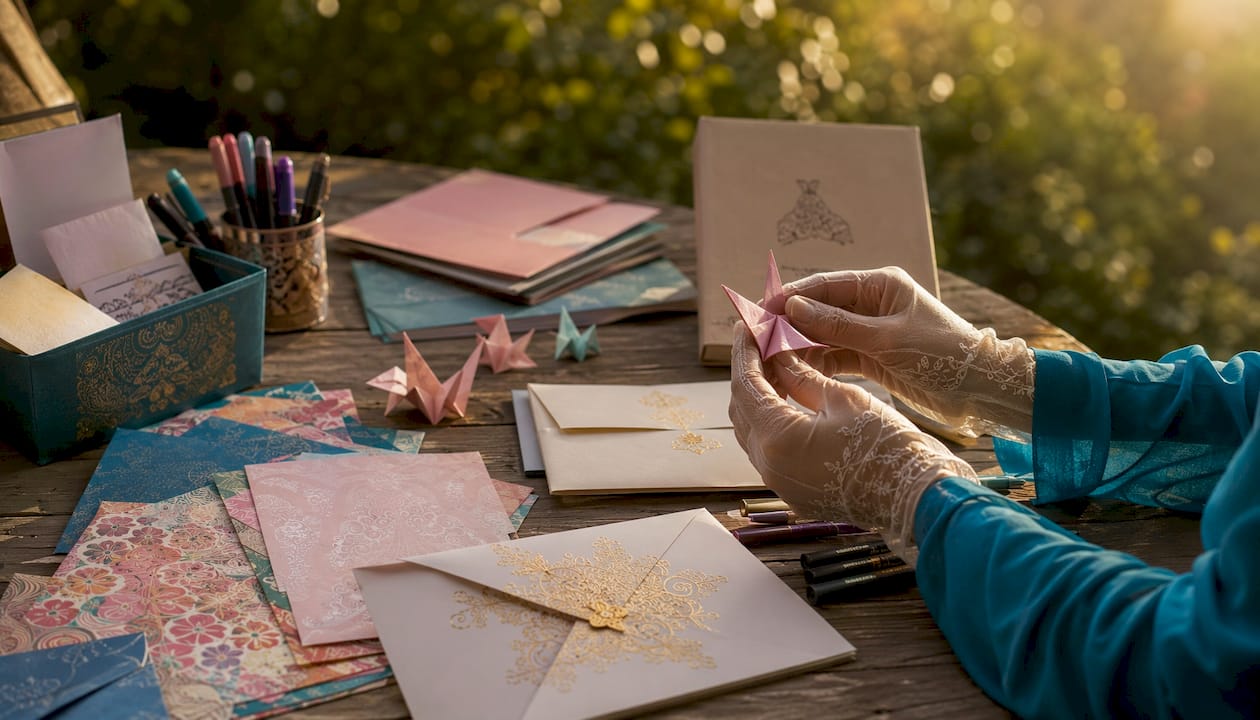
The “honor” versus “pleasure” distinction is the most widely recognized religious signal in American invitation etiquette. “Honor of your presence” traditionally indicates a house of worship; “pleasure of your company” signals a secular setting. For interfaith or multicultural ceremonies, you can use either phrase or craft something entirely your own that reflects both traditions.
Wording considerations by situation:
- Interfaith weddings: Neutral language like “invite you to join them as they are united in marriage” avoids implying a single religious tradition
- Destination weddings: Include the country and a note directing guests to the wedding website for travel details; “We are getting married in Tuscany and would love for you to join us” sets the tone warmly
- Same-sex couples: Names can be listed alphabetically, by personal preference, or in whatever order sounds best aloud; traditional bride-first conventions simply don’t apply
- Blended and non-traditional families: “Together with their families” sidesteps complicated naming decisions gracefully
- Cultural ceremonies with specific rituals: A brief line like “to be followed by a traditional reception” or “in a ceremony honoring both our heritages” gives guests helpful context
Sensitivity in phrasing:
- Avoid gendered assumptions in the host line when family structures don’t fit the traditional mold
- For multicultural families, listing both sets of parents by name (rather than using titles alone) can feel more personal and inclusive
- When a parent has passed, acknowledging them with “the late [name]” is a respectful and widely accepted practice
The goal is always clarity paired with warmth. Your guests should feel welcomed, not confused, by every line.
Common wording mistakes to avoid and etiquette guidelines
Even the most beautifully designed invitation falls flat if the wording has errors. These are the mistakes that come up most often, and they’re all easy to avoid once you know what to watch for.
Mistakes to skip:
- Abbreviating on formal invitations: Write “South Carolina,” not “SC.” Spell out “Street” and “Avenue.” Numerals and abbreviations undercut the formality you’re working to create
- Including registry information: Registry details belong on your wedding website, never on the invitation itself. Putting them on the main card reads as presumptuous, regardless of how it’s phrased
- Using “and family” in RSVP wording: Name each invited guest explicitly on the envelope. “And family” is vague and can lead to guests bringing people you didn’t intend to include
- Skipping the RSVP deadline: A response card without a date gives guests no urgency. Set a deadline three to four weeks before the wedding and state it clearly
- Overcrowding the invitation: Parking details, hotel blocks, shuttle schedules, and dress code expansions all belong on a separate enclosure card or your wedding website, not on the main invitation
- Inconsistent capitalization: Names should be capitalized the same way across every piece of the suite, from the save-the-date to the envelope
Pro Tip: Have at least two other people proofread your final wording before you send it to print. A fresh set of eyes catches the typos you’ve stopped seeing, and fixing an error on a printed invitation is expensive.
One more thing worth mentioning: the tone of your wording should match your venue, helping guests choose the perfect wedding guest maxi dress with floral print for the occasion. If your invitation uses formal, spelled-out language but your venue is a casual brewery, guests will arrive uncertain about what to expect. Let the wording and the setting tell the same story.
How personalized stationery and custom stamps elevate your invitations
The words on your invitation matter, but so does the way they’re presented. Personalized stationery with custom stamps and monograms increases the perceived quality of your invitation suite and gives guests a tangible sense of your wedding’s personality before they even arrive.
Invitationbox offers a range of options that let you carry your wedding’s aesthetic from the invitation all the way through to the thank-you notes. Monogrammed designs, thematic photo cards, and custom ink colors all work together to create a cohesive suite that feels intentional rather than assembled from separate sources.
Two popular choices for completing your suite are the Filigree Dress Pink Thank You Cards and the Tying the Knot Flirt Thank You Cards. Both pair beautifully with romantic and modern invitation styles, giving your post-wedding correspondence the same polished feel as your original invitations.
Custom self-inking stamps and Snap Stamps from Invitationbox are another way to add a personal touch. A monogram stamp on the envelope flap, or a custom return address stamp, signals care and attention to detail from the moment your invitation lands in a guest’s mailbox.
Pro Tip: Match your envelope stamp design to your invitation’s color palette and paper weight. A delicate floral stamp on a heavy cotton envelope reads as intentional and elegant; a mismatched stamp can undercut an otherwise beautiful suite.
For couples who want to choose the right wedding invitations from the start, coordinating the stationery style with the wording tone makes the whole suite feel unified.
Should you include your wedding website on the invitation?
Yes, and most couples do. A wedding website is now the standard home for all the logistical details that don’t belong on the main invitation, including hotel room blocks, shuttle schedules, parking information, registry links, and dress code guidance.
The etiquette around including the URL is straightforward. Place it on a separate enclosure card rather than on the main invitation itself. This keeps the invitation clean and elegant while still giving guests easy access to everything they need. A simple card that reads “For travel and accommodation details, please visit [yourweddingwebsite.com]” does the job perfectly.
A few guidelines worth following:
- Don’t list the website on the main invitation card. It reads as cluttered and pulls focus from the essential details.
- Keep the URL short and easy to type. Most wedding website platforms let you customize the address; choose something guests can remember without squinting at the card.
- Match the tone of your website to your invitation. If your invitation is formal and classic, a website with casual, emoji-heavy language creates a jarring shift. Consistency across all your correspondence matters.
- Include the website on your RSVP card if you’re accepting online RSVPs. Something like “RSVP at [yourweddingwebsite.com] by May 15” is clean and clear.
One practical note: if you’re using unique RSVP card designs that direct guests to respond online, make sure the website URL is printed in a legible font size. Guests who are less comfortable with technology will appreciate a phone number or email address as an alternative.
How to address envelopes to match your invitation’s wording style
The envelope is the first thing your guests see, and it sets expectations for everything inside. Addressing it correctly, and in a style that matches your invitation’s formality, completes the experience.
For formal invitations:
- Use full names and titles: “Mr. and Mrs. Robert Ellison” or “Dr. Sarah Whitfield and Mr. James Whitfield”
- Spell out street names, apartment designations, and state names in full
- Avoid abbreviations entirely, including “St.” for Street or “Ave.” for Avenue
- Use an outer and inner envelope when following traditional etiquette; the inner envelope lists only the names of those actually invited
For semi-formal and casual invitations:
- First names are acceptable: “Claire and James Ellison”
- Numerals for street addresses are fine
- State abbreviations are acceptable on casual suites
A few etiquette points that trip people up:
- Address a married couple with different last names on two lines, or use “Ms. Sarah Chen and Mr. David Ellison” on one line
- For unmarried couples living together, list both names on separate lines
- Children under 18 are listed by first name on the inner envelope only; they should not appear on the outer envelope
- “And guest” on the inner envelope signals that a plus-one is welcome; the outer envelope carries only the invited guest’s name
The wording style you chose for your invitation should guide your envelope addressing. If you spelled everything out formally inside, carry that same care to the outside. If your invitation is warm and conversational, a slightly relaxed addressing style feels natural. The whole suite should feel like it came from the same thoughtful place.
For couples looking for creative wedding invitation ideas that carry through to the envelope, coordinating the addressing style with the invitation design creates a genuinely memorable first impression.
Your wedding stationery, made personal with Invitationbox
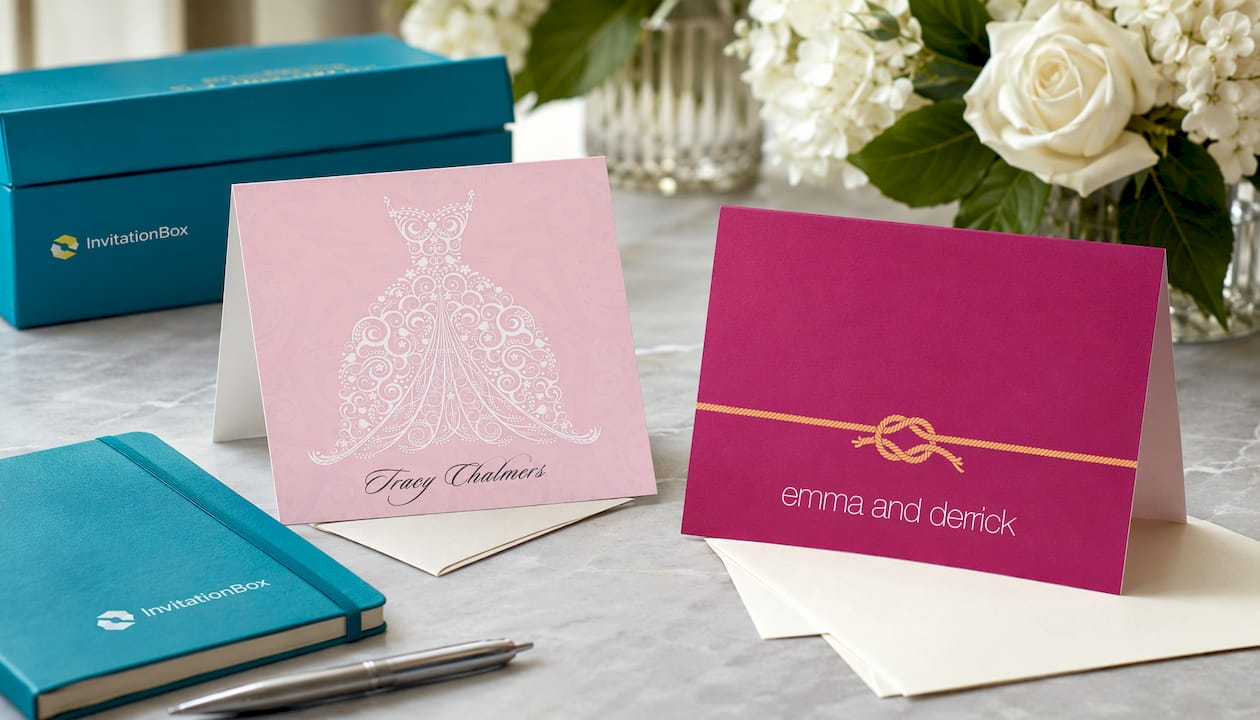
Crafting the perfect wording is only half the picture. The other half is finding stationery that brings those words to life with the warmth and style your wedding deserves. Invitationbox makes that part genuinely enjoyable. From custom monogram stamps and Snap Stamps to coordinated thank-you card sets, every product is designed to give your invitation suite a polished, personal feel from the first envelope to the last note of gratitude.
The Filigree Dress Pink Thank You Cards and Tying the Knot Flirt Thank You Cards are two of the most loved options for couples who want their post-wedding correspondence to match the elegance of their invitations. Pair either with a custom self-inking return address stamp, and your entire suite feels cohesive and intentional.
Ready to see what’s possible? Browse the full collection at Invitationbox and find the stationery that fits your wedding’s story.
Key Takeaways
Thoughtful wedding invitation wording balances clear etiquette, honest family representation, and a tone that previews the celebration your guests are about to experience.
| Point | Details |
|---|---|
| Spell out formal details | Dates, times, and state names should be written in full on formal invitations, never abbreviated or shown as numerals. |
| “Honor” vs. “pleasure” matters | Use “honor of your presence” for religious ceremonies and “pleasure of your company” for secular venues. |
| Keep the invitation focused | Registry info, parking, and hotel details belong on enclosure cards or your wedding website, not the main invitation. |
| RSVP wording needs a deadline | Always include a specific response date and method; vague RSVP requests lead to planning headaches. |
| Invitationbox completes the suite | Custom stamps, monogram designs, and coordinated thank-you cards from Invitationbox give your invitation suite a unified, personal finish. |
Recommended
- From Save-the-Dates to Engagement Party Invitations: Coordinating Your – InvitationBox.com
- Creative Ideas for Wedding Invitations That Wow Guests – InvitationBox.com
- Popular Color Trends for Wedding Invitations in 2025 – InvitationBox.com
- 5 Graduation Invitation Etiquette Tips for the Modern Graduate – InvitationBox.com