

What Size Should RSVP Cards Be for Your Wedding?
The short answer: use A1 (3.5" × 5") for a simple yes-or-no reply, step up to A2 (4.25" × 5.5") when you need room for meal choices or extra fields, choose a 4" × 6" postcard for a stampless mail-in option, and save 5" × 7" for RSVPs with a long list of details. The USPS Quick Service Guide sets 3.5" × 5" as the smallest mailable size for a response card, so anything smaller simply won’t clear the mail stream.
Here’s the quick cheat sheet:
- A1, 3.5" × 5": minimal mail-in reply, fits the smallest USPS-approved envelope
- A2, 4.25" × 5.5": more fields, better presence, still easy to mail
- 4" × 6" or 4.25" × 5.5": postcard-style, no return envelope needed
- 5" × 7": larger design or lots of RSVP options
Quick fact: the USPS minimum mailable dimension for a card is 3.5" × 5", which is exactly why A1 sits at the small end of the standard lineup instead of going smaller.
Once you’ve settled on a size, Invitationbox carries matching envelopes and coordinating stampers and embossers for each of these standard formats, which we’ll walk through later in this guide.
Key Takeaways
RSVP card size should be chosen by content needs first, mailing method second, and matched to an envelope with roughly a quarter inch of clearance in both directions.
| Point | Details |
|---|---|
| Default to A1 for simple replies | A1 (3.5"×5") fits the USPS minimum mailable size and works for yes/no responses. |
| Upgrade to A2 for more fields | A2 (4.25"×5.5") gives room for meal choices, guest counts, or a song request line. |
| Match envelopes with a quarter-inch buffer | Order envelopes about 1/4" larger than the card in both dimensions to avoid jamming. |
| Postcards cut mailing steps | 4"×6" or 4.25"×5.5" postcard RSVPs skip the return envelope and use postcard postage. |
| Sample before the full run | Invitationbox offers matching envelopes and sample ordering to test fit and paper weight before printing 150 cards. |
Table of Contents
- Standard RSVP Card Sizes and When to Choose Each
- Which Envelope Fits Which RSVP Card?
- How Do You Choose the Right RSVP Size?
- Print-Ready Specs: Bleed, Trim, and Safe Area for RSVP Cards
- Invitationbox Picks That Match These Standard Sizes
- Mailing RSVP Cards Internationally: What Changes?
- Order Your RSVP Cards and Matching Envelopes
- Frequently Asked Questions
- Sources
Standard RSVP Card Sizes and When to Choose Each
Four sizes cover almost every wedding suite you’ll see. A1, at 3.5" × 5", is the compact classic: room for a name line, a yes/no checkbox, and maybe one more short field. It’s the size most couples default to when the RSVP only needs to confirm attendance.
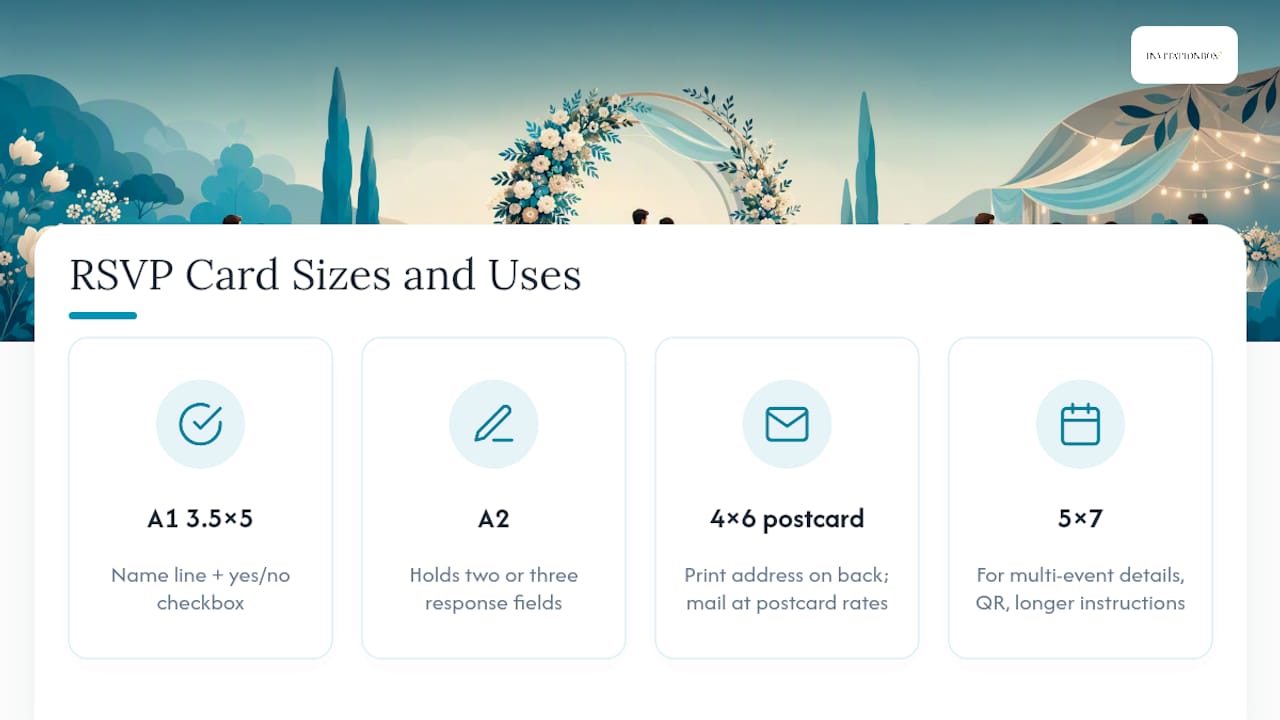
That extra room matters the moment you add meal selections, a guest count line, or a note for song requests. PrintPlace lists A2 as a standard size specifically because it balances compact mailing with enough space for two or three response fields.
4" × 6" is the postcard workhorse. Skip the return envelope entirely, print the address directly on the back, and mail it at postcard rates. Retail listings for 4×6 RSVP cards paired with A6 envelopes show just how common this combination has become for couples who still want an envelope option in reserve.
5" × 7" is the size to reach for when your reply card is doing heavy lifting: multiple event days, a QR code linking to a wedding website, and a longer instructions block. It’s rarely the default, but it earns its place when content demands it.
One design note worth remembering: your RSVP card should never outshine the main invitation. If your invitation is 5" × 7", an A1 or A2 reply card creates a natural visual hierarchy. A 5" × 7" RSVP paired with a 5" × 7" invitation can read as two competing centerpieces instead of one cohesive suite.
Which Envelope Fits Which RSVP Card?
Envelope sizing follows the A-series naming system, and matching it correctly saves you a reprint. An A1 card (3.5" × 5") pairs with an A1 envelope, which measures about 3.625" × 5.125" inches. An A2 card (4.25" × 5.5") pairs with an A2 envelope at roughly 4.375" × 5.75".
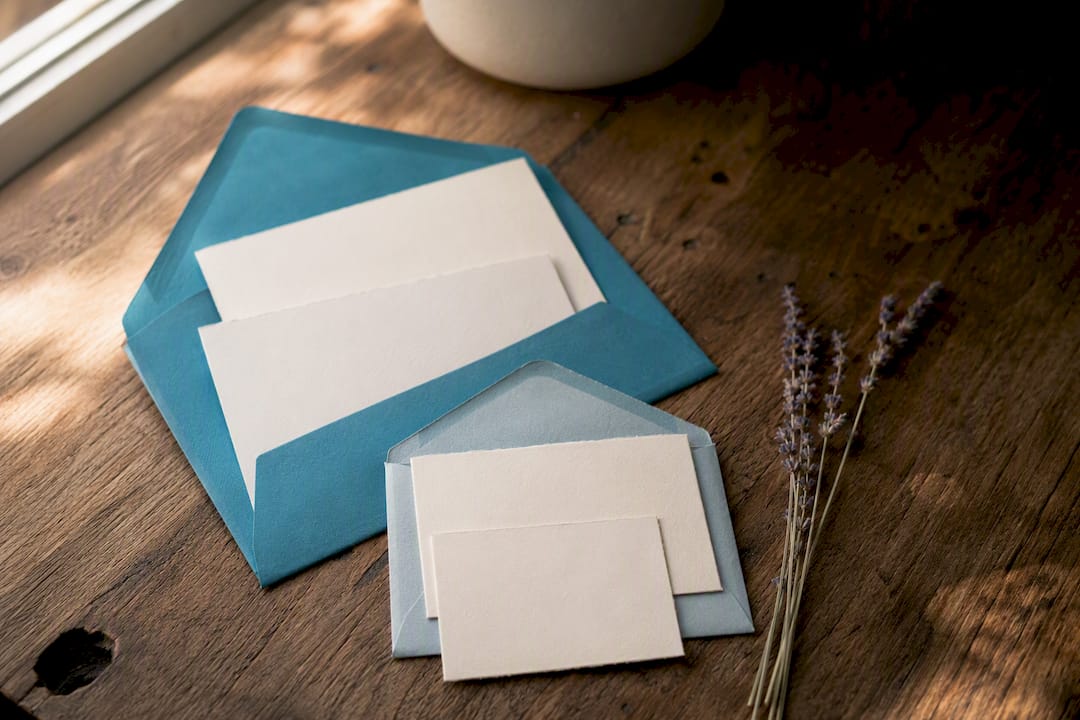
The rule of thumb that print shops swear by: order envelopes about a quarter inch larger than the card in both directions. The Knot recommends this exact clearance because anything tighter causes jamming, creased corners, or a card that’s genuinely hard to pull out. Shop by the A-series name, not raw inches. An envelope marketed as “5×7” from one vendor can run tighter than another brand’s “5×7,” but an A7 will fit a 5×7 card consistently across printers.
If you’re going the postcard route, the USPS minimum mailable card size is 3.5" × 5", and common postcard RSVP sizes land at 4" × 6" or 4.25" × 5.5". Skipping the envelope on a postcard-format RSVP typically means paying the postcard postage rate instead of the standard letter rate, which adds up when you’re mailing 150 invitations.
- A1 card → A1 envelope (3.625" × 5.125")
- A2 card → A2 envelope (4.375" × 5.75")
- 4"×6" or 4.25"×5.5" postcard → no envelope needed
Pro Tip: Order one sample card and envelope combo before your full print run. Slide the card in, check for snug movement without jamming, and weigh it on a kitchen scale if you’re unsure about postage class. A five-dollar sample order beats a reprint of 150 cards.
How Do You Choose the Right RSVP Size?
Work through content first, mailing second, and budget last. Skipping straight to “what looks nice” is how couples end up with a beautiful card that doesn’t fit their envelope stock.
- Count your required fields. Just a yes/no box? A1 works fine. Adding meal choices, a guest count, or dietary notes? Move to A2 or a 4"×6" postcard.
- Decide envelope vs. postcard. Postcards save on postage and simplify guest response, but they expose the reply to anyone handling the mail. Envelopes cost a bit more but keep responses private.
- Factor in domestic vs. international guests. International postcards may face different size and rate rules, so double check before finalizing print quantities.
- Weigh paper stock against postage class. Heavier cardstock feels more substantial but can bump your mailing into a higher rate tier.
- Order a sample before the full run. Give yourself one to two weeks between sample approval and final print to catch any sizing or fit issues.
Pro Tip: If you’re on the fence between A2 and a 4"×6" postcard, ask yourself one question: does this RSVP need to say anything guests wouldn’t want a mail carrier to see? If not, the postcard almost always wins on cost.
Print-Ready Specs: Bleed, Trim, and Safe Area for RSVP Cards
Hand your printer (or plug into an Invitationbox template) three numbers: a 0.125" bleed beyond the trim line for any background color or design element that touches the edge, a 0.125" safe area inside the trim for text and important graphics, and the exact final trim size (3.5"×5", 4.25"×5.5", or whichever you’ve chosen).
For type, keep body text between 9 and 12 points and names or headers between 10 and 14 points, depending on your font’s natural size. If guests are handwriting their names or meal choices, leave enough vertical space between lines. A cramped writing line on an A1 card looks worse than a slightly larger A2 with breathing room.
Standard reply fields to include: reply-by date, number attending, meal selections if applicable, a song request line if you want one, and a QR code or short URL if you’re routing guests to a wedding website.
Quick fact: because RSVP cards are typically the most-handled piece in a wedding suite, heavier paper stock can shift your mailing into a different postage class, so confirm weight before locking in your final print order.
Invitationbox Picks That Match These Standard Sizes
Once you know your size, finishing touches make the suite feel intentional. Invitationbox stocks stampers and embossers that coordinate with A1, A2, and postcard-format RSVPs, letting you brand envelope flaps or add a monogram touch without redesigning the card itself.
- The Corner Scrolls Square Stamper or Embosser and Classic Scroll Square Stamper or Embosser work well on envelope seals for A1 or A2 suites
- The Modern Scroll Stamper or Embosser pairs with cleaner, minimalist RSVP layouts
- Photo card formats like the Fun Holiday Confetti Photo Card and Believe Photo Card show how image crops and safe-area rules apply across standard sizes
Every product listing includes exact dimensions and sample-ordering options, so you can check fit and paper weight before committing to a full print run.
Mailing RSVP Cards Internationally: What Changes?
Sizing rules that apply domestically don’t automatically carry over once your guest list crosses a border. Postage rates, size thresholds, and even envelope conventions vary by country, and assuming U.S. postcard minimums apply everywhere is a common and costly mistake.
If you have international guests, your safest bet is to mail those specific RSVPs in a standard envelope rather than as a bare postcard. Many countries outside the U.S. either restrict postcard-format mail for certain purposes or apply different rate tiers that don’t map cleanly onto the USPS postcard and minimum mail dimensions you’d use for domestic guests. An enclosed A1 or A2 card in a properly sized envelope avoids that ambiguity entirely.
Postage cost is the other variable. International postage almost always runs higher than domestic rates, and it’s calculated by weight and destination country rather than a flat domestic tier. If you’re using heavier cardstock for your main suite, consider a slightly lighter stock for the small number of international RSVPs, or budget extra for postage on those envelopes specifically.
Practically, this means: identify your international guest addresses early, set those RSVPs aside from your main postcard run if you’re using postcards domestically, and confirm current postage rates for each destination country before your final mailing date. A quick check at your local post office a few weeks before mailing prevents a returned or delayed reply card from a guest you’re counting on to plan seating and catering numbers.
Getting the balance right
Choosing an RSVP size always comes down to the same tension: enough room for the fields you actually need, without so much card that postage and printing costs balloon. A1 covers most simple weddings well. The moment you add meal choices or a website link, A2 earns its keep. Invitationbox’s sample-ordering process exists precisely so you can test that balance before committing to 150 printed pieces.
Order Your RSVP Cards and Matching Envelopes
Once you’ve landed on a size, the fastest path forward is ordering a sample set rather than guessing your way through a full print run. Invitationbox pairs customizable RSVP templates in A1, A2, and postcard formats with envelopes sized to fit, so you’re not left hunting for a “5×7” envelope that turns out too tight.
Beyond the cards themselves, Invitationbox carries finishing touches that make a suite feel complete: the Horseshoe Stamper or Embosser, the Jolly Rogerette Stamper or Embosser, and the Extra Ornamental Stamper or Embosser all work as envelope-seal accents for RSVP suites of any size. If you’re coordinating a full stationery set, the wedding invitation wording guide can help you match your RSVP fields to your invitation language, and a wedding photography questionnaire is a useful reference if you’re deciding what guest details to collect beyond a simple headcount.
Start with one sample card, one matching envelope, and one stamper or embosser option. Check the fit, check the print quality, and only then commit to your full order.
Frequently Asked Questions
What is the standard RSVP card size for weddings? The two most common sizes are A1 (3.5" × 5") for simple replies and A2 (4.25" × 5.5") when you need room for meal choices or extra fields. Both fall within USPS minimum mail dimensions.
What size envelope do I need for a 3.5×5 RSVP card? Use an A1 envelope, which measures about 3.625" × 5.125", giving the card enough clearance to slide in without jamming.
Can I mail an RSVP card without an envelope? Yes, as long as it meets USPS postcard dimensions, typically 4" × 6" or 4.25" × 5.5". Postcard mailing uses postcard postage rates instead of standard letter rates.
Should my RSVP card match the size of my main invitation? No, it should complement it. A 5" × 7" invitation paired with an A1 or A2 reply card creates visual hierarchy instead of two competing focal points in the same suite.
How much bigger should the envelope be than the RSVP card? About a quarter inch larger in both height and width, per guidance from The Knot. This clearance prevents creased corners and difficult insertion.
Sources
- USPS Quick Service Guide (mailing standards)
- The standard invitation size guide: formats, uses, and other tips | PrintPlace
- Wedding response RSVP envelopes | LCI Paper
- Wedding invitation tips | The Knot
Recommended
- 5 Unique Wedding RSVP Card Designs That Guests Love – InvitationBox.com
- How Do I Choose the Right Wedding Invitations for My Big Day? – InvitationBox.com
- From Save-the-Dates to Engagement Party Invitations: Coordinating Your – InvitationBox.com
- How Early Should Engagement Party Invitations Be Sent? – InvitationBox.com