

Save the Dates vs Invitations: Your Complete Wedding Guide
A save-the-date is a friendly heads-up that asks guests to hold your wedding day on their calendars. A wedding invitation is the formal request that delivers the full details and asks for an RSVP. The standard timing rule is simple: send save-the-dates 6–12 months before the wedding and invitations 6–8 weeks out.
The one rule that matters most: Send a save-the-date only to people you are certain will receive an invitation. Once it lands in someone’s mailbox, you have made a commitment.
Here is when each piece makes sense at a glance:
- Send save-the-dates when your wedding is more than 6 months away, guests need to travel, or the date falls on a holiday weekend.
- Send invitations 6–8 weeks before the wedding for local events, or 8–12 weeks for destination celebrations.
- Skip save-the-dates when your engagement is under 6 months or your guest list is small and local. Send invitations earlier instead.
Key Takeaways
Save-the-dates and invitations serve two distinct purposes, and the timing of each determines whether your guests can actually attend.
| Point | Details |
|---|---|
| Save-the-date vs. invitation | A save-the-date is an early heads-up; an invitation is the formal request with full details and an RSVP. |
| Standard timing windows | Send save-the-dates 6–12 months out; mail invitations 6–8 weeks before the wedding. |
| When to skip save-the-dates | Skip them if your engagement is under 6 months or your guest list is small and entirely local. |
| RSVP deadline rule | Set your RSVP deadline 3–4 weeks before the wedding to allow time for vendor counts and follow-ups. |
| Invitationbox for production | Custom stampers and embossers from Invitationbox speed addressing and add a polished finish to every piece. |
Table of Contents
- What is the difference between save the dates and invitations?
- What should you put on a save-the-date?
- What belongs on a wedding invitation?
- When should you send save-the-dates and invitations?
- Who should receive save-the-dates versus invitations?
- Digital vs. printed: which format is right for you?
- Do you need both? A quick checklist for deciding
- Should your save-the-dates match your invitations?
- Common mistakes couples make with save-the-dates and invitations
- How much do save-the-dates and invitations cost?
- Practical stationery and mailing tips from Invitationbox
- The planning mindset that actually makes this easier
- Invitationbox makes save-the-dates and invitations easier
- Sources
What is the difference between save the dates and invitations?
| Feature | Save-the-Date | Wedding Invitation |
|---|---|---|
| Purpose | Early heads-up to hold the date | Formal request with full event details |
| Timing | 6–12 months before the wedding | 6–8 weeks before (8–12 weeks for destination) |
| RSVP required | No | Yes |
| Typical contents | Names, date, city, wedding website | Venue, time, dress code, RSVP card, enclosures |
| Who receives it | Everyone on the invitation list | Everyone on the invitation list |
| Format options | Card, magnet, postcard, digital | Printed suite, digital, or hybrid |
The single most useful decision rule: if your guests need to book flights, hotels, or time off work, a save-the-date is worthwhile. If everyone lives within driving distance and your engagement is short, skip it and send invitations a little earlier than usual.
What should you put on a save-the-date?
Keep it simple. Wedding industry pros consistently advise that save-the-dates work best when they carry only the essentials, leaving the formal invitation to deliver the full picture.
Core information every save-the-date needs:
- Both names (or the couple’s names as you want them to appear on all stationery)
- The wedding date
- City and state or general location
- A line noting that a formal invitation will follow
- Your wedding website URL (optional but helpful for travel and accommodation info)
Format choices and when each works:
- Flat card: The most versatile option; works for formal and casual weddings alike.
- Magnet: Guests keep it on the fridge, which means fewer forgotten dates. Expect slightly higher postage for weight.
- Postcard: Budget-friendly and easy to mail, though less formal.
- Digital: Ideal for casual weddings, tight timelines, or when most guests are spread across the country.
Sample save-the-date wording ideas
Formal: Mr. and Mrs. James Hartley joyfully announce the upcoming marriage of their daughter, Claire, to William Ashford. Please save the date: September 13, 2026, in Charleston, South Carolina. Formal invitation to follow.
Casual: We’re getting married! Claire & Will, September 13, 2026, Charleston, SC. Details coming soon at claireandwill.com.
Destination: Pack your bags! Claire & Will are tying the knot in Tuscany, Italy, on June 7, 2026. Save the date and watch your inbox for travel details.
Digital: Save the date: Claire & Will, September 13, 2026, Charleston, SC. Full details at claireandwill.com. Formal invitation to follow.
Pro Tip: Keep your save-the-date wording intentionally brief. If your venue or ceremony time changes before invitations go out, a vague save-the-date protects you from having to send corrections.
What belongs on a wedding invitation?
Your invitation suite is where every detail gets locked in. Guests use it to confirm the time, find the venue, and respond with their attendance. For guidance on wedding invitation wording and etiquette, the choices are broader than most couples expect.
Invitation essentials:
- Host line (optional)
- Both names, written as they will appear formally
- Date and ceremony time
- Venue name and address, including city and state
- RSVP deadline and method (card, website, or both)
- Dress code, if applicable
Common enclosures to consider:
- RSVP card with return envelope: Still the gold standard for response tracking.
- Details card: Covers accommodations, transportation, and shuttle information.
- Directions insert: Helpful for venues with tricky access or limited GPS accuracy.
- Registry information: Link guests to your wedding website rather than printing registry details directly on the invitation.
Sample invitation wording
Formal: Together with their families, Claire Elizabeth Hartley and William James Ashford request the honor of your presence at their marriage on Saturday, the thirteenth of September, two thousand twenty-six, at six o’clock in the evening. The Cathedral of St. Luke, Charleston, South Carolina.
Semi-formal: Claire Hartley and Will Ashford invite you to celebrate their wedding on Saturday, September 13, 2026, at 6:00 PM. The Cathedral of St. Luke, Charleston, SC. Kindly reply by August 15.
Casual: Hey, you’re invited! Claire & Will are getting married September 13, 2026, at 6 PM. The Cathedral of St. Luke, Charleston, SC. RSVP by August 15 at claireandwill.com.
Set your RSVP deadline 3–4 weeks before the wedding. That window gives you enough time to chase nonresponders, finalize headcounts with your caterer, and complete seating arrangements without a last-minute scramble.
Pro Tip: Set your RSVP deadline 3–4 weeks before the wedding date, not 1–2 weeks. Caterers and venues typically need final counts 10–14 days out, and you will need buffer time to follow up with guests who have not responded.
When should you send save-the-dates and invitations?
Timing is where most couples either get it right or create unnecessary stress. The right window depends on your situation.
Standard weddings
- Send save-the-dates 6–8 months before the wedding date.
- Mail invitations 6–8 weeks before the ceremony.
- Set the RSVP deadline 3–4 weeks before the wedding.
Destination or holiday weekend weddings
For destination events, send save-the-dates 9–12 months ahead and invitations 8–12 weeks before. Guests booking international flights or peak-season hotels need that runway to find reasonable rates and request time off work.
Short engagements (under 6 months)
- Skip save-the-dates entirely.
- Send invitations as soon as your venue, date, and time are confirmed, ideally 10–12 weeks before the wedding.
- Notify your wedding party and immediate family by phone or text right away so they can hold the date while stationery is in production.
Production lead time checklist:
- Design and proof approval: 1–2 weeks
- Printing: 1–2 weeks
- Addressing and assembly: 3–7 days
- Mailing buffer (domestic): 5–7 business days
- International mailing buffer: 2–4 weeks additional
Build these windows into your calendar before you set your send date, not after.
Who should receive save-the-dates versus invitations?
The etiquette here is clear: a save-the-date confirms a guest is on the invitation list. Sending one is a promise. Do not send a save-the-date to anyone you are not fully committed to inviting.
Household rules:
- Send one save-the-date per household for couples or families living together.
- Send separate save-the-dates to adult children living at the same address if they are individually invited.
- Roommates who are both invited each get their own, addressed to them by name.
Plus-ones and partners:
- If a guest’s partner will be invited, include that partner’s name on the save-the-date. “And Guest” is acceptable when you do not yet know the partner’s name, but confirm it before invitations go out.
- Do not add a plus-one to the save-the-date if you are still undecided. It is much harder to remove a plus-one after a save-the-date than to add one later.
Edge case checklist:
- Work colleagues you are on the fence about: Wait until invitations. Do not send a save-the-date to someone whose invitation is uncertain.
- Long-distance acquaintances: Send a save-the-date only if you are confident they are on the final list.
- Vendors: No save-the-date needed. Vendors receive contracts, not stationery.
Digital vs. printed: which format is right for you?
Both formats have a real place in modern wedding planning. The choice comes down to formality, budget, and your guest mix.
Printed save-the-dates and invitations:
- Carry a keepsake quality that digital cannot replicate.
- Signal formality and set the tone for the celebration.
- Require more lead time and budget for design, printing, and postage.
Digital save-the-dates and invitations:
- Deliver instantly, which helps when timelines are tight.
- Cost significantly less per piece.
- Work well for casual or intimate weddings and for guests who are geographically scattered.
- Carry a small risk of landing in spam folders or being overlooked.
Hybrid strategies that work well:
- Digital save-the-dates paired with printed invitations: a smart budget move that keeps formality where it counts.
- Printed save-the-dates with a digital RSVP link: combines the keepsake feel with easy response tracking.
Tracking responses:
- Use your wedding website’s RSVP tool to monitor responses in real time.
- For printed RSVP cards, number the backs lightly in pencil so you can match responses to your guest list if a card arrives unsigned.
- Follow up with nonresponders by phone or text, not email, one week after the RSVP deadline.
Pro Tip: Match formality across formats. If your save-the-date is a beautifully printed card, your invitation should feel equally polished. A mismatch in quality sends a confusing signal about the tone of your celebration.
Do you need both? A quick checklist for deciding
Not every couple needs save-the-dates. Answer these four questions honestly.
- Is your wedding more than 6 months away? If yes, save-the-dates help guests plan.
- Do any guests need to book travel or accommodations? If yes, send save-the-dates, especially for destination or holiday weekend weddings.
- Is your guest list finalized or close to it? If your list is still shifting significantly, wait until it stabilizes before sending anything.
- Is stationery budget a concern? Digital save-the-dates solve the cost problem without skipping the heads-up entirely.
Clear rules:
- Send save-the-dates if your wedding is more than 6 months away and travel is involved.
- Skip them if your engagement is under 6 months or your guest list is small and entirely local.
If you skip save-the-dates:
- Call or text your wedding party and immediate family the moment your date is set.
- Post a brief digital announcement to your wedding website or social channels for wider notification.
- Send invitations as early as 10–12 weeks before the wedding to compensate.
Should your save-the-dates match your invitations?
Think of them as sisters, not twins. Your save-the-date and invitation should feel like they belong to the same celebration without being identical. For ideas on coordinating your stationery across every piece, a shared design thread makes the whole suite feel intentional.
When to match closely:
- Formal or black-tie weddings, where consistency signals elegance.
- When you want the stationery to serve as a keepsake set.
- When your venue or theme is so distinctive that it anchors every design choice.
When creative variation makes sense:
- Budget weddings where the save-the-date is a simple postcard and the invitation is a full suite.
- When you want the invitation to feel like a reveal, building anticipation after a simpler save-the-date.
Subtle tie-ins that create cohesion without duplication:
- A shared color palette (even if the shades shift slightly between pieces)
- The same typeface or font family
- A repeated motif, such as a floral element, monogram, or venue illustration
Pro Tip: Use your save-the-date to preview the vibe of your wedding without giving everything away. If your invitation features a stunning custom illustration, keep the save-the-date simpler so the invitation feels like a genuine moment of delight when it arrives.
Common mistakes couples make with save-the-dates and invitations
Most stationery regrets come from the same handful of errors. Here is how to avoid them.
Timing mistakes:
- Sending save-the-dates too late, leaving guests without enough time to book travel.
- Mailing invitations with RSVP deadlines only 1–2 weeks before the wedding, which creates chaos for vendors.
- Sending invitations so early that guests lose them or forget to respond.
Guest list mistakes:
- Sending a save-the-date to someone who later gets cut from the list. Once it is sent, the invitation is expected.
- Forgetting to include a plus-one’s name when the decision has already been made.
Addressing errors:
- Misspelling names, which is both embarrassing and costly to correct.
- Using outdated addresses without verifying current ones first.
- Forgetting to include apartment numbers or suite designations.
Logistics mistakes:
- Not accounting for postage weight. Magnets, heavy card stock, and square envelopes all cost more to mail and may require hand-canceling at the post office.
- Skipping international mail timing. Mail to Europe or Asia can take 2–4 weeks, so factor that into your send date.
Pro Tip: Collect and clean your mailing addresses early, ideally at the save-the-date stage. Build a master spreadsheet with full names, addresses, and a confirmation column. Collecting addresses early prevents costly reprints and addressing errors when invitations go out.
How much do save-the-dates and invitations cost?
Stationery costs vary widely based on format, quantity, and finish. Here is a realistic picture to help you budget.
Printed save-the-dates typically run $1–$3 per piece, while full invitation suites (including RSVP cards and envelopes) land closer to $4–$10 or more per suite. Add postage, and the numbers climb quickly for larger guest lists.
Where to save:
- Digital save-the-dates eliminate per-piece printing and postage costs entirely.
- Postcard-format save-the-dates cost less to print and carry lower postage than standard envelopes.
- Limiting enclosures (directing guests to your wedding website instead of printing a details card) trims both printing and postage costs.
Where to invest:
- Printed invitations with quality card stock and a thoughtful finish make a lasting impression.
- Special finishes like letterpress, foil, or embossing add perceived value and keepsake appeal.
- A full suite with a printed RSVP card and return envelope tends to generate faster, more complete responses than a digital-only RSVP.
International postage and assembly:
- International mail adds $1.50–$2.00 or more per piece depending on destination and weight.
- Heavy or nonstandard pieces (magnets, square envelopes, wax-sealed suites) may require hand-canceling at the post office to prevent damage.
Practical stationery and mailing tips from Invitationbox
Getting stationery from design to doorstep takes more time than most couples expect. Build your production timeline backward from your mail date, not forward from when you start designing.
Recommended production lead times:
- Allow 1–2 weeks for design revisions and final proof approval.
- Budget 1–2 weeks for printing after the proof is signed off.
- Set aside 3–7 days for addressing, assembly, and stuffing envelopes.
- Add a 5–7 business day domestic mailing buffer, and 2–4 additional weeks for international guests.
Proofing checklist before you approve any print run:
- Both names spelled correctly, exactly as they should appear
- Date, day of the week, and year confirmed
- Ceremony time and time zone (especially for destination weddings)
- Full venue name and street address
- RSVP deadline and response method (card, website, or both)
- Wedding website URL tested and live
Stampers and embossers for a polished finish:
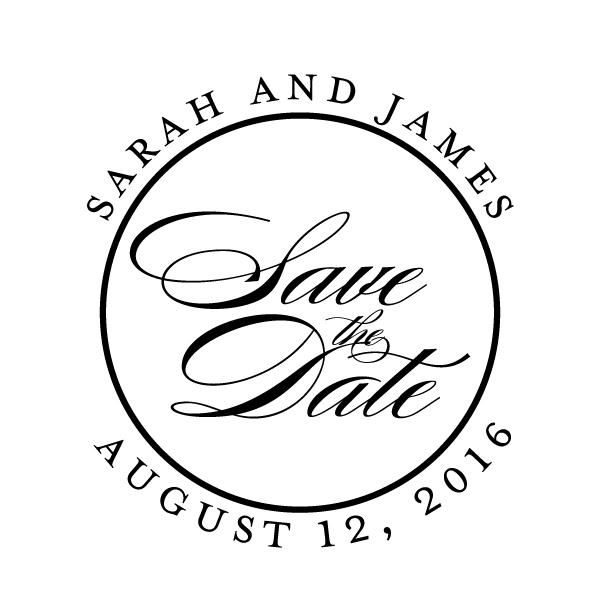
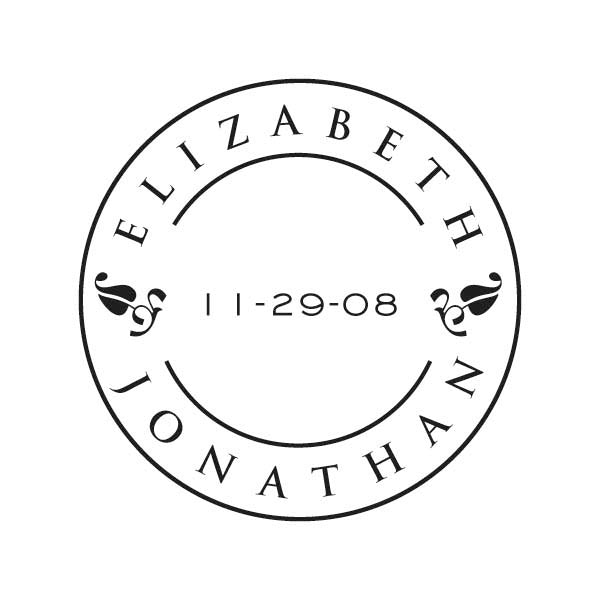
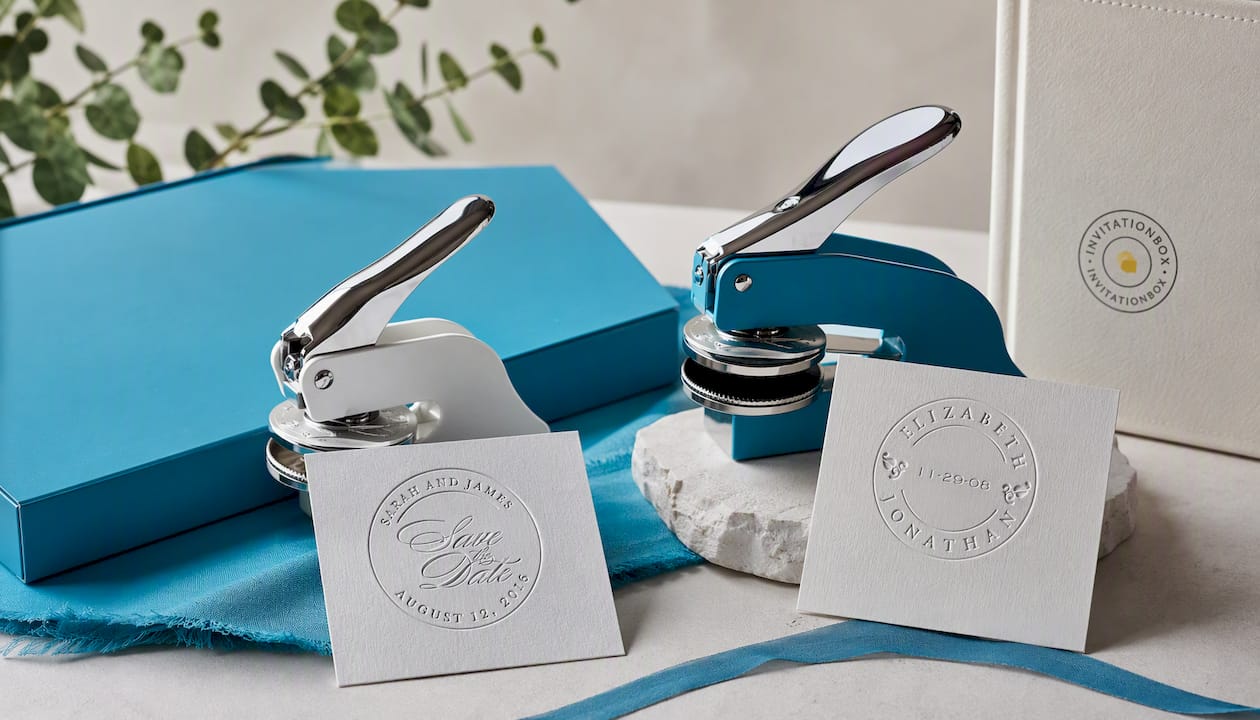
Two tools that genuinely speed up the addressing process are a Save the Date Wedding Stamper or Embosser and a Save the Date Circle Stamper or Embosser. A custom stamper handles return addresses in seconds rather than minutes, and an embosser adds a raised, elegant impression to envelope flaps or the back of save-the-date cards. Both tools are especially useful when you are addressing 100 or more pieces by hand. For more on how custom stampers elevate stationery, the options range from simple address stamps to full monogram designs.
Mailing tips:
- Pre-weigh a fully assembled envelope at the post office before your full mailing run. Magnets and heavy card stock often exceed standard letter weight.
- For delicate or nonstandard pieces, ask for hand-canceling. Machine rollers can damage wax seals, ribbon closures, and thick card stock.
- For international guests, mail to Europe or Asia can take 2–4 weeks, so factor that into your send date.
Pro Tip: Order 5–10 extra save-the-dates and 10–20 extra invitations beyond your confirmed count. Last-minute additions, keepsakes for parents, and photographer flat-lays all eat into your supply faster than you expect.
The planning mindset that actually makes this easier
Most couples spend more energy worrying about stationery perfection than the decisions that actually affect their guests. The real priority is simple: give people enough time to show up. Everything else, the paper weight, the wax seal, the exact wording, is secondary to that.
There is no universal right answer on format, budget, or design. A magnet save-the-date and a beautifully printed invitation suite can coexist. A digital save-the-date followed by a formal printed invitation is a perfectly reasonable hybrid. What matters is that your guests know when and where to be, and that they have enough time to get there.
If you are looking for product-focused help, Invitationbox carries a full range of stampers, embossers, and stationery accessories that make the production side of this process much smoother.
Invitationbox makes save-the-dates and invitations easier
Addressing 150 envelopes by hand is where most couples hit a wall. Invitationbox offers a practical shortcut: a custom wedding date stamper that handles return addresses in seconds, and a circle save-the-date embosser that adds a raised, professional impression to envelope flaps and card backs. Both tools cut addressing time significantly and give your stationery a polished, cohesive look from the first piece to the last.
Beyond stampers and embossers, Invitationbox carries custom save-the-date cards, full invitation suites, and a range of stationery accessories designed for weddings of every size and style. Browse the full collection and order samples to see the quality before you commit to a full print run at Invitationbox.
Sources
- Save the Date Wedding Stamper or Embosser
- Do You Really Need to Send Save-the-Dates?
- When to Send Save-the-Dates vs. Invitations: Complete Timeline | Plan A Wedding
- Save the Date vs Wedding Invitation
Recommended
- From Save-the-Dates to Engagement Party Invitations: Coordinating Your – InvitationBox.com
- Crafting the Perfect Engagement Party Invitations: A Step-by-Step Guid – InvitationBox.com
- How Do I Choose the Right Wedding Invitations for My Big Day? – InvitationBox.com
- A Guide to Personalizing Your Perfect Wedding Invitations – InvitationBox.com