

InvitationBox's 19 Years of Thank You Note Ideas for Small Businesses
This article gives you categorized, ready-to-copy thank-you note templates for every stage of the customer relationship, from the first purchase to the tenth referral. You will find short, editable scripts for email, packaging inserts, handwritten cards, and social media, plus the timing rules that make them land. Research on gratitude backs up what InvitationBox has seen across 19 years of helping small businesses stamp, sign, and mail their own notes: a specific, well-timed thank you does more for retention than another discount code ever will.
TL;DR:
- Sending a thank-you within 24 to 72 hours of purchase significantly increases customer retention, especially via email with a specific message.
- Packaging inserts should be brief, fitting on a 2x3 inch card, and often include a personal touch or small discount code to boost shareability.
- Repeat customers respond better to personalized notes that acknowledge their loyalty and milestone moments, often outperforming digital messages for high-value clients.
- Service-related thank-yous should reference specific outcomes or projects, with a focus on gratitude and openness for further questions or reviews.
- Consistency and personalization, achieved through simple templates and easy-to-use tools like stamps, are more effective than overly clever or infrequent notes.
Table of Contents
- Post-Purchase and New Customer Thank-You Templates
- Packaging Inserts and Handwritten Card Examples
- Repeat-Customer and Loyalty Thank-You Examples
- After Service, Consultation, or Project Completion Templates
- Referral, Testimonial, and Review Thank-You Examples
- Social Media Replies, DMs, and SMS Micro-Messages
- Best Practices: Tone, Length, Personalization, and Common Mistakes
- Scaling Personalization: Automation Triggers and Simple CRM Workflows
- Research Backing and InvitationBox’s Approach to Thank-You Notes
- Cultural Considerations and Etiquette for Diverse Customer Bases
- What We’ve Learned Sending Thousands of These Notes
- Pick a Card and a Stamp That Make Every Note Effortless
- Sources
- FAQ
Post-Purchase and New Customer Thank-You Templates
The first thank-you note a customer receives sets the tone for everything after it. Send it too late and it feels like an afterthought. Send it fast and specifically, and you have started a relationship instead of just closing a sale.
For email, timing matters more than length. A confirmation-style thank you should go out within 24 to 72 hours of purchase, while the buying decision is still fresh:
- “Thanks for your order, [Name]! We’re already getting [Product] ready to ship, and we’ll send tracking as soon as it’s out the door.”
- “You just made our day. Your order supports a small team that genuinely cares about [what you make]. We can’t wait for it to arrive.”
- “Welcome to [Business Name]! First orders are our favorite. If anything about your [Product] isn’t right, just reply to this email.”
Packaging inserts work best as short, warm one-liners rather than paragraphs. A few that fit on a standard insert card:
- “Made with care, packed with thanks.”
- “You picked us. We packed this one ourselves.”
- “First order? First of many, we hope.”
- “Thank you for shopping small. It means more than you know.”
A handwritten card adds weight an email cannot match: “Hi [Name], thank you for trying [Business Name] for the first time. Orders like yours are what let us keep doing what we love. We hope [Product] becomes a favorite. Warmly, [Your Name].”
Match the channel to the moment: email for speed, an insert for every physical shipment, and a handwritten card for orders that deserve a little more effort.
Packaging Inserts and Handwritten Card Examples
A packaging insert has one job: fit a small space and still feel human. Size your message for a 2 by 3 inch card and keep handwritten notes to one to three sentences, following the short structure that works reliably for business thank-you notes: a greeting, the thanks itself, one specific detail, and a sign-off.
Insert lines that work at that size:
- “Thank you for choosing [Business Name]. We hope this brightens your day.”
- “Handled with care by our small team. Thank you for your support.”
- “Enjoy a small discount on your next order with code THANKS10.”
- “Tag us @[handle], we love seeing our products in your hands.”
A handwritten line for the same package might read: “Hi [Name], thank you for supporting our small business. We loved putting this order together for you. Enjoy!”
Physical extras matter too. Include return or contact information somewhere on the card, and consider a small discount code or a sticker tucked in alongside it. A small, unexpected freebie increases both shareability and brand recall, which is a low-cost way to turn one order into a social media mention. For more insert ideas sized to different box types, packaging insert examples are worth building into your standard fulfillment kit.

Pro Tip: Stamp your logo or signature on every card instead of printing it. A self-inking stamp takes two seconds per card and makes a batch of 50 notes look individually finished rather than mass-produced.
Repeat-Customer and Loyalty Thank-You Examples
Repeat customers deserve a different tone than first-time buyers. They already know your brand, so the note should acknowledge history, not reintroduce your business.
For milestone recognition, specificity beats enthusiasm:
- “This is your 5th order with us; thank you for being one of our favorite regulars.”
- “One year ago today, you placed your first order. We’re so glad you stuck around.”
- “We appreciate your ongoing support and referrals; thank you for standing with us.”
When you want to offer a reward, frame it as gratitude first and incentive second: “As a thank you for your continued support, we’re giving you early access to our new [Collection] before it goes public,” lands very differently than “Here’s a discount, come back and spend more.”
Channel choice should scale with customer value. A quick email covers most repeat purchases, but for higher-value or long-tenure customers, a mailed card carries more weight than an inbox message ever will. Mailed and handwritten notes tend to outperform digital-only approaches for high-value moments, which makes them worth the extra few minutes for your best customers.
After Service, Consultation, or Project Completion Templates
Service businesses have an advantage email-only retailers don’t: a specific outcome to reference. Use it. Generic thanks after a project reads as an afterthought; a note tied to the actual work reads as attention.
Try structures like:
- “Thank you for trusting us with [Project/Service]. It was great to help you [specific outcome, e.g., ‘launch your new office space’].”
- “It was a pleasure working on your [consultation topic]. If questions come up as you move forward, just reach out.”
- “Thank you for your business this month. We hope [Service] delivers exactly what you needed.”
If you want a testimonial or review, ask after the thanks, not instead of it: “If you have a minute, a quick review would mean a lot to us, but no pressure either way, we’re just glad we could help.”
Close with a sign-off that keeps the door open: your name, direct contact information, and a line inviting follow-up questions. That combination signals gratitude without hunting for another sale in the same breath.
Referral, Testimonial, and Review Thank-You Examples
A customer who refers a friend or leaves a review is doing your marketing for free. The thank you should reflect that, not treat it as a transaction to process.
Direct wording that keeps gratitude first:
- “Thank you for sending [Friend’s Name] our way. Referrals from customers like you mean everything to a small business.”
- “We saw your review and just wanted to say thank you. It genuinely made our day.”
- “Your testimonial is going right on our website. Thank you for taking the time to share it.”
If a reward is attached to the referral or review, name it clearly and deliver it fast: “As promised, here’s your $10 credit for referring a friend, it should already be applied to your account.” Vague promises (“we’ll get you something soon”) undercut the gratitude more than they help. Say the reward, confirm it’s done, and let the thanks stand on its own rather than burying it under fine print.
Social Media Replies, DMs, and SMS Micro-Messages
Public replies and direct messages need to be short enough to read in a glance and specific enough to not feel copy-pasted.
Public comment replies:
- “This made our whole team smile, thank you!”
- “We’re so glad it worked out. Thanks for sharing!”
DM-length thanks:
- “Hey! Just saw your post and wanted to say thank you, it really means a lot to us.”
- “Thanks for the shoutout! Let us know if you ever need anything.”
SMS works best for short, functional gratitude tied to an update, since SMS performs well for timely, brief customer messages rather than long-form appreciation: “Thanks for your order! It’s on the way, track it here: [link].”
If a social exchange turns into a longer conversation, a complaint, or a detailed compliment, move it to email or a handwritten note. Public threads and DMs are not the place for a five-sentence story about how much a customer’s support means to you.
Best Practices: Tone, Length, Personalization, and Common Mistakes
Every channel has a natural length, and ignoring it is one of the fastest ways to make a thank-you note feel off. Following a structure similar to what works across thank-you messages and templates, here’s a practical rule of thumb by channel:
- Email: 2 to 4 sentences. Enough room for warmth and one specific detail, not enough to ramble.
- Handwritten card: 3 to 4 sentences. Long enough to feel personal, short enough to write by hand at volume.
- DM or social reply: 1 to 2 sentences. Fast, casual, and immediate.
- SMS: One sentence, ideally with a link if it references an order or update.
Personalization does not require rewriting every note from scratch. One specific line, referencing an item, a date, or a detail from the order, does most of the work: “We noticed you picked the sage green option again, it’s one of our favorites too.”
The most common mistakes are easy to avoid once you know to look for them: sending a note so generic it could apply to any customer, attaching a hard sell to what should be pure gratitude, and letting too much time pass between the moment and the message.
Pro Tip: Keep a running list of five one-line personalization details, a repeat item, a referral source, a review quote, so your team can slot one in without starting from a blank page every time.
Scaling Personalization: Automation Triggers and Simple CRM Workflows
Personalizing every note by hand does not scale past a handful of orders a day, but full automation strips out the warmth that makes a thank you worth sending. The answer is splitting the work: automate the trigger, personalize the line.
Good CRM triggers to build around include first order, repeat order, referral completed, and review submitted. A workflow can automatically send a short thank-you email the moment one of those events fires, while flagging your highest-value customers, VIPs, milestone orders, referrals, for a handwritten card instead. That queue-and-review approach routes automated emails and manual card queues separately, so nothing slips through and nothing feels robotic.
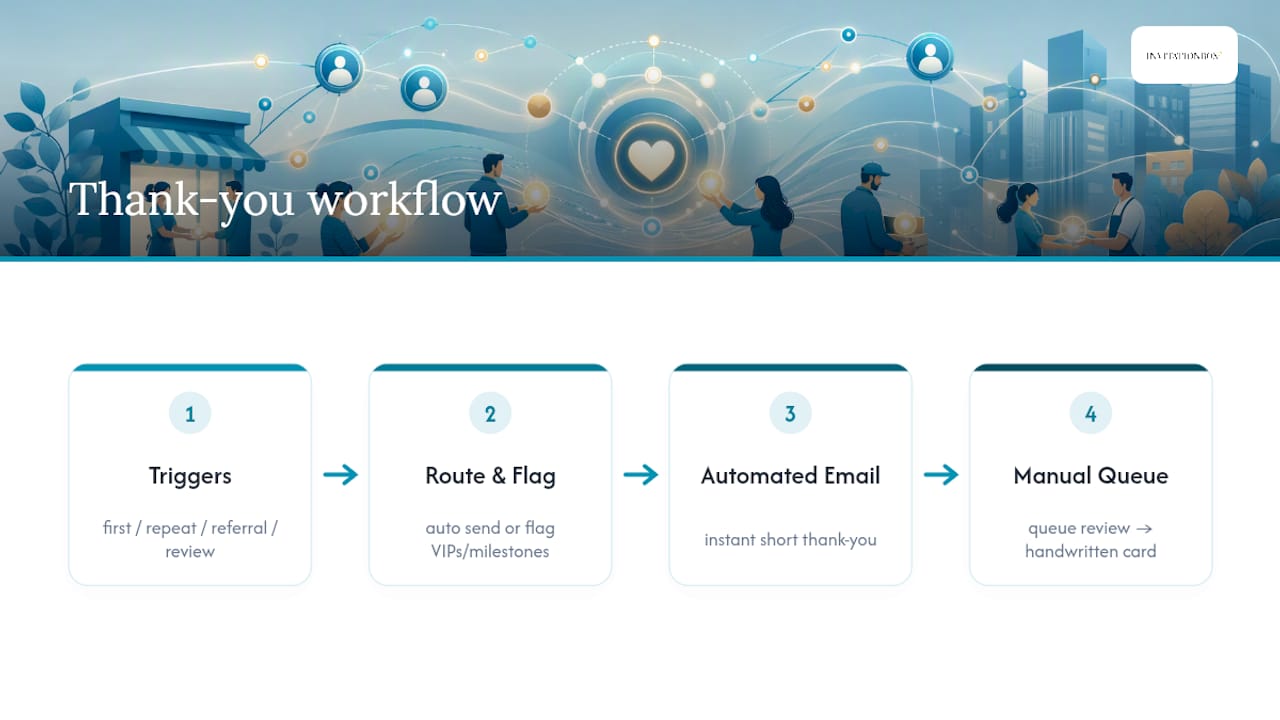
The one-line personalization itself can run on simple tokens (customer name, product ordered, order count) with a manual override field for anything that needs a human touch. Track three metrics to know if it’s working: email open rate on thank-you sends, repeat purchase rate among customers who received a note, and redemption rate on any coupon code included. If redemptions are near zero, the code is probably being ignored, not the gratitude.
Research Backing and InvitationBox’s Approach to Thank-You Notes
The case for thank-you notes isn’t just anecdotal. Psychological research on gratitude has found that expressing thanks improves well-being and strengthens social bonds, which is exactly the mechanism a small business is trying to trigger with every note it sends.
A specific, well-timed thank you does more to build a relationship than a generic one ever will, because gratitude itself encourages reciprocity and future engagement, a pattern related to what psychologists call the Ben Franklin effect.
Many small businesses have spent years helping put that research into practice, one stamped card at a time. Some fulfillment teams have turned a single self-inking stamp into a daily habit: stamp, sign, done, at a pace that keeps many orders moving without losing the personal touch. A stamp and signature station next to a packing area can remove the biggest barrier to consistency, the time it takes to write out a return address or a signature by hand, every single day.
Cultural Considerations and Etiquette for Diverse Customer Bases
Gratitude language does not translate the same way across every customer base, and a small business serving a broad audience needs to write with that in mind. Some cultures favor understated, formal thank-you language, while others expect warmth and enthusiasm even in a brief note. When you’re unsure, lean toward simple, sincere phrasing over anything that leans heavily on American idioms or slang, since idiom-heavy lines are the first thing to feel out of place in translation or across generations.
Names and titles deserve attention too. Some customers prefer a first name, others expect a formal title and last name, particularly in B2B relationships or in communities where formality signals respect. When you have that information, use it; when you don’t, a neutral “Hi [Full Name]” avoids the risk of guessing wrong.
Religious and seasonal references are worth double-checking before they go into a template. A note that says “Happy Holidays” ages better across a diverse list than one built around a specific holiday, unless you know your customer celebrates it.
Finally, watch your humor and casualness settings. A joke that lands well with one segment of your customers can read as flippant to another, especially in service or B2B thank-you notes where the reader may expect a more professional register. When in doubt, sincerity travels further than cleverness.
What We’ve Learned Sending Thousands of These Notes
Across nearly two decades of helping small businesses stamp and send their own cards, the biggest lesson has been consistency over cleverness. The best-performing notes are not the most creative ones, they’re the ones that go out reliably, every time, without becoming a bottleneck for a small team. Businesses that build a simple stamp-and-sign station near their packing area tend to stick with the habit far longer than those relying on one person to handwrite every note from scratch.
If you take nothing else from this article, try one template on your next 20 orders. Track how customers respond, then adjust the wording before rolling it out further.
— Jon
Pick a Card and a Stamp That Make Every Note Effortless
The fastest way to put these templates into practice is to stop starting from a blank card every time. Some sellers carry pre-designed thank-you cards built for this kind of daily use, paired with a self-inking stamp for instant signing and personalization.
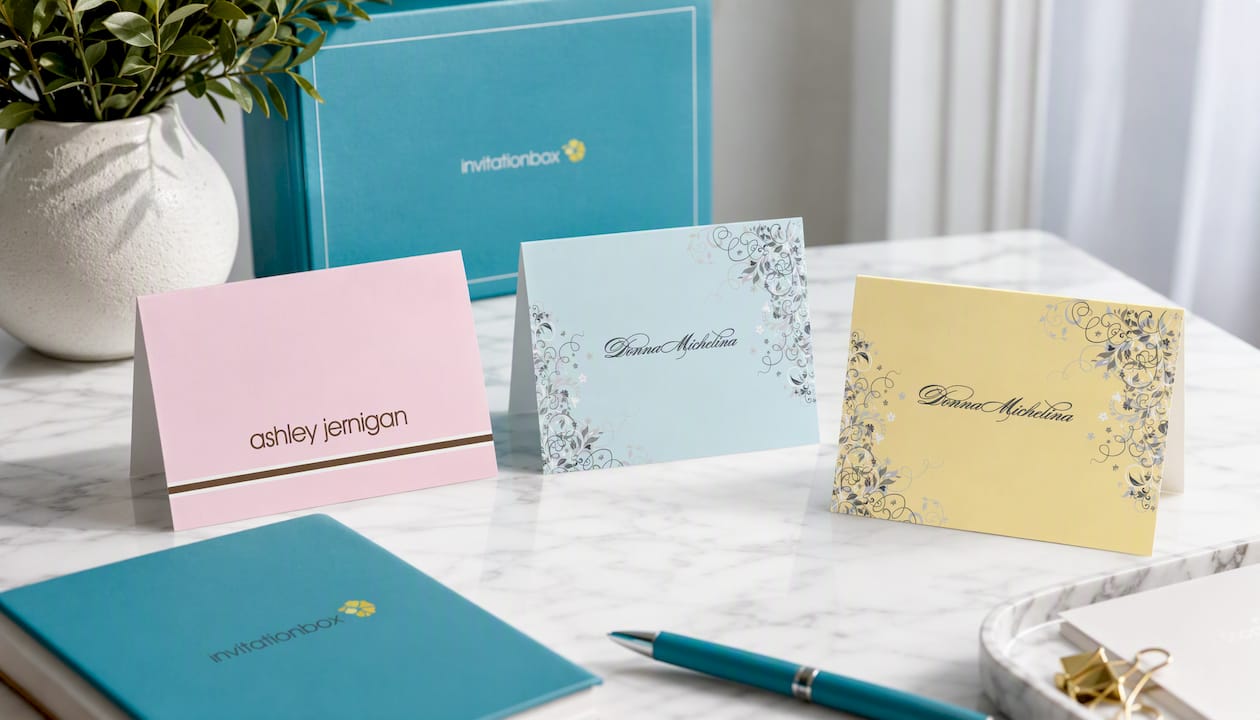
For wellness and self-care brands, the Spa Day Pink Thank You Cards set a calm, polished tone that fits spa, skincare, and self-care product lines without any extra design work. General retail businesses tend to reach for the Floral Corners Blue Thank You Cards, a versatile design that works across most product categories and customer types. If your orders lean seasonal or gift-focused, subscription boxes, seasonal gift shops, the Floral Corners Yellow Thank You Cards bring a brighter, more festive feel that fits recurring shipments well.
Pair any of these with a personalized Snap Stamp and you can sign a stack of 50 cards in the time it takes to write five by hand. Browse the current thank-you card collection and find the design that matches your brand’s tone.
Sources
FAQ
What should you write in a thank-you card from a small business?
Keep it short: a greeting, a specific thank you tied to the actual order or interaction, and a warm sign-off. Something like “Thank you for supporting [Business Name], we hope you love your [Product]” covers the essentials without sounding generic.
What’s a good thank-you message for a small business customer?
A message that names the customer, references what they bought or did, and skips any hard sell works best. “Thanks for your order, [Name], we loved putting this together for you” hits all three notes in one sentence.
What’s a good short thank-you message?
For quick channels like SMS or a public reply, one sentence is enough: “Thanks for your order! It’s on the way.” Save longer, more personal wording for email or handwritten cards.
How do you professionally say thank you for someone’s business?
Keep the tone warm but not overly casual, thank them specifically for their business or project, and leave the door open for future work: “Thank you for trusting us with [Project]. We’d welcome the chance to work with you again.”