

Wedding Invitation Cost: A Budget Guide for Couples
Most U.S. couples spend a modest amount on wedding invitations alone, but that range barely tells the full story. According to The Knot Real Weddings Study, the average spend on invitations is moderate, while a complete stationery suite (invitations, RSVP cards, details cards, and envelopes) costs more. Guest count, printing method, and the add-ons you choose can push that number well below $100 or well past $2,000 for 100 suites.
Here is a quick snapshot of where most couples land, depending on their approach:
- DIY or digital templates: $50–$150 for 100 suites (printing at home or through a local print shop)
- Online pre-designed suites: $150–$400 per 100
- Semi-custom designs: $400–$900 per 100
- Fully custom with specialty printing: $1,000–$3,000+ per 100
One budgeting rule worth knowing right away: order by households, not by guests. A 150-person guest list typically translates to roughly 110–120 households, which is the number of invitations you actually need. That one adjustment alone can save you 20–30 invitations worth of printing and postage costs.
Printing method is the single largest lever on your total. Moving from digital printing to letterpress or engraving can triple or quadruple the per-suite price even when the paper stock stays the same. Add-ons like foil accents, wax seals, and envelope liners layer on hundreds more. Plan for stationery to represent roughly 4–6% of your total wedding budget, and you will have a realistic starting point before you talk to a single vendor.
Key Takeaways
Wedding invitation cost in the U.S. typically averages about $220 for invitations alone and about $510 for a full stationery suite, based on wedding industry surveys. The final cost for 100 suites can fall well below $100 or exceed $2,000 depending on printing method and add-ons.
| Headline averages | Industry reports indicate an average spend of around $220 on invitations and $510 on a full stationery suite. | Order by households | Invite count is roughly 75–80% of guest count; add 10–15 extras for a safe buffer. | | Printing method drives cost | Digital suites stay in the lower hundreds; letterpress starts around $1,500 per 100; engraving often exceeds $2,000. | | Budget 4–6% of total spend | Stationery typically represents 4–6% of the overall wedding budget, with invitations at roughly half of that. | | Invitationbox for custom touches | Invitationbox offers embossers, Snap Stamps, and folded note cards that add a personal finish at accessible price points. |
Table of Contents
- What does a wedding invitation suite actually cost, piece by piece?
- How do printing methods and paper choices change your price?
- What add-ons and postage costs often get overlooked?
- How many invitations should you order, and how does quantity affect price?
- When should you design, order, and mail your invitations?
- How should you budget for invitations and where can you save?
- How do you get accurate quotes from vendors?
- How Invitationbox fits into your stationery budget
- What most couples get wrong about stationery planning
- Bring your invitation vision to life with Invitationbox
- Sources
What does a wedding invitation suite actually cost, piece by piece?
A “wedding invitation” is rarely just one card. Most couples send a full suite, and each piece carries its own price tag. Understanding the line items helps you see exactly where your quote is coming from.
The core pieces of a typical suite:
- Main invitation card: The centerpiece of the suite, usually the most expensive single piece. Pre-designed digital versions can run $1.00–$2.50 per card; custom letterpress versions often cost $8–$15 per card.
- RSVP card and envelope: A smaller card guests return with their meal choice or attendance confirmation. Typically priced at $0.50–$1.50 per set.
- Details or reception card: Covers venue directions, hotel blocks, or reception timing. Often $0.50–$1.00 per card.
- Outer envelope: Usually included in suite pricing, but premium options (square envelopes, colored stock) add cost.
- Inner envelope: An older tradition that is making a comeback in formal suites; adds $0.25–$0.75 per piece.
- Envelope liner: A decorative insert that lines the inside of the outer envelope. One of the most visible upgrades, typically adding $250–$400 per 100.
Beyond per-piece pricing, most printers charge setup or plate fees that are fixed regardless of quantity. These can range from $50 to several hundred dollars for letterpress or engraving plates. Digital printing generally has no setup fee, which is one reason it stays budget-friendly at lower quantities.
Assembly and hand-addressing are labor costs, usually billed per piece or per hour. Expect $1–$3 per suite for professional assembly, and $1–$2 per envelope for hand calligraphy or printed addressing.
How do printing methods and paper choices change your price?
Printing method is where the biggest price swings happen, and knowing the tiers helps you make a confident tradeoff between the look you want and the budget you have.
Brides documents these tiers clearly: digital printing sits at the affordable end, while engraving sits at the top. Here is how the methods stack up:
-
Digital printing produces clean, full-color results using inkjet or laser technology. It is the most accessible option, with suites often landing in the lower hundreds per 100. No setup fees, fast turnaround, and excellent for photo-heavy or colorful designs.
-
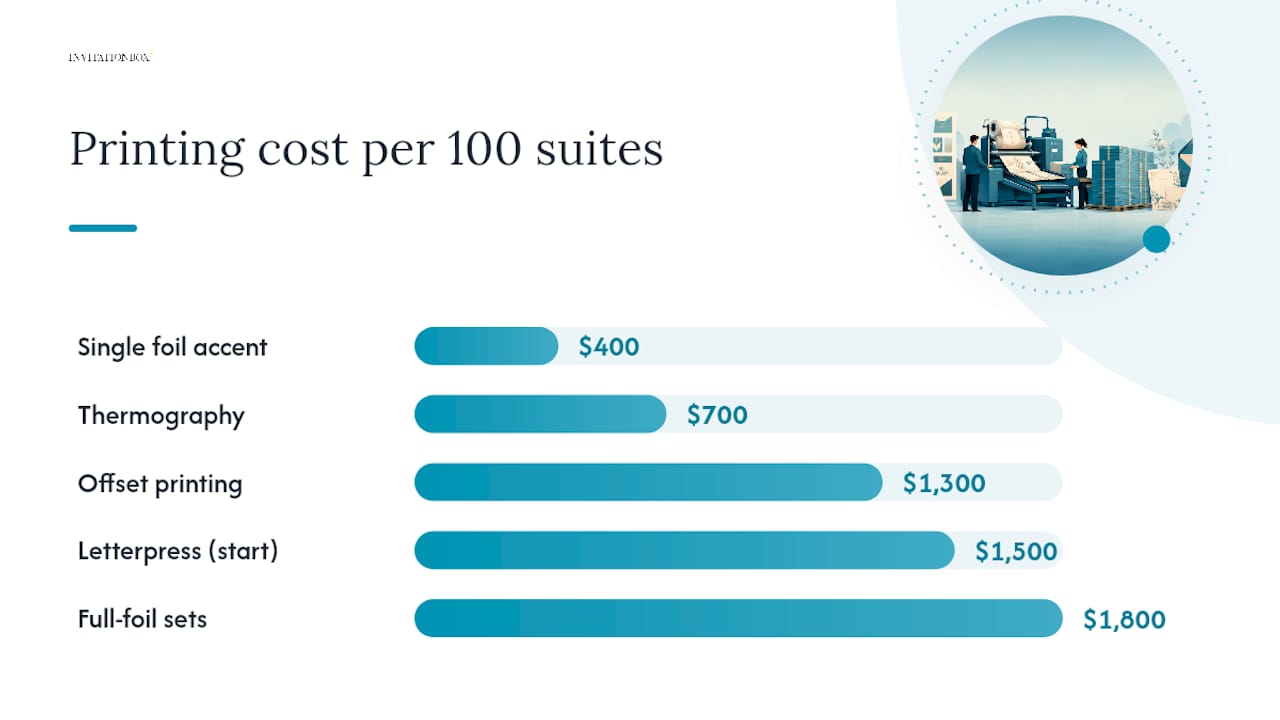
Offset printing uses ink plates pressed onto paper for consistent, rich color. It tends to run roughly $800–$1,800 per 100 suites and suits couples who want professional color accuracy without specialty texture.
-
Thermography creates a raised-ink effect that mimics engraving at a lower price. It sits between digital and letterpress, typically in the $500–$900 range per 100, and works well for classic, formal designs.
-
Letterpress presses type and imagery into thick cotton paper, leaving a tactile impression. Prices start around $1,500 per 100 and climb with complexity. The setup cost for plates is significant, so letterpress rewards larger quantities.
-
Foil stamping applies metallic or colored foil to the surface of the paper. A single foil accent can add roughly $400 per 100; full-foil sets can reach $1,800 per 100 or more. Current wedding invitation trends show foil as one of the most requested finishes.
-
Engraving is the most formal and most expensive method, using intaglio plates to press ink into the paper from below. Costs often exceed $2,000 per 100 and require the longest lead times.
Paper and substrate choices add another layer of cost variation. Standard 80–100 lb. cardstock is the baseline. Cotton paper (often called “rag paper”) feels noticeably heavier and more luxurious, and it typically costs 20–40% more than tree-pulp stock. Specialty substrates like acrylic, wood veneer, or vellum overlays are priced individually and can add $2–$8 per piece on top of printing costs.
Pro Tip: Each additional ink color in offset or letterpress printing typically adds a setup fee and increases per-unit cost. If your design uses three colors, ask your printer for a quote at two colors as well. Simplifying the palette by even one color can save $100–$300 per 100 suites.
What add-ons and postage costs often get overlooked?
This is where many couples experience sticker shock. The base suite looks affordable, then the add-ons arrive in the quote and the total climbs fast. Here is what to watch for:
Common add-ons and their approximate per-100 cost ranges:
- Foil accents (single color): around $400 per 100
- Full-foil stamp sets: up to $1,800 per 100
- Blind debossing: $300–$400 per 100
- Bevel cuts or die cuts: around $400 per 100
- Edge painting: roughly $150 per 100
- Wax seals: $200–$300 per 100
- Envelope liners: $250–$400 per 100
- Belly bands or ribbon wraps: $100–$200 per 100
- Custom dies (for unique shapes): $150–$300 as a one-time fee
Postage deserves its own line in your budget. A standard single-card invitation in a standard-size envelope typically mails at the current first-class letter rate. But most suites are heavier. Add an RSVP card, a details card, an inner envelope, and a liner, and your suite may weigh over one ounce, which bumps it into a higher postage tier. Square envelopes require a surcharge on top of the base rate regardless of weight.
The U.S. Postal Service recommends taking a fully assembled, sealed suite to your local post office for a weight and size check before you print thousands of envelopes. That five-minute visit can save you from under-stamping 120 invitations.
Pro Tip: Budget $1.00–$1.50 per invitation for postage on a standard suite, and $1.50–$2.00 for heavier or square-envelope suites. Multiply by your household count, not your guest count, for an accurate postage estimate.
Hand addressing, assembly, and custom tissue slips are labor costs that printers often list separately. Professional calligraphy addressing typically runs $1.50–$3.00 per envelope. If your suite has five pieces to nest and seal, assembly labor can add $0.75–$1.50 per suite. These feel small per piece but add up meaningfully across 100+ suites.
How many invitations should you order, and how does quantity affect price?
Ordering the right quantity is one of the most practical decisions you will make in the whole stationery process. Order too few and you pay rush fees for reprints. Order too many and you have paid for paper that sits in a box.
The household rule is your starting point. The Knot advises ordering by invited households rather than by individual guests, since one invitation covers everyone living at the same address. A rough planning guideline: your invitation count will be a substantial fraction of your total guest count.
Here is a simple worked example for a 150-person guest list:
- 150 guests × 75% = approximately 113 households
- Add 10–15 extras for keepsakes, late additions, and any that get lost in the mail
- Order total: approximately 125–130 invitations
That buffer matters. Most printers charge significantly more for reprints than for adding 10–15 units to the original run. At the time of your initial order, the marginal cost of adding 10 more suites is usually $15–$40. A reprint order for those same 10 suites could cost $75–$150 or more because setup fees apply again.
Quantity also affects per-unit price in a meaningful way. Most printers use tiered pricing: the per-suite cost at 50 units is noticeably higher than at 100, and 100 is higher than 150. If you are close to a pricing tier (say, 95 suites when the next tier starts at 100), it often costs less to order the full 100.
Pro Tip: Before committing to a full print run, request a physical proof or a small sample set. Seeing the actual paper weight, ink color, and finish in your hands prevents surprises and gives you a chance to catch any wording errors before they are printed 125 times.
When should you design, order, and mail your invitations?
Timing is one of the most underestimated parts of the stationery process. Rush fees are real, and they can add 20–50% to your printing cost. Building a realistic timeline protects both your budget and your sanity.
Here is a phase-by-phase breakdown of what the process looks like:
-
Design and wording finalization: Allow 2–4 weeks. This includes selecting your design, finalizing all wording, and getting approval from both families if needed. Getting the wording right before you submit to a printer avoids costly proof revisions.
-
Proof review and approval: Most printers provide a digital proof within 3–5 business days. Physical proofs take 1–2 weeks to arrive. Budget at least one round of revisions.
-
Print production: This varies significantly by method. Digital printing can turn around in 5–10 business days. Letterpress and engraving typically require 3–5 weeks. Custom die-cutting or foil stamping adds another 1–2 weeks.
-
Finishing and assembly: If you are adding liners, wax seals, or belly bands, allow 1–2 weeks for professional finishing. DIY assembly can be done in a weekend but requires planning.
-
Addressing and mailing: Hand calligraphy addressing takes 1–3 weeks depending on your calligrapher’s schedule. Printed addressing is faster, usually 3–5 business days. Mail invitations 6–8 weeks before the wedding date for domestic guests, and 10–12 weeks for international guests.
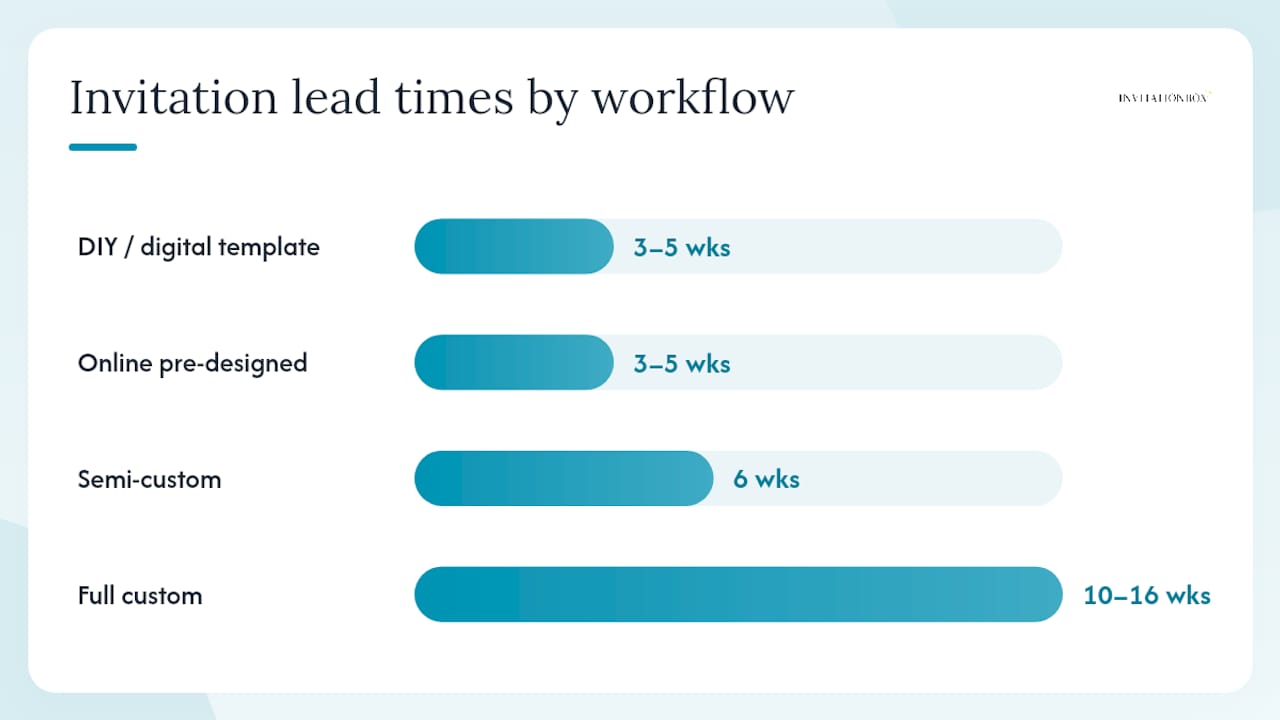
A realistic total timeline from “start designing” to “invitations in the mail” runs 10–16 weeks for semi-custom or custom suites. Digital or pre-designed suites can move faster, often in 4–6 weeks total.
| Workflow type | Design to proof | Production | Total lead time |
|---|---|---|---|
| DIY / digital template | 1–2 weeks | 1–2 weeks | 3–5 weeks |
| Online pre-designed | 1–2 weeks | 1–2 weeks | 3–5 weeks |
| Semi-custom | 2–4 weeks | 2–3 weeks | 6 weeks |
| Full custom (letterpress/engraving) | 3–5 weeks | 4–6 weeks | 10–16 weeks |
Rush fees typically kick in when you compress the production phase. Most printers define “rush” as anything under their standard turnaround, and the surcharge is usually 20–50% of the base order price.
How should you budget for invitations and where can you save?
Stationery is one of the more flexible line items in a wedding budget, which makes it a good place to apply intentional tradeoffs. Brides recommends setting aside roughly 4–6% of your total wedding budget for stationery, which includes invitations, save-the-dates, day-of paper, and thank-you notes.
For a $25,000 wedding, that puts your stationery budget at $1,000–$1,500. For a $40,000 wedding, it is $1,600–$2,400. Invitations alone typically represent about half of the total stationery spend.
A worked example for 150 guests (approximately 125 households):
- Semi-custom digital suite at $3.50 per suite: $437
- Envelope liners: $300
- Postage at $1.10 per envelope: $137
- Assembly labor: $100
- Estimated total: approximately $975
That same suite in letterpress with foil accents could easily reach $2,200–$2,800 for the same quantity.
Where the savings are largest:
- Skip the inner envelope. It is a formal tradition, but most guests do not notice its absence. Removing it saves $0.25–$0.75 per suite and reduces postage weight.
- Choose digital printing over letterpress. The visual difference is real, but digital printing has improved dramatically. For couples prioritizing budget, it delivers a polished result at a fraction of the cost.
- Move your RSVP online. A QR code or wedding website link replaces the RSVP card and return envelope entirely, saving $75–$150 per 100 suites plus return postage.
- Limit foil to one element. Full-foil suites are stunning but expensive. A single foil-stamped monogram or border gives a luxury feel at a fraction of the full-foil price.
- Order all stationery pieces together. Many printers offer discounts when you order invitations, save-the-dates, and thank-you notes as a package. Creative design choices can also maximize visual impact without adding expensive finishes.
How do you get accurate quotes from vendors?
A vague inquiry gets a vague quote. The more specific your request, the more useful the number you get back. Before you contact any printer or stationery vendor, gather the following:
What to include in your quote request:
- Finalized household count (your actual order quantity)
- Design concept or artwork files (or a description if still in concept stage)
- Paper weight preference (80 lb., 110 lb., cotton)
- Printing method preference (digital, letterpress, foil, etc.)
- Number of ink colors
- Suite pieces needed (main card, RSVP, details card, envelopes, liners)
- Envelope size and shape (standard A7, square, etc.)
- Assembly requirements (do you need them to assemble and address?)
Questions worth asking every vendor:
- Is a digital proof included, and how many revision rounds are covered?
- What is the standard turnaround, and what does rush service cost?
- How do you handle color matching between proof and final print?
- Are setup or plate fees included in the quote, or billed separately?
- Can I order a physical sample before the full run?
- What is your policy if the final print differs from the approved proof?
When comparing quotes, watch for the difference between per-piece pricing and fixed setup fees. A printer with a lower per-piece rate but a $300 plate fee may cost more than a printer with a slightly higher per-piece rate and no setup fee, especially at quantities under 100. Always ask for the all-in total for your specific quantity.
Color proofing is worth a separate conversation. Screen colors and printed colors differ, sometimes significantly. A physical proof on your actual paper stock is the only reliable way to confirm that the deep navy you chose on screen will not print as a muddy gray.
How Invitationbox fits into your stationery budget
Invitationbox has been helping couples and planners personalize their stationery for over 19 years. The platform offers a range of products that map directly to the budget tiers and customization needs covered in this guide.
For budget-focused couples who want a polished, personal touch without a full custom print run, Invitationbox’s folded note cards are a practical starting point. The Retro Black Folded Thank You Note Cards and the Nautical BP Folded Note Cards are pre-designed options that pair well with a digital invitation suite and give your stationery a cohesive, finished feel. The Bookplate Shower Lime Note Cards offer a cheerful, themed option for couples who want something a little more playful.
For couples who want a tactile, premium element without the cost of full engraving, Invitationbox’s custom embossers and stampers are worth exploring. Custom embossers add a raised, elegant impression to envelopes, notecards, or wax seals at a fraction of what a full engraving setup costs. The proprietary Snap Stamp system lets you create self-inking stamps with a wide range of motifs, from the Vintage Seahorse Stamper or Embosser to the Seahorse Stamper or Embosser, the Horseshoe Stamper or Embosser, and the Jolly Rogerette Stamper or Embosser. The Paw Print Stamper or Embosser is a sweet option for couples who want to include a nod to their pets.
Two practical buyer scenarios:
- Scenario A (budget-focused): A couple with 120 households orders pre-designed folded note cards for thank-you notes and uses a Snap Stamp embosser on their envelopes for a custom wax-seal effect. Total stationery spend stays well under $500.
- Scenario B (premium touch): A couple ordering a semi-custom digital suite adds a custom embosser for envelope sealing and uses foil-accent stamps on their inner envelopes. The embosser becomes a keepsake after the wedding.
Pro Tip: Browse Invitationbox’s product pages to request samples before committing to a full order. Seeing the paper weight and stamp impression in person helps you confirm the finish matches your vision, and it prevents the kind of last-minute reprints that inflate your budget.
What most couples get wrong about stationery planning
The most common mistake is treating invitations as a last-minute detail. Couples who start the stationery process late end up paying rush fees, accepting whatever paper stock is available, and skipping the proof stage entirely. That combination is where errors slip through and budgets blow up.
A second mistake: ordering by guest count instead of household count. It sounds minor, but on a 200-person guest list, that error means ordering 40–50 extra suites. At $4–$8 per suite for a semi-custom design, that is $160–$400 in unnecessary printing and postage.
The third mistake is adding embellishments after the quote is approved. Wax seals sound simple to add at the last minute, but they change the weight of the envelope, which changes postage, which changes your total cost. Every add-on decision should happen before the quote is finalized, not after.
My strongest advice: order a physical proof set and take a fully assembled, sealed suite to the post office before you approve the final print run. Those two steps together cost almost nothing and protect you from the two most expensive surprises in the stationery process.
Bring your invitation vision to life with Invitationbox
Planning your stationery budget is the first step. The next is finding products that deliver the look you want at the price you have planned for.
Invitationbox offers personalized stationery, custom embossers, Snap Stamps, and folded note cards that give your wedding suite a heartfelt, finished quality without the cost of a full custom print house. Whether you are looking for a tactile embossed seal for your envelopes or a pre-designed folded card that ties your whole suite together, the product range covers both budget-friendly and premium options.
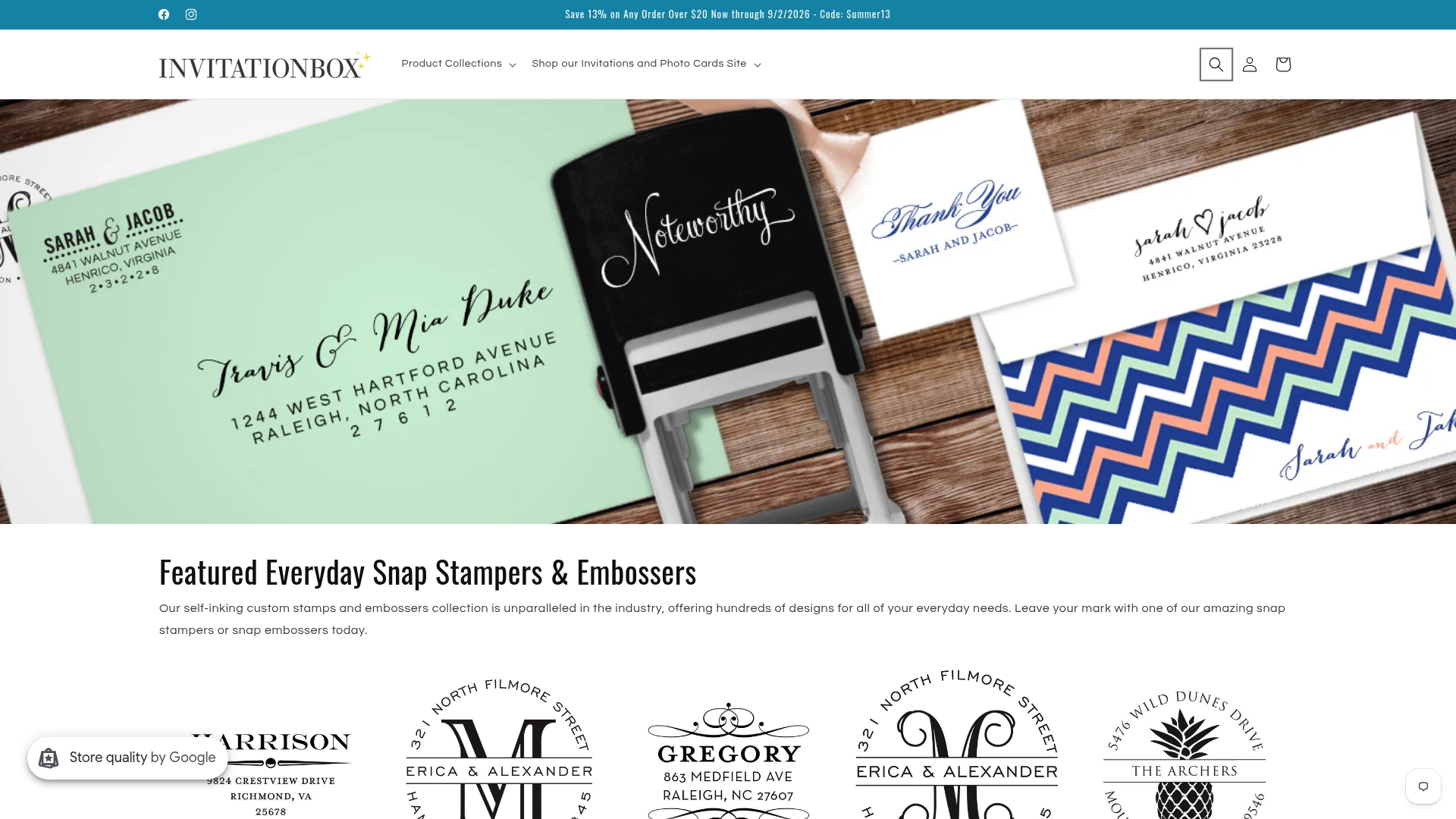
Browse the full collection at Invitationbox and use the product pages to request samples or place a custom order. Start with the Retro Black Folded Thank You Note Cards or explore the stamper and embosser range to find the finishing touch that makes your invitations feel genuinely yours.
Sources
Recommended
- Best Bridal Shower Invitations for Every Budget & Vibe – InvitationBox.com
- Wedding Invitation Wording: Examples and Etiquette 2026 – InvitationBox.com
- From Save-the-Dates to Engagement Party Invitations: Coordinating Your – InvitationBox.com
- Crafting the Perfect Engagement Party Invitations: A Step-by-Step Guid – InvitationBox.com