

The USPS Non-Machinable Surcharge: What Senders Need to Know
The USPS non-machinable surcharge is an extra fee added to First-Class letter postage when a mailpiece cannot be processed by automated sorting equipment. As of the most recently published USPS rates, the surcharge adds $0.42 to the base letter rate, bringing a standard 1-oz First-Class letter from $0.73 to $1.15 total. The fastest way to avoid it: use a standard, flexible, rectangular envelope with nothing rigid inside.
$0.42 extra per piece — that is the non-machinable surcharge on a First-Class letter when your mailpiece cannot run through USPS high-speed sorting equipment.
A few things trigger this fee most often:
- Aspect ratio outside the 1.3–2.5 range (square envelopes are a common culprit)
- Too rigid to bend around an 11-inch diameter turn
- Uneven thickness from coins, keys, or hard inserts
- Clasps, strings, or buttons on the closure
- Polywrap or non-paper exterior materials
- Address printed parallel to the short side of the envelope
Key Takeaways
The non-machinable surcharge adds $0.42 per piece to First-Class letter postage, and a few simple design choices eliminate it entirely.
| Point | Details |
|---|---|
| Surcharge amount | $0.42 per piece added to the base letter rate, bringing a 1-oz letter to $1.15 total. |
| Main triggers | Square envelopes, rigid inserts, clasps, uneven thickness, and wrong address orientation all cause the fee. |
| Bend and ratio tests | Check aspect ratio (length ÷ height = 1.3–2.5) and flex the sealed envelope around an 11-inch curve before mailing. |
| Volume cost impact | 500 non-machinable pieces per month adds $210 in surcharges; design changes can reduce this to $0. |
| Invitationbox solution | Stampers, embossers, and flexible photo cards from Invitationbox personalize mail without adding rigidity or triggering the surcharge. |
Table of Contents
- Why does USPS charge a non-machinable surcharge?
- What are the official USPS criteria for non-machinable mail?
- How does the surcharge change what you actually pay?
- How to make your mailpieces machinable and avoid the fee
- Simple tests you can run before you mail
- Special cases: shaped envelopes, invitations, and the butterfly stamp question
- What the surcharge means for small businesses mailing at volume
- A stationery seller’s perspective on designing for machinability
- Stationery that works beautifully and mails without extra fees
- Sources
Why does USPS charge a non-machinable surcharge?
USPS charges the surcharge because pieces that cannot run through automated sorting equipment must be handled by postal workers individually. That manual handling takes more time and labor, and the surcharge is intended to offset that additional operational cost.
The distinction between a surcharge and a reclassification matters here. A non-machinable surcharge still keeps your piece classified as a letter. You pay the base letter rate plus the surcharge. But if your piece exceeds letter dimensions or weight limits entirely, it gets reclassified as a flat or package, which carries a completely different, often higher, pricing structure. A square envelope that is 6 inches on each side, for example, may be reclassified as a flat rather than simply surcharged, depending on its other dimensions. Knowing which outcome applies to your piece before you mail it saves real money.
What are the official USPS criteria for non-machinable mail?
The official nonmachinable criteria from USPS Publication 25 define exactly which letter characteristics trigger the surcharge. A First-Class letter is classified as non-machinable if it meets any one of these conditions:
- Aspect ratio outside 1.3–2.5: Divide the length by the height. A result below 1.3 or above 2.5 fails. Square envelopes almost always fall below 1.3.
- Too rigid to bend: The piece cannot flex around an 11-inch diameter cylinder without damage or resistance. Stiff card stock, rigid inserts, or wax seals can cause this.
- Uneven thickness: Items like coins, keys, or hard embellishments create lumps that jam sorting equipment.
- Clasps, strings, or buttons: Any closure that is not a simple flap or adhesive strip triggers the surcharge.
- Polywrap or non-paper exterior: Plastic wrap, poly windows larger than allowed, or non-paper outer materials all qualify.
- Address orientation: The delivery address must run parallel to the long side of the envelope. Printing it parallel to the short side makes the piece non-machinable.
- Minimum dimensions not met: Letters must be at least 5 inches long and 3.5 inches high. Pieces smaller than this are non-machinable.
The Postal Explorer Quick Service Guide and the DMM 600 series provide the full technical standards, including thickness tolerances and acceptable closure materials, for anyone who wants the complete official wording.
How does the surcharge change what you actually pay?
The formula is straightforward: base letter rate + non-machinable surcharge = total postage. Using the current published rates, here is how that plays out across a few common scenarios.
Two important thresholds to keep in mind:
- The 3.5-oz letter limit. A First-Class letter can weigh up to 3.5 oz and still be priced as a letter. Above that weight, it is reclassified as a flat, which carries a higher base rate regardless of shape.
- The flat/package reclassification point. If a piece exceeds letter dimensions (no longer than 11.5 inches, no taller than 6.125 inches, no thicker than 0.25 inches), it becomes a flat or package. At that point, the non-machinable surcharge no longer applies because the piece is no longer a letter at all. The USPS First-Class Mail page lists current base rates for letters, flats, and packages so you can compare the full cost picture.
The surcharge is applied per piece, so even a modest mailing of 200 invitations adds $84.00 in surcharge costs alone if every piece is non-machinable.
How to make your mailpieces machinable and avoid the fee
Follow this checklist before you seal and stamp a single envelope. Each step is a direct fix for one of the criteria that triggers the surcharge.
- Choose a standard rectangular envelope. A 4-bar (A2) or A7 envelope in a standard size keeps your aspect ratio well within the 1.3–2.5 range. Avoid square envelopes entirely unless you are prepared to pay the surcharge.
- Keep the contents flexible. Soft card stock, folded inserts, and thin liners all pass the bend test. Rigid items like acrylic charms, thick chipboard, or wax seals do not.
- Distribute thickness evenly. If you include multiple inserts, nest them together so no single spot creates a lump. Coins, keys, or hard embellishments should be removed or replaced with printed alternatives.
- Use a simple flap or peel-and-seal closure. Clasps, strings, and buttons automatically trigger the surcharge. Adhesive strips and gummed flaps are always safe.
- Print the address parallel to the long side. This is one of the most overlooked rules. Rotate your address block if needed before printing.
- Weigh each finished piece. Stay under 3.5 oz to remain in letter pricing. A postal scale accurate to 0.1 oz is a worthwhile investment for anyone mailing in volume.
- Check overall dimensions. Length must be between 5 and 11.5 inches; height between 3.5 and 6.125 inches; thickness no more than 0.25 inches.
Pro Tip: For invitation mailers, swap wax seals and metal charms for a custom self-inking stamp or embosser on the envelope flap. You get a polished, personalized look without adding rigidity or uneven thickness. Check out embossing tools for invitations for ideas that keep your mail both beautiful and machinable.
Simple tests you can run before you mail
Two quick checks will tell you whether a finished piece is likely to draw the surcharge.
The aspect ratio calculation: Measure the length and height of your sealed envelope in inches. Divide length by height. A result between 1.3 and 2.5 means you pass. A standard A7 envelope (5.25 x 7.25 inches) gives a ratio of about 1.38, safely inside the range. A 5x5 square envelope gives exactly 1.0, which fails.
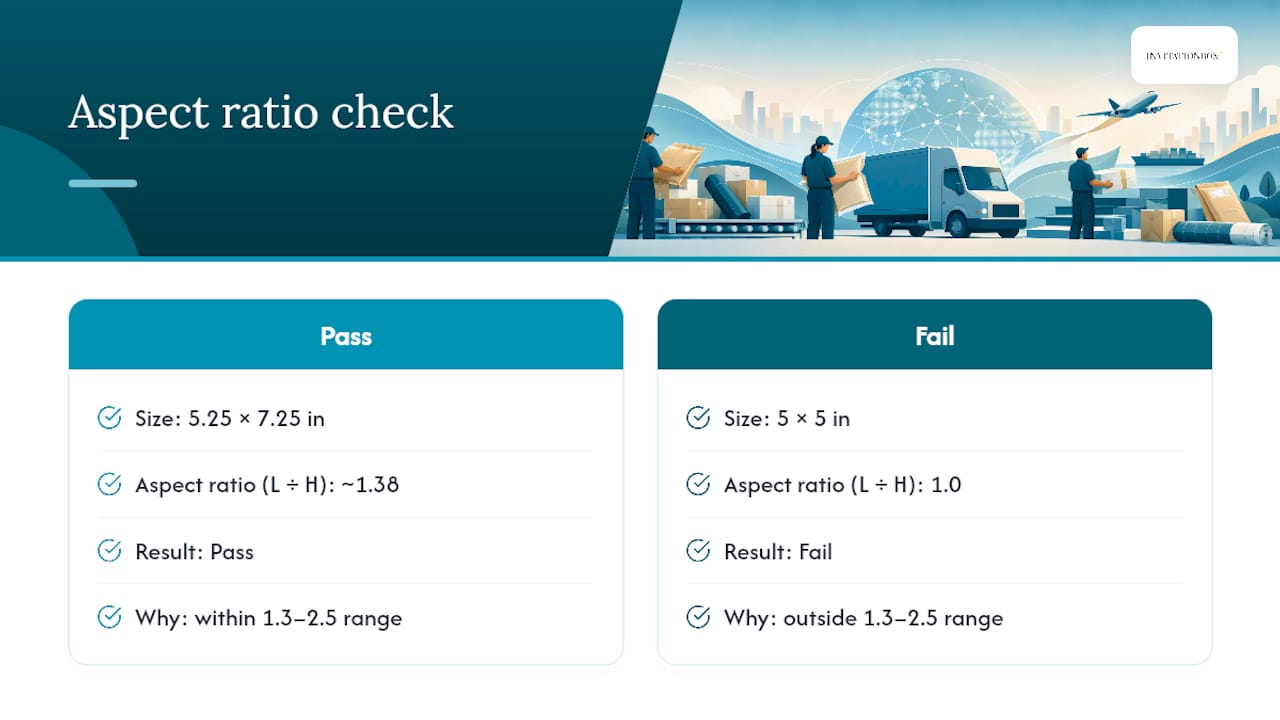
The bend test: Hold the sealed envelope by its short ends and gently curve it as if wrapping it around a cylinder about 11 inches across. If it flexes without resistance or damage, it passes. If it resists or the contents feel like they might crack, it will likely be flagged as non-machinable. This is the same physical test USPS sorting equipment applies automatically.
Weight check: Place the finished, sealed, stamped envelope on a postal scale. Anything over 3.5 oz moves out of letter pricing entirely, so catch that before you apply postage. The DMM 600 standards detail the full weight and thickness tolerances if you need the precise technical specs.
Special cases: shaped envelopes, invitations, and the butterfly stamp question
Shaped or die-cut envelopes almost always trigger the surcharge, and sometimes a reclassification. A heart-shaped envelope, for example, fails the aspect ratio test and cannot be processed by sorting equipment regardless of its contents.
For wedding and party invitations, the most common triggers are:
- Wax seals on the flap: These create rigidity and uneven thickness at the seal point.
- Belly bands or ribbon ties: These wrap around the envelope and prevent it from lying flat.
- Multiple thick inserts: An invitation, RSVP card, details card, and envelope liner stacked together can push thickness past 0.25 inches.
- Vellum wraps: Thin vellum alone is usually fine, but vellum wrapped around a card and secured with a brad or charm is not.
Inexpensive substitutions that preserve the look: use a custom stamper or embosser on the envelope flap instead of a wax seal, tuck inserts into a single folded card rather than stacking loose sheets, and skip the belly band in favor of a printed design element.
On the butterfly stamp question: the non-machinable surcharge is determined entirely by the physical characteristics of the mailpiece, not by which postage stamp you use. A butterfly-themed Forever stamp does not make a piece non-machinable. What matters is the envelope’s shape, rigidity, thickness, and closure. USPS guidance on acceptable envelope features makes clear that the surcharge applies to the piece, not the artwork on the stamp.
Polywrapped mail and envelopes with large poly windows are also non-machinable. If you are mailing a catalog or product sample in a poly mailer, expect it to be classified as a flat or package rather than a letter.
What the surcharge means for small businesses mailing at volume
Pitney Bowes notes that small businesses consistently underestimate how cumulative surcharge costs affect margins, especially when mailing in batches of several hundred pieces. The math is simple but easy to overlook during the design phase.
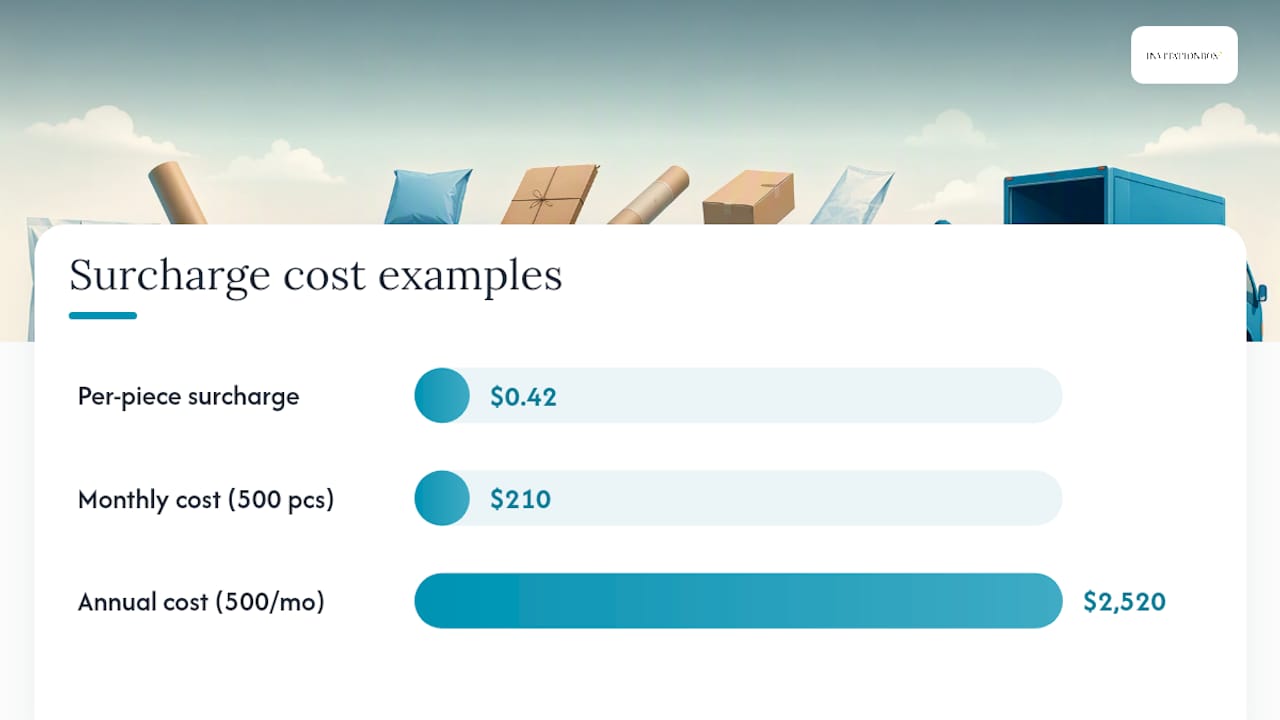
A quick cost model: multiply your monthly piece count by $0.42. If you mail 500 invitations per month and every piece is non-machinable, that is $210 in surcharges on top of base postage. Over a year, that is $2,520 in fees that a few design adjustments could eliminate entirely.
Mitigation strategies worth considering:
- Design for machinability from the start. Choosing a standard A7 envelope and flexible card stock costs nothing extra and removes the surcharge entirely.
- Switch to flats intentionally when it makes sense. If your piece genuinely needs to be thick or rigid, price it as a flat from the beginning rather than paying the surcharge on a letter rate that no longer fits.
- Use presort or commercial mail options. If you mail more than 500 pieces at a time, USPS commercial rates and presort discounts can offset costs significantly.
- Audit your current mailing specs. Pull a finished sample of your most common mailpiece and run the bend test and aspect ratio check. You may find a simple envelope swap eliminates the surcharge entirely.
For event-based businesses, timing your mailings thoughtfully also helps. Planning your invitation send dates in advance gives you room to test pieces before committing to a full print run.
A stationery seller’s perspective on designing for machinability
At Invitationbox, keeping products machinable is a design priority, not an afterthought. The goal is always to give you something beautiful that also travels through the mail without extra fees.
That means favoring flexible card stock over rigid chipboard for photo cards like the Fun Holiday Confetti Photo Card and the Believe Photo Card, both of which are designed to fit standard machinable envelopes. For personalization, stampers and embossers are the right tool precisely because they add visual detail without adding thickness or rigidity to the mailpiece. A Woodcut Stamper or Embosser pressed onto an envelope flap gives a handcrafted feel with zero surcharge risk. The same logic applies to the Paw Print Stamper or Embosser and the Vintage Seahorse Stamper or Embosser, all of which keep your envelope flat, flexible, and fully machinable.
Address placement matters too. Invitationbox recommends following envelope addressing etiquette that keeps the delivery address parallel to the long side of the envelope, which is both the postal standard and the most elegant presentation.
Stationery that works beautifully and mails without extra fees
Personalized mail should feel special, not cost extra at the post office. Invitationbox designs its stampers, embossers, and photo cards specifically to give you that polished, heartfelt look while keeping your envelopes flexible and machinable.
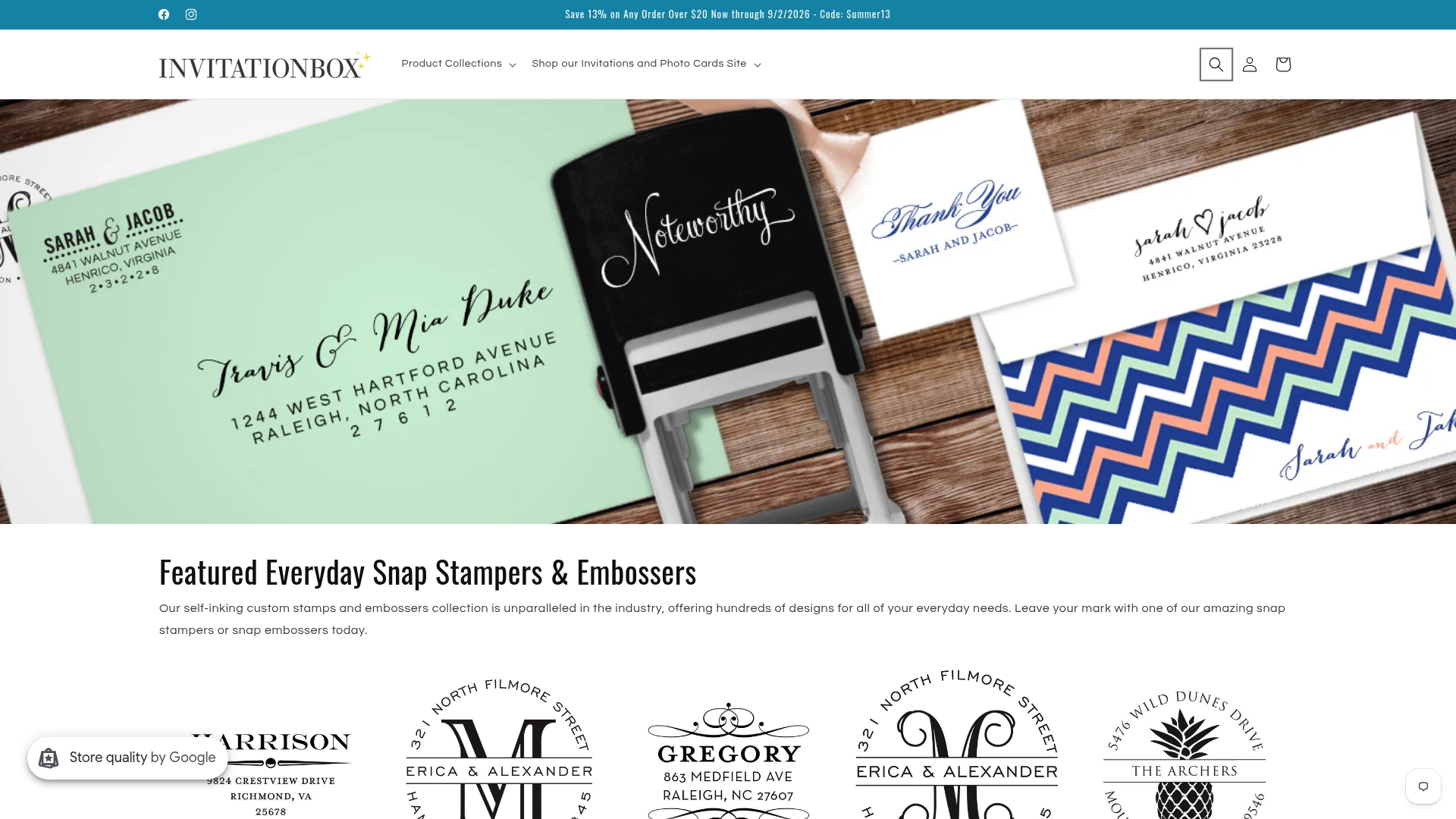
Whether you are sending holiday photo cards, wedding invitations, or branded thank-you notes, the right personalization tool makes all the difference. The Horseshoe Stamper or Embosser, the Jolly Rogerette Stamper or Embosser, and the Extra Ornamental Stamper or Embosser each add personality to your envelopes without a single extra ounce of thickness. Browse the full collection at Invitationbox and find the stamper or photo card that fits your next mailing perfectly.
Sources
These official and industry sources are the best places to verify current rates and technical criteria:
- 201 Quick Service Guide | Postal Explorer
- First-Class Mail & Postage | USPS
- Shipping surcharges explained - Pitney Bowes blog
- USPS Nonmachinable guidance - About USPS Home
- United States Postal Service (USPS) Charges and Rates