

100–120 gsm Notepad Paper Weight for Notebook Buyers and Fountain Pens
For most everyday notepads and journals, 100 gsm hits the sweet spot between smooth writing and reasonable bulk. Drop to 70 to 90 gsm for budget, high page count pads where cost matters more than ink show-through, and go 160 gsm or heavier when watercolor or heavy markers are involved. The GSM standard is the number to trust here, and it is the same one Invitationbox weighs against pen type and binding when sourcing stock for its personalized notepads.
TL;DR:
- Notepads with 100 to 120 gsm paper provide a good balance for everyday use, handling gel and light fountain pen writing without excessive ghosting.
- Conversion between GSM and pounds is approximate and varies by paper type, so always ask for the GSM number when comparing products from different suppliers.
- Heavier paper weights, such as 160 gsm and above, are suited for markers and watercolor, but they increase bulk and may require custom binding options.
- Pen type influences ideal GSM selections, with fountain pens and markers demanding at least 90 to 160 gsm for optimal ink performance.
- Testing samples in advance ensures the chosen paper withstands specific ink types, drying times, and binding styles before bulk ordering.
Table of Contents
- What Is Notepad Paper Weight, and Why Does It Matter?
- GSM to Pound Conversion: What the Numbers Actually Mean
- Which Paper Weight Fits Your Use Case?
- Does Your Pen Type Change the Ideal Paper Weight?
- How Paper Weight Changes Notebook Bulk and Binding Choice
- How to Test Paper Before You Commit to a Batch
- Why Does Paper Weight Affect Bleed-Through and Ghosting?
- How We Choose Paper for Personalized Notepads
- Find the Right Notepad Weight and Style for Your Needs
- Sources
- FAQ
What Is Notepad Paper Weight, and Why Does It Matter?
GSM stands for grams per square meter, and it tells you how much a single sheet of that paper weighs at a fixed size, regardless of how the sheet is cut. A higher GSM number usually means a thicker, more opaque sheet, which cuts down on bleed-through (ink soaking clear through the page) and ghosting (shadows of writing showing on the back). That relationship holds most of the time, but it is not absolute. Coating and surface sizing can make a lighter sheet perform better than a heavier, uncoated one.
In the United States, paper is often labeled in pounds (lb) instead of GSM. This is basis weight: the weight of 500 sheets at a standard size for that paper category. The catch is that “standard size” changes depending on whether you’re looking at bond, text, or cover stock, so the same pound number means different things depending on the grade.
Caliper is a third measurement worth knowing. It measures actual thickness in points or millimeters, independent of weight. Two sheets can share a GSM rating and still feel different in your hand because one is denser and thinner while the other is fluffier and thicker. Opacity, a related but separate spec, tells you how much shows through from the other side.
GSM to Pound Conversion: What the Numbers Actually Mean
Converting between GSM and pounds only works as a rough guide, because the math depends on the paper grade. For bond paper, the kind most notepads use, some common equivalents show up again and again in industry references.
| GSM | Approximate lb (bond) | Typical Use |
|---|---|---|
| 70 to 75 gsm | Roughly 20 lb equivalent in bond paper | Budget notepads, legal pads |
| 90 gsm | ~24 lb | Standard writing pads |
| 105 gsm | Approximate 28 lb equivalent in bond paper | Midweight journals |
| 120 gsm | Approximate 32 lb equivalent in bond paper | Premium notepads, fountain pen paper |
These conversion benchmarks hold reasonably well for bond and text paper, but cover stock and specialty art paper use different basis sizes entirely. That’s why paper weight guides recommend asking for the GSM number directly whenever you’re comparing products from different manufacturers. A “24 lb” sheet from one supplier and a “24 lb” sheet from another can land at noticeably different GSM values if they’re not the same paper category.
Which Paper Weight Fits Your Use Case?
Not every notepad needs the same stock. The right weight depends on how many pages you need, what you’re writing with, and how much bulk or cost you’re willing to trade for better ink performance.
- 70 to 90 gsm: Best for ballpoint pens, pencils, and high page count pads where keeping costs down matters more than eliminating every trace of ghosting.
- 100 to 120 gsm: The general-purpose range. This weight handles gel pens and most fountain pens well, and it’s the range Dingbats and similar notebook makers point to as the sweet spot for everyday journaling.
- 120 to 160 gsm: Premium journals and brush-pen work land here. Expect fewer pages per pad and a higher price, since heavier stock costs more to produce and takes up more spine space.
- 160 gsm and up: Reserved for mixed media. Watercolor washes, alcohol markers, and other water-based tools need this weight paired with the right surface coating, or the page will warp or blow through.
Standard SKUs from most manufacturers top out around 80, 90, 100, or 120 gsm. If you need anything heavier, plan on a custom order rather than expecting it off the shelf.
Does Your Pen Type Change the Ideal Paper Weight?
Pen choice matters as much as GSM when you’re picking notepad stock, because different tools deposit ink differently and demand different surface behavior.
- Ballpoint or pencil: 70 to 90 gsm works fine. These tools lay down minimal liquid ink, so bleed-through isn’t much of a concern.
- Gel pens and rollerballs: Look for 90 to 100 gsm or higher. These pens use more liquid ink than ballpoints, which raises the bleed-through risk on thinner sheets.
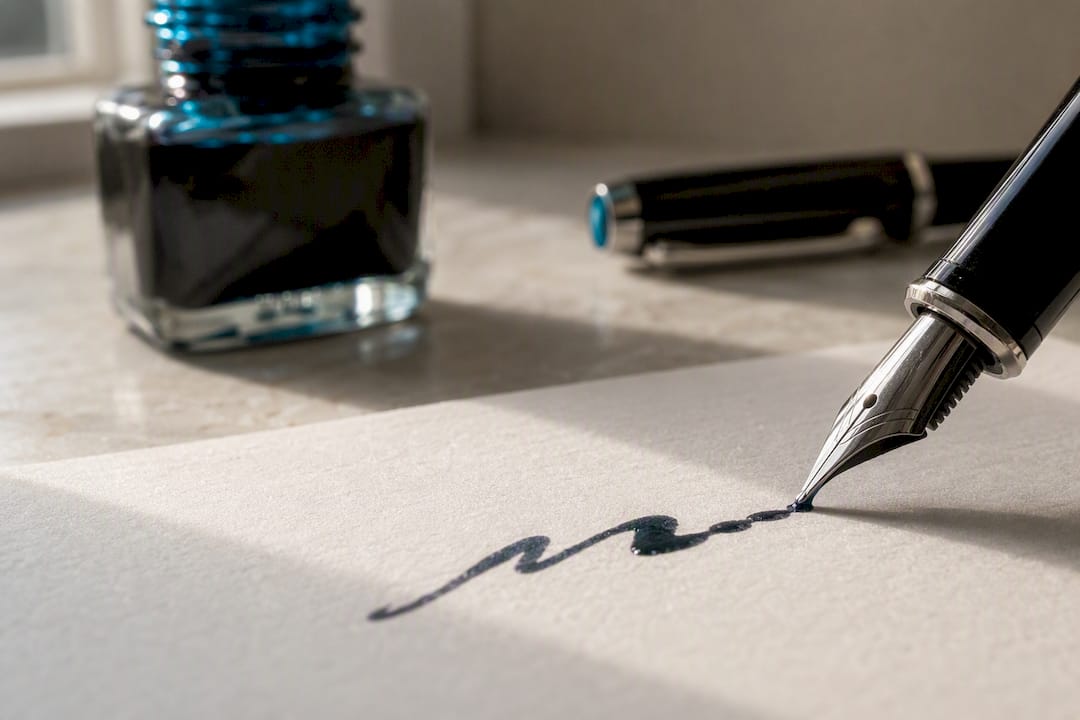
- Fountain pens: Aim for 90 to 100 gsm minimum, with good surface sizing. Fountain pen ink sits wetter on the page than gel or ballpoint ink, and it rewards a well-treated surface as much as raw thickness.
- Markers and brush pens: 120 to 160 gsm or heavier, depending on how saturated the ink is.
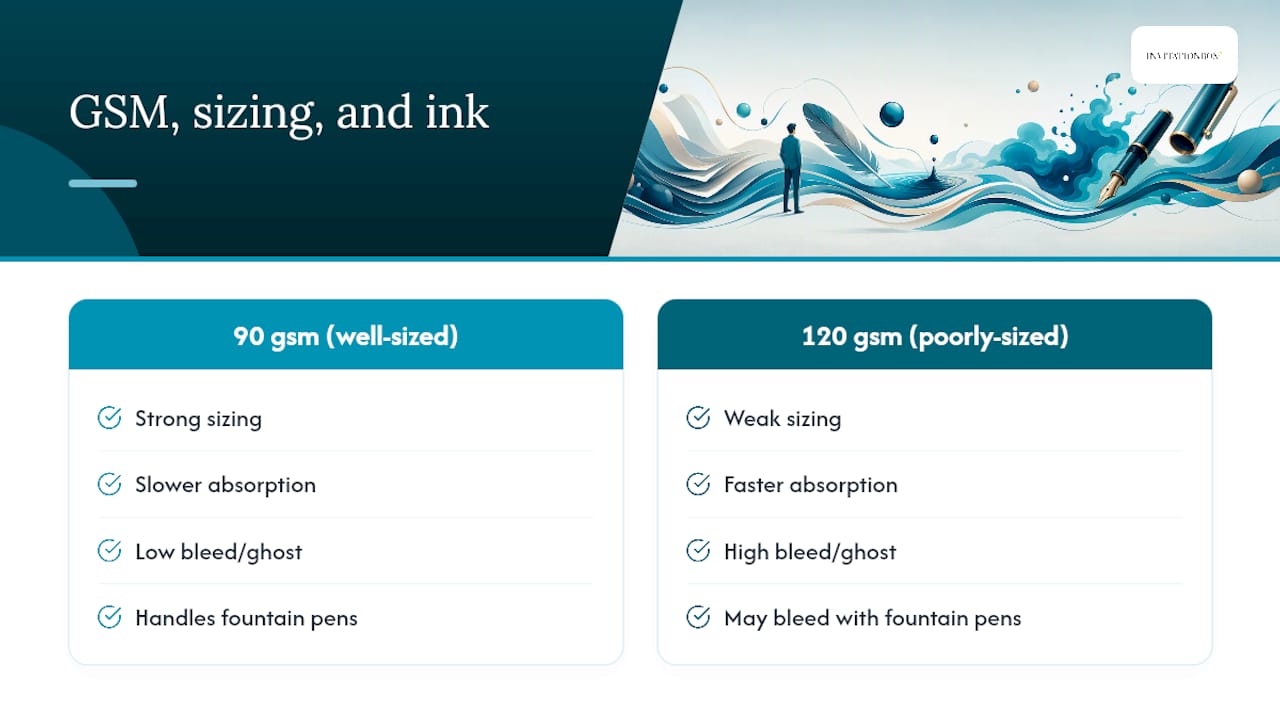
Surface sizing (the coating applied during manufacturing) and fiber composition affect performance independently of GSM. A well-sized 90 gsm sheet can outperform a poorly finished 120 gsm sheet with a wet fountain pen.
Pro Tip: If you write with more than one type of pen, test your worst-case tool first. A page that handles a wet fountain pen well will handle a dry ballpoint without issue, but the reverse isn’t true.
How Paper Weight Changes Notebook Bulk and Binding Choice
Pages-per-inch, or PPI, describes how many sheets fit into a given spine thickness. Heavier paper takes up more room per sheet, so a notepad with a fixed page count gets physically thicker, and heavier, as GSM climbs.
Binding style matters too. Stitched and spiral bindings handle thick, heavy stock well because the mechanism doesn’t depend on adhesive flexing across dozens of pages. Perfect binding, which relies on glue at the spine, can struggle with very high GSM paper in large page counts, since the glue has to flex across thicker sheets every time the notepad opens.
Weight adds up faster than most buyers expect. An A5 block of 80 sheets at 100 gsm weighs roughly 249 grams, while the same block at 120 gsm climbs to around 298 grams, not counting the cover.
How to Test Paper Before You Commit to a Batch
Specs on a product page only tell part of the story. Testing a physical sample tells you how the paper actually behaves with your pens.
- Write a line with each pen you plan to use, from ballpoint to fountain pen to marker.
- Time how long the ink takes to dry on the surface.
- Flip the page over and check for bleed-through or ghosting.
- Run a highlighter over part of the text to see if it smears or bleeds.
- Rub a pencil eraser across a marked line to check how the surface holds up.
- Fold the sample at the binding edge to see how it creases and whether it tears.
If you’re ordering a custom or high-volume batch, ask the supplier for a finished bound sample, not just a loose sheet. Binding can change how paper lies flat and how pages turn, which loose sheets won’t show you.
Pro Tip: Label each test sample with the pen used and the drying time you observed. When you’re comparing three or four paper weights side by side a week later, you won’t remember which sheet was which without notes.
Why Does Paper Weight Affect Bleed-Through and Ghosting?
Bleed-through happens when ink soaks completely through a sheet and becomes visible on the other side. Ghosting is milder: you see a faint shadow of writing through the page without full ink penetration. Both problems get worse as paper gets thinner, because there’s less fiber mass to absorb and hold the ink before it reaches the opposite surface.
GSM is the biggest lever here, but it isn’t the only one. A sheet’s surface sizing, the chemical treatment applied during manufacturing, determines how much ink soaks in versus sits on top. A well-sized 90 gsm sheet can resist bleed-through better than a poorly sized 120 gsm sheet, because sizing controls absorption rate independent of raw thickness.
Pen and ink type interact with all of this. Fountain pens deposit more liquid ink than ballpoints, so they’re the most demanding test case for any paper. Alcohol-based markers behave differently again, often bleeding through even heavy stock unless the paper has a specific coating designed to resist solvent-based ink.
This is why testing matters more than trusting a GSM number alone. Multiple industry sources note that a coated, well-sized lower-GSM paper can outperform an uncoated higher-GSM sheet for fountain pen use specifically. If you write primarily with fountain pens or markers, treat 100 gsm as a starting point rather than a guarantee, and run the sample test from the previous section before committing to a full order.
How We Choose Paper for Personalized Notepads
A company specializing in personalized stationery has extensive experience working with paper stock, stamps, and personalization, including innovative products used across its self-inking product line. That background shapes how we pick GSM for notepads: we favor the 100 to 120 gsm range for most personalized pads, since it holds up to gel pens and light fountain pen use while keeping pad thickness manageable. For readers exploring related finishes, our guide to paper weight for embossing and our breakdown of notepad sizes cover the adjacent decisions that come with customization.
Find the Right Notepad Weight and Style for Your Needs
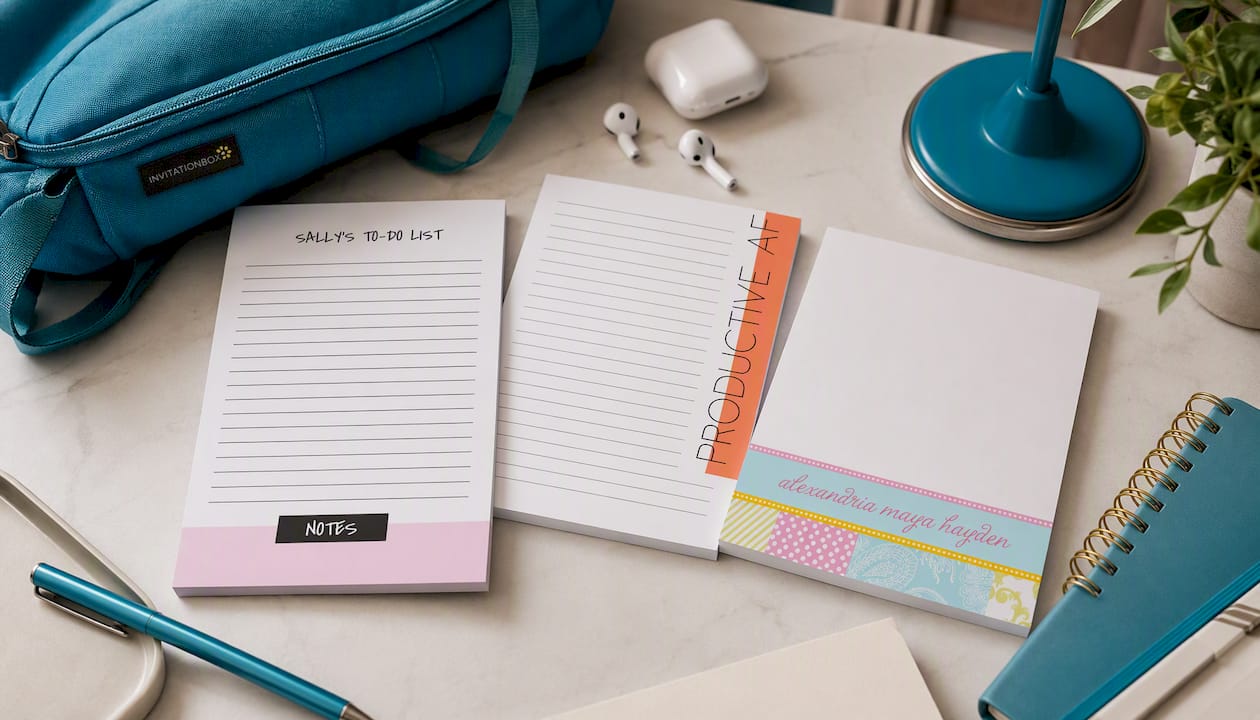
Customers can find personalized notepads built on the 100 to 120 gsm range recommended throughout this guide, avoiding guesswork from generic retail options. If everyday to-do lists are your main use, the Your To-Do List Notepad matches that midweight range well. Want something with more personality for a desk or gift? The Productive AF Notepad fits the same general-purpose GSM band with a bolder design angle, while the Pastel Patchwork Personalized Notepad suits gifting or premium stationery use where the look matters as much as the feel.
Before ordering, request a sample and ask specifically for the GSM, pages-per-inch, and finished binding type, the same three specs covered in the testing checklist above. Our guide on customizing personalized notepads walks through what to check before you commit to a full run. Browse the current lineup and place a sample or full order through the Invitationbox product pages today.
Sources
- Notebook Paper GSM Guide | Dingbats*
- Which Paper Weight Is Best for Notebooks, Planners, and Journals?
- What Is Booklet Paper? A Notebook Manufacturer’s Honest Take
FAQ
How Much Does a Notepad Weigh?
A notepad’s total weight depends on page count and paper weight together, not GSM alone. A standard legal pad using 16 to 20 lb bond paper weighs noticeably less than a premium 100 gsm journal with the same number of sheets, since that bond weight sits closer to 60 to 75 gsm.
What Type of Paper Is Best for Making Notepads?
For most notepads, 100 gsm bond or text paper balances smooth writing with reasonable cost and bulk. Drop to 70 to 90 gsm for high page count, budget pads, and go heavier, 160 gsm or more, only if the notepad needs to handle markers or watercolor.
Is 20 or 24 lb Paper Heavier?
24 lb paper is heavier than 20 lb paper. In GSM terms, 20 lb bond converts to roughly 75 gsm, while 24 lb bond corresponds approximately to 90 gsm.
Which Paper Is Heavier, 80 or 100 Gsm?
100 gsm is heavier than 80 gsm paper by definition, since GSM measures grams per square meter directly. The difference shows up in hand feel and opacity: 100 gsm resists bleed-through and ghosting noticeably better than 80 gsm for most gel and fountain pen use.
Does Invitationbox Offer Custom Notepad Paper Weights?
Invitationbox’s Personalized Notepads line is built around the GSM ranges covered in this guide, with sample requests available before you commit to a full order. Current pricing and available specs are listed on the product pages rather than fixed here, so check the site directly for up-to-date details.