

Mail Ready in 6–8 Weeks: 2026 Wedding Invitation Trends for Couples
The top wedding invitation trends for 2026 lean toward personalized, tactile stationery, think decorated envelopes, hand-drawn illustrations, textured papers, and small 3D keepsakes guests actually want to save. This guide walks through every major trend, explains why it’s showing up on so many escort cards and save-the-dates this year, and gives you a real framework for choosing what fits your venue, budget, and timeline.
TL;DR:
- Personalization through decorated envelopes, hand-drawn details, and tactile elements is central to creating memorable and keepsake-worthy invitations for 2026.
- Incorporating small 3D keepsakes like charms or wax medallions significantly increases production complexity and postage costs, so weigh these factors carefully.
- Using bold, saturated color palettes and mixed materials such as acrylic and foil adds visual impact but may also elevate costs and mailing challenges.
- Testing paper, finish, and postage combinations with samples is essential, as thick or unusual finishes can interfere with printing methods or trigger extra postal surcharges.
- Planning your timeline: start design research 8 to 10 months before the wedding, and order proofs at least 4 to 6 months ahead to ensure time for assembly and mailing.
Table of Contents
- The Top Wedding Invitation Trends for 2026
- How to Pick Which Trends Actually Suit Your Wedding
- Materials and Printing Methods: What Works and What to Avoid
- Ordering Timeline, Assembly, and Postage Checklist
- Why 19 Years of Stationery Experience Actually Matters Here
- Bring These Trends to Life With a Suite That’s Actually Mail-Ready
- Sources
- FAQ
The Top Wedding Invitation Trends for 2026
Wedding stationery has quietly become one of the most expressive parts of the planning process, and this year’s crop of ideas treats the invitation less like an announcement and more like a keepsake. The Knot’s 2026 trend roundup lists twelve directions shaping the season, and most of them share one thread: couples want guests to hold something worth framing, not just recycling. Here’s how each trend plays out, along with what it will cost you in time, money, or printing complexity.
1. The envelope as the first reveal
Designers are treating the envelope itself as part of the experience, patterned liners, wax seals, curated vintage stamps, and even hand-lettered addressing. This is one of the clearest signals in the entire trend list this year, since your envelope is the first thing a guest touches before they ever open the card inside. Try a colored liner that peeks out from the flap, or a cluster of coordinated postage stamps instead of one plain sheet. Cost/complexity: low to medium.
2. Illustrated, hand-drawn details
Loose scribble-style line art and doodled florals are replacing the stiffer botanical borders of past years. It reads as personal rather than templated. Pair it with a cotton cardstock that holds fine ink lines well. Cost/complexity: low.
3. Elevated enclosures
Instead of a stack of loose cards, couples are building pocket folds or vellum wraps that guests slide the invitation out of, turning the unboxing into a small moment. A glassine wrap tied with twine or a pocket enclosure in a contrasting color both work well. Cost/complexity: medium.
4. Textiles and textile-inspired textures
Vellum overlays, faux crochet borders, and lace-patterned foil are showing up across formal and casual suites alike, a trend Paperless Post’s 2025 roundup flagged as gaining momentum going into 2026. A vellum layer over a letterpress card adds texture without weight. Cost/complexity: medium.
5. Hospitality-influenced branding
Couples are designing a cohesive “wedding brand,” a monogram or wordmark that repeats across the invitation, menu, and welcome bag, borrowing the polish of boutique hotel branding. A simple two-letter monogram in foil ties the whole suite together. Cost/complexity: medium.
6. Charms, baubles, and 3D keepsakes
Small metal charms, wax medallions, or tiny dried flowers attached to the card are turning invitations into objects guests keep on a shelf. This tactile shift toward keepsake-worthy stationery is one of the biggest departures from the flat, minimal suites of a few years ago. Cost/complexity: high, mostly due to hand-assembly time and postage weight.
7. Handwritten watercolor and calligraphic headings
Loose watercolor lettering for names and dates softens an otherwise formal suite. It pairs naturally with cotton or cold-press stock that holds pigment texture. Cost/complexity: low.
8. Bold, color-forward palettes
Deep berry, cobalt, and burnt orange are replacing the blush-and-sage palette that dominated recent years. Try pairing a saturated envelope liner with a cream card, or a two-color foil combination like emerald and gold. Invitationbox’s color trend guide has more pairing ideas if you want to see how these combinations look printed. Cost/complexity: low to medium.
9. Mixed materials
Acrylic, vellum, and foil are being combined on a single suite rather than used alone, an unexpected-materials approach Brides has highlighted as a way to make a modern suite feel less flat. Acrylic invitations pair especially well with minimalist black-tie weddings. Cost/complexity: high.
10. Layered suites and die-cut shapes
Arched tops, scalloped edges, and layered card stacks are replacing the standard rectangle. These look striking in photos but need careful postage planning. Cost/complexity: high.
11. Venue-inspired custom illustrations
A hand-drawn sketch of the ceremony venue, whether a barn, a chapel, or a city skyline, gives guests a preview of where they’re headed. Cost/complexity: medium to high, depending on the illustrator.
12. Conversational, modern wording
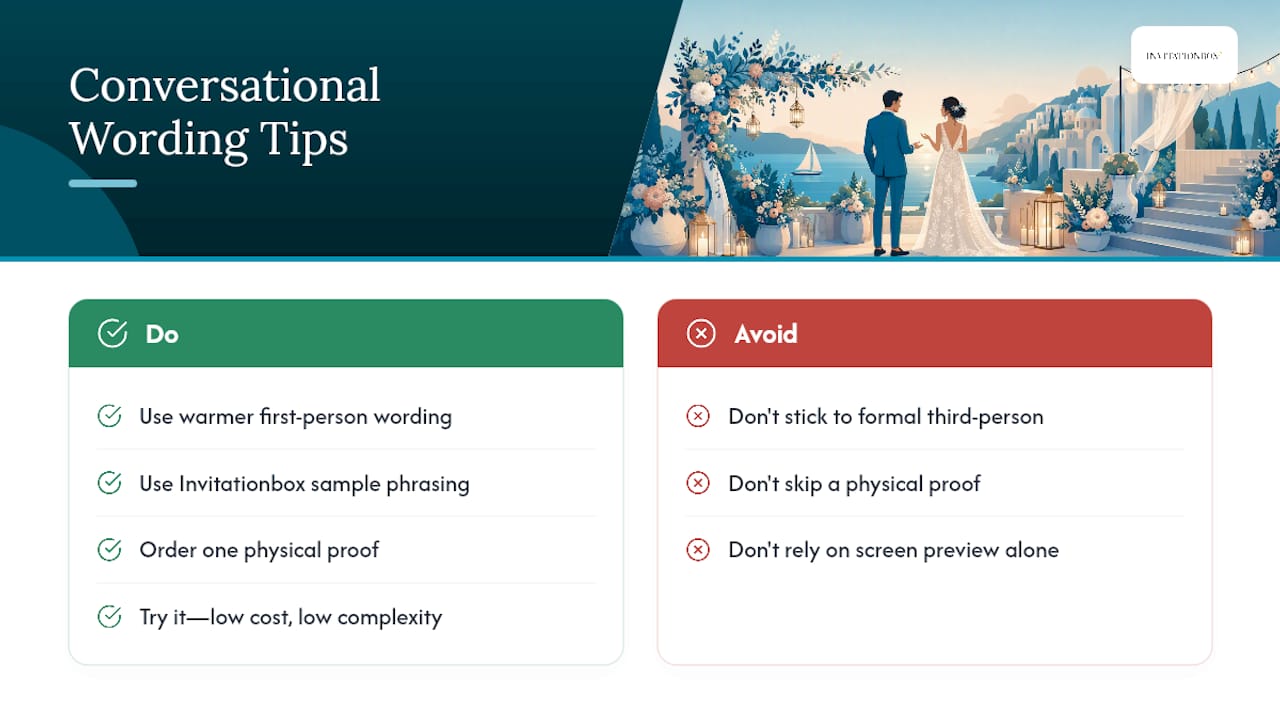
Formal third-person wording is giving way to warmer, first-person language that sounds like the couple actually wrote it. Invitationbox’s wording and etiquette guide has sample phrasing if you want a starting point. Cost/complexity: low, it’s free, and it’s the easiest trend on this list to adopt.
Pro Tip: Before you commit to any finish, order one physical proof of your exact paper, ink, and embellishment combination. A screen preview never shows you how foil catches light or how a wax seal sits against a textured envelope.
How to Pick Which Trends Actually Suit Your Wedding
Not every trend belongs on every invitation. Start by matching the mood of the trend to your venue and season: a venue illustration makes sense for a destination barn wedding, but feels out of place for a downtown rooftop reception. Then weigh the trade-off between memorabilia and mailing costs, a charm or wax seal adds delight but also adds weight and thickness that can trigger postal surcharges.
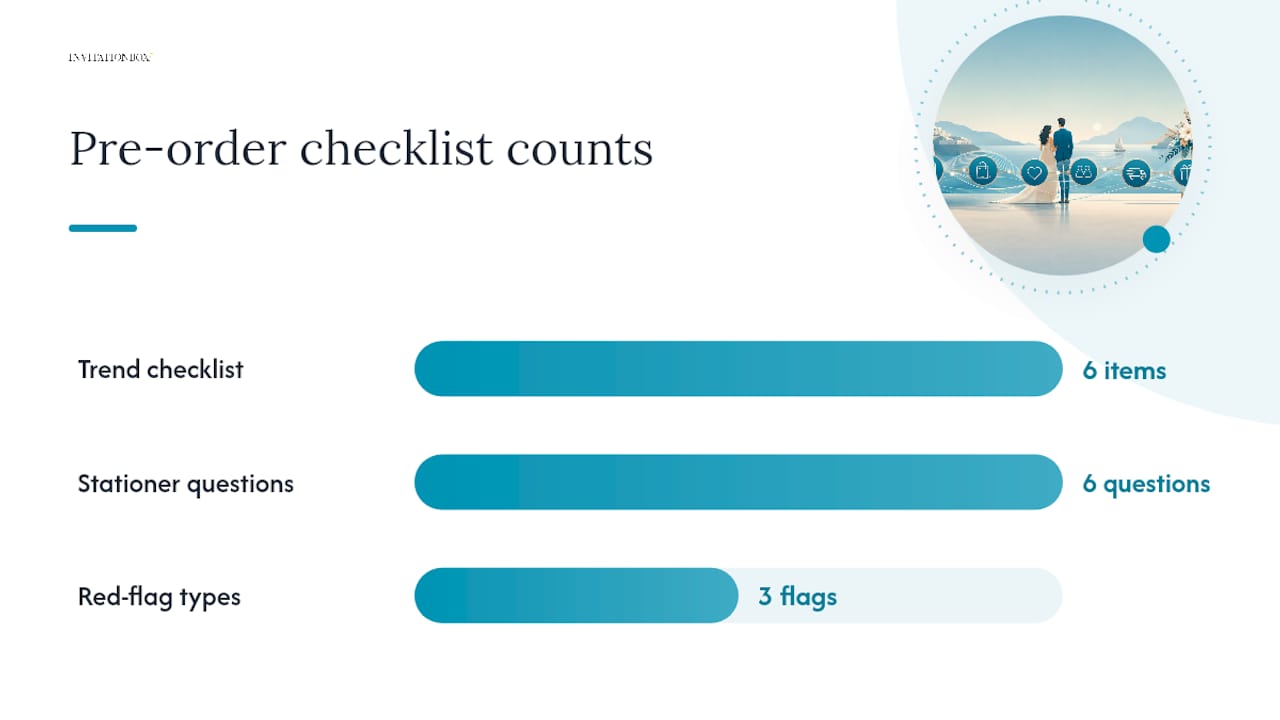
Run each trend you’re considering through this checklist:
- Does it fit the formality and setting of your venue?
- Can guests read the key details (date, time, address) at a glance?
- Does the shape or thickness risk a non-machinable postage surcharge?
- Does it fit your printing budget once you add assembly labor?
- Will your stationer’s production timeline allow for it?
- Can you get a physical sample before ordering in bulk?
Before signing off on a design, ask your stationer six questions: What’s the finished weight of the assembled suite? What are the printing method’s technical limits? How long does proofing take? What’s the estimated postage per invitation? Is there an assembly fee? What envelope sizes do you recommend for this design?
Watch for red flags: oddly shaped or non-machinable enclosures, suites so heavily layered they push into extra postage tiers, and finishes that simply don’t work with your chosen printing method.
Pro Tip: If a shape or material makes your printer pause and say “let me check,” that hesitation is worth listening to. It usually means added cost or a longer timeline.
Materials and Printing Methods: What Works and What to Avoid
Paper choice drives almost everything else about how a trend translates into a finished piece. Cotton and rag stocks hold letterpress impressions beautifully and give calligraphic or watercolor lettering a soft, absorbent texture. Vellum works best as an overlay rather than a primary card, since it’s translucent and thin on its own. Acrylic suits minimalist, modern suites but requires specialized printing and doesn’t fold, so it needs a rigid mailer.
Here’s the constraint most couples don’t find out until it’s too late: very thick, luxurious paper stocks can actually prevent certain printing methods from working. Vogue’s guidance on choosing a suite notes that letterpress and heavy foil stamping need enough pressure to create crisp detail, and an overly thick stock can blunt that detail or simply won’t run through some presses at all.
- Request a printed sample of your exact paper and finish combination before bulk ordering.
- Assemble one complete invitation, exactly as it will be mailed, and run it through a postal scale to confirm the price and machinability.
- If you’re mixing methods (foil plus letterpress, for example), ask whether your printer’s equipment can do both in one pass or requires two separate runs.
For a deeper look at stock options, Invitationbox’s paper type guide breaks down weight and finish choices in more detail.
Ordering Timeline, Assembly, and Postage Checklist
Give yourself more runway than you think you need. Most couples start researching designs 8 to 10 months before the wedding, finalize the design 6 to 8 months out, and order samples and proofs 4 to 6 months before mailing. Final printing typically happens 2 to 3 months ahead, leaving time to assemble and mail domestic invitations 6 to 8 weeks before the big day. Industry guidance generally recommends 10 to 12 weeks for destination weddings, with RSVP deadlines set 3 to 4 weeks before the event so caterers and venues can finalize headcounts.
- Assemble one complete invitation and weigh it at the post office, not at home, since non-machinable shapes or thick embellishments can trigger surcharges or require hand-canceling.
- Decide between a DIY assembly night with your wedding party (cheaper, but time-consuming) or a professional stuffing and mailing service (faster, at added cost).
- Order 15 to 20% more invitations than your guest count to cover addressing mistakes, last-minute additions, and keepsakes for yourselves.
Why 19 Years of Stationery Experience Actually Matters Here
Experience shows that couples happiest with their final suite are the ones who tested paper, finish, and postage combinations before printing in bulk. A long-running stationer has already seen which foil colors shift under different lighting and which envelope liners survive a trip through the mail intact. Order samples, request a proof, and consider coordinating your thank-you cards with your invitation suite from the start.
— Jon
Bring These Trends to Life With a Suite That’s Actually Mail-Ready
Some providers help couples turn stationery inspiration into a printed, mailable reality, offering sample-testing and format guidance built into the ordering process. Whatever trend caught your eye, textured envelope, bold color pairing, hand-lettered wording, you can preview it on real paper before committing to a full print run.
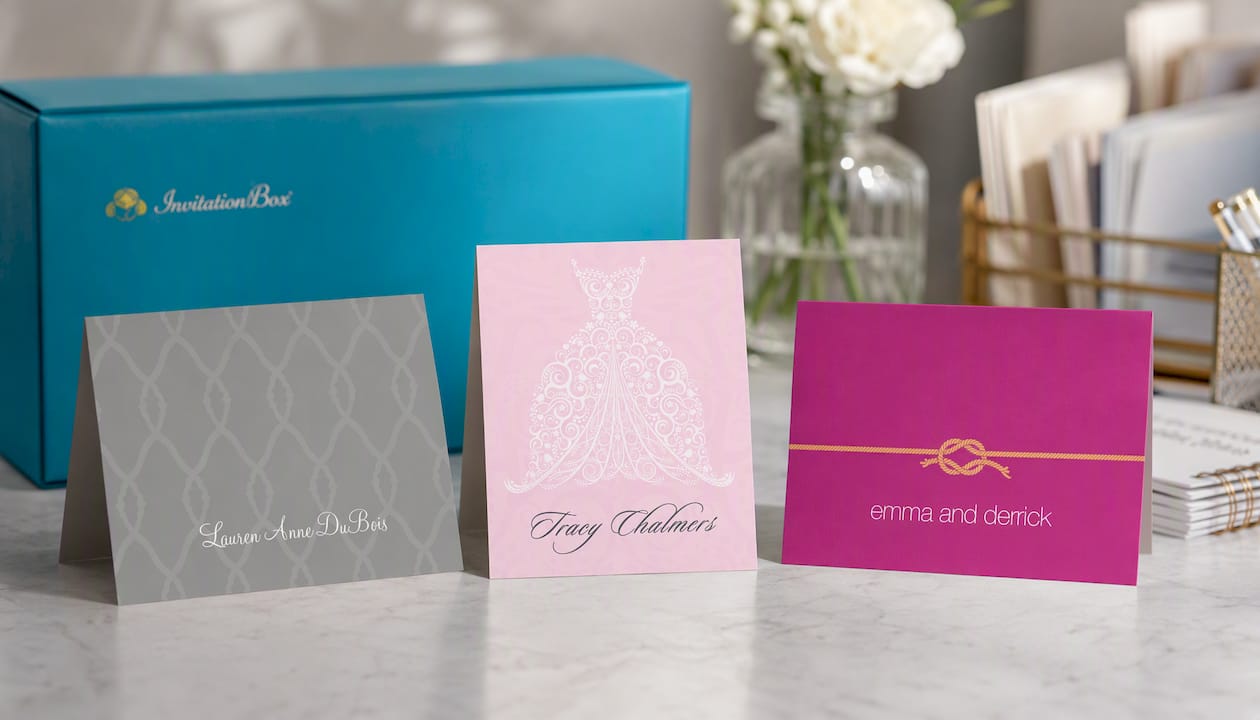
If you’re building out coordinated stationery, the Bridal Side Grey Thank You Cards pick up on the muted, elevated palettes trending this year, while the Filigree Dress Pink Thank You Cards lean into the illustrated, romantic detailing showing up across 2026 suites. For couples who want their thank-you notes to carry a little personality, the Tying the Knot Flirt Thank You Cards match the conversational, modern tone many 2026 invitations are adopting.
Browse current wedding invitation trends for more design inspiration, order a sample pack, and request a printed proof before you finalize your bulk order.
Sources
- You’ve Got Mail: Top Wedding Invitation Trends for 2026 — The Knot
- Unique wedding invitation ideas — Brides
- Designing Wedding Invitations: How to Choose Your Suite — Vogue
FAQ
What are the trendiest wedding invitation styles for 2026?
The leading styles combine decorated envelopes, hand-drawn illustrations, textured papers like vellum and faux lace, bold color palettes, and small 3D keepsakes such as charms or wax seals.
What are the biggest trends for wedding invitation cards this year?
Keepsake-oriented details, envelope liners, layered enclosures, and hospitality-inspired monogram branding are the standout shifts, alongside a move toward conversational, first-person wording.
How far in advance should I order wedding invitations?
Start researching designs 8 to 10 months ahead, finalize your design 6 to 8 months out, and mail domestic invitations 6 to 8 weeks before the wedding, or 10 to 12 weeks ahead for a destination wedding.
Are eco-friendly wedding invitations still trending in 2026?
Yes, cotton and recycled paper stocks remain popular, and many couples are pairing printed keepsake pieces with a wedding website for RSVPs to cut down on paper and postage.
Do bold colors work for a formal wedding invitation?
Bold, saturated colors like cobalt or berry can absolutely work for formal suites when paired with a classic layout, foil accents, and a neutral card stock to keep the design balanced.