

USPS Postcard Size: 3.5–4.25 by 5–6 in Rules and Mail Prep Tips
A USPS-eligible postcard must measure at least 3.5 inches high by 5 inches long and no more than 4.25 inches high by 6 inches long, with a thickness between 0.007 and 0.016 inches. If your card runs thicker or larger than that top range, watch the 0.009 inch minimum that kicks in for bigger card sizes. When your piece sits close to any of these limits, a quick check with a Mailpiece Design Analyst saves you from a pricing surprise later.
TL;DR:
- Postcards must measure between 3.5 and 4.25 inches high and 5 to 6 inches long, with thickness between 0.007 and 0.016 inches, and aspect ratios between 1.3 and 2.5.
- Oversized or thicker cards, especially above 4.25 by 6 inches or 0.016 inches thick, are classified as letters or flats, incurring higher postage and handling fees.
- The 6 by 9 inch commercial postcard format requires a minimum thickness of 0.009 inches and proper automation standards to qualify for postcard rates.
- Common sizing mistakes include exceeding dimensions by a sixteenth of an inch after lamination or incorrectly orienting the address, which can delay or increase costs.
- Testing final sizes with a caliper, confirming measurements before printing, and consulting USPS or an analyst can prevent shipping issues and unexpected charges.
Table of Contents
- USPS Postcard Dimension Standards: The Exact Numbers
- Thickness, Aspect Ratio, and Address Rules That Trip Up Mailers
- What Happens When Your Card Exceeds Postcard Limits
- Commercial and Automation Exceptions for Larger Postcards
- Common Postcard Sizes and the Trade-Offs Behind Each
- How to Measure, Test, and Confirm Your Postcard Qualifies
- What Trips Up Most Small-Batch Mailers
- Ready-to-Mail Photo Cards and Finishing Touches From InvitationBox
- Sources
- FAQ
USPS Postcard Dimension Standards: The Exact Numbers
The postcard category has specific size limits, and postcards that do not fit the defined dimensions become nonmailable or are charged at higher postage as letters or flats.

USPS measures length as the dimension parallel to the address line and height as the dimension perpendicular to it. Get those two reversed and you can misjudge which category your card actually falls into, since a card turned sideways may suddenly look like it fits a completely different size class.
Here’s the quick reference for the three categories that matter most:
- Postcard: 3.5 inches to 4.25 inches high, 5 inches to 6 inches long, 0.007 inches to 0.016 inches thick.
- Letter: 3.5 inches to 6.125 inches high, 5 inches to 11.5 inches long, up to 0.25 inches thick.
- Flat: generally larger than letter-size limits, with its own separate rate structure and handling rules.
Keep a printed version of these three ranges near your design files. It takes thirty seconds to check a layout against them, and that habit alone prevents most of the sizing headaches small mailers run into.
Thickness, Aspect Ratio, and Address Rules That Trip Up Mailers
Size isn’t the only thing USPS checks. A handful of secondary rules decide whether your postcard actually qualifies for postcard pricing, and these are the ones that catch people off guard.
The baseline thickness minimum is 0.007 inches, roughly the feel of a standard index card. But once your card is larger than the standard 4.25 by 6 inch postcard maximum, the minimum thickness jumps to 0.009 inches, and the ceiling stays at 0.016 inches. Miss that jump and your oversized card gets treated as a nonmachinable letter instead.
A few more rules worth knowing:
- Pieces must be rectangular, with an aspect ratio (length divided by height) between 1.3 and 2.5.
- Corners can be rounded, but the radius cannot exceed 1/8 inch.
- The address must run parallel to the longer side; turn it the wrong way and the card can be ruled nonmailable.
Pro Tip: Keep a plastic caliper and a few index cards on your design desk. An index card approximates the 0.007 inch minimum, so you can eyeball whether your stock feels thinner or thicker before it ever reaches a mail carrier.
What Happens When Your Card Exceeds Postcard Limits
Step outside any postcard dimension, whether it’s height, length, or thickness, and your piece automatically shifts into letter or flat classification. That change brings higher postage rates and, in some cases, a nonmachinable surcharge if the card can’t run through USPS sorting equipment cleanly.
Weight matters too. Some commercial postcard categories cap out around 3.5 ounces for machinable processing, and going over that threshold changes how the piece gets prepared and priced. Whether you’re mailing single-piece First-Class or working through a commercial presort service also changes which size and rate table applies, so pin down your mailing method before you finalize your card’s dimensions.
A few practical guardrails:
- Run your finished dimensions through the USPS Postage Calculator before ordering a full print run.
- Ask your local acceptance clerk or an MDA to confirm eligibility if your card is within an eighth of an inch of any limit.
- Build in a small margin, rather than printing exactly to the maximum, so trimming variance during production doesn’t push you over.
Commercial and Automation Exceptions for Larger Postcards
USPS does allow a larger commercial card format, up to 6 inches by 9 inches, but this option comes with conditions. These oversized cards require a minimum thickness of 0.009 inches and generally need to meet specific automation or presort preparation standards to qualify for card-level pricing rather than letter pricing.
Here’s the catch many small businesses miss: buying 6 by 9 inch card stock does not automatically earn postcard rates. Without the right presort and automation prep, that same card gets classified and charged as a letter.
- The 6 by 9 inch option is built primarily for commercial mailers with automation or presort capability.
- Retail, single-piece mailers should assume the standard 4.25 by 6 inch maximum unless they’ve confirmed otherwise.
- A commercial printer familiar with USPS preparation rules can tell you quickly whether your volume and process qualify.
Pro Tip: If you’re considering a 6 by 9 inch postcard run for a marketing campaign, talk to your printer or a Mailpiece Design Analyst before you commit to quantity. Businesses exploring direct mail loyalty campaigns often discover the automation requirements shape their design just as much as the creative does.
Common Postcard Sizes and the Trade-Offs Behind Each
Three sizes dominate real-world postcard printing, and each one comes with its own balance of impact and cost.
- 4 by 6 inches: the most economical choice, fits squarely within standard postcard pricing, and works well for holiday cards, announcements, and everyday mailers.
- 5 by 7 inches: a step-up in visual presence, often used for photo cards and invitations. However, it can edge toward letter-size postage depending on thickness.
- 6 by 9 inches: the boldest option for impact, but as covered above, it’s typically limited to commercial mailers with automation setup rather than a retail counter mailing.
Whichever size you choose, a few design habits keep production smooth: leave a proper bleed around your artwork, keep text inside a safe zone away from the edges, leave the barcode clear zone open near the address, and reserve enough blank space for the address block itself.
Paper choice matters as much as the printed design. Heavier basis weights and laminated finishes look sharp, but they also add thickness, so a stock that reads beautifully on screen can push your finished card past the 0.016 inch ceiling. Coordinate finished size and finished thickness with your printer at the same time, not as an afterthought.
How to Measure, Test, and Confirm Your Postcard Qualifies
A few careful minutes at the measuring stage save you from a rejected mailing later. Here’s the process worth following before any print run:
- Orient the card correctly, with the address line running parallel to the longer side.
- Measure length and height separately, confirming both fall within the postcard ranges.
- Check thickness with a caliper, watching for the 0.009 inch threshold if your card exceeds standard postcard maximums.
- Calculate the aspect ratio by dividing length by height, confirming it lands between 1.3 and 2.5.
- Submit a physical sample to your local post office or an MDA for a binding determination if any measurement is close to a limit.
If you’re choosing paper stock for a batch of holiday cards or announcements, InvitationBox’s own stamp and card size guide walks through compatible product dimensions, and our photo card sizing guide covers bleed and proofing in more detail.
Pro Tip: Always order one printed proof before committing to a full run. A proof lets you check the real, finished thickness and trim size rather than relying on a spec sheet alone.

What Trips Up Most Small-Batch Mailers
The most common mistake I see isn’t a wild size error. It’s a card that’s a sixteenth of an inch too big after lamination, or an address printed the wrong direction on an otherwise perfect layout. Small production choices carry real postage consequences.
The mailers who avoid trouble share one habit: they measure the finished piece, not just the file, and they check with USPS or an MDA before the full print run rather than after.
— Jon
Ready-to-Mail Photo Cards and Finishing Touches From InvitationBox
Once your sizing is locked in, the easiest next step is choosing a card that’s already built around mailing-friendly dimensions. Our Fun Holiday Confetti Photo Card and Believe Photo Card come in finished sizes that pair naturally with standard postcard mailing, so you’re not guessing at trim or thickness on your own.
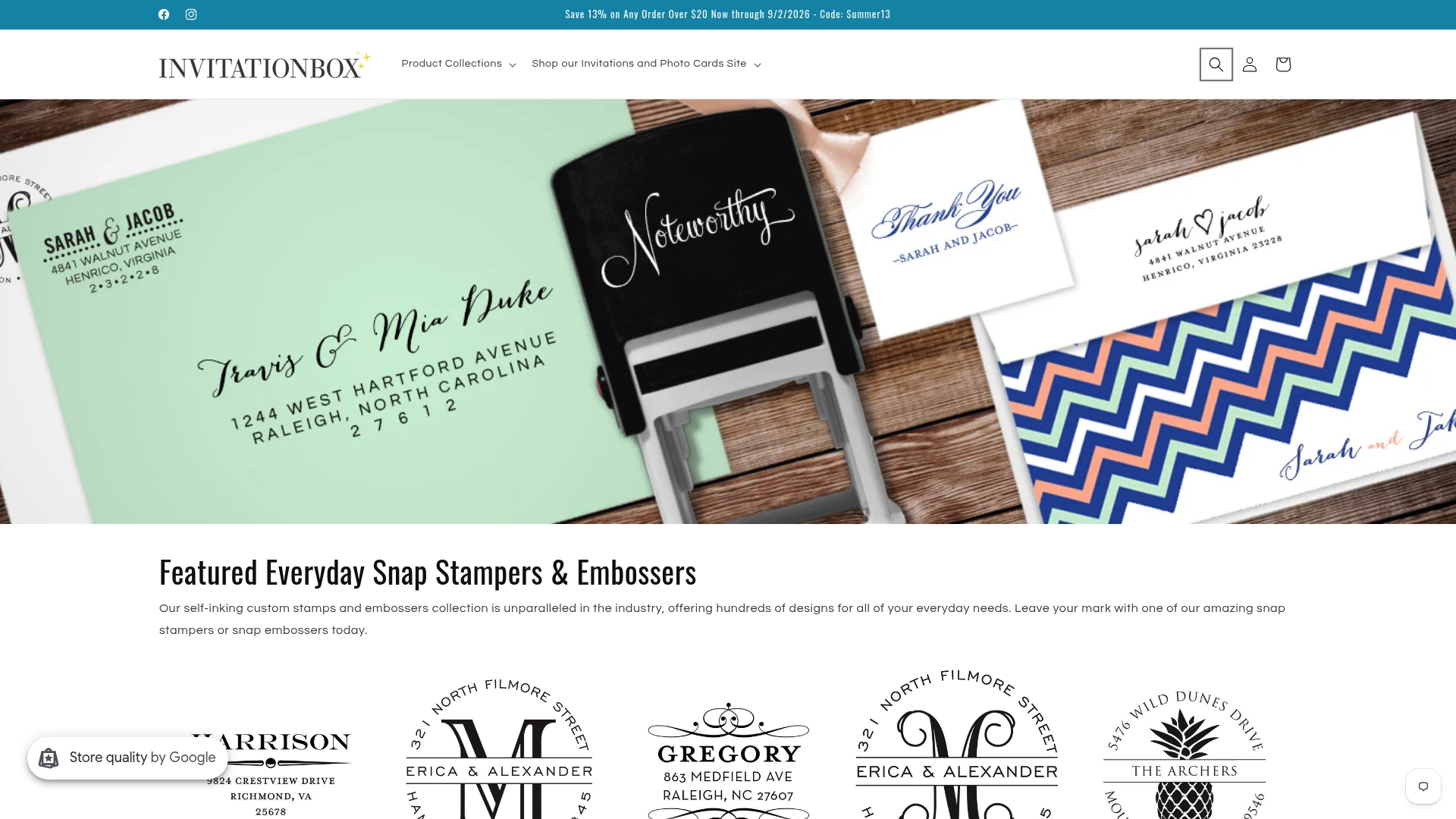
A clean return address matters too, and that’s where a good stamper earns its keep. Our Corner Scrolls, Classic Scroll, and Modern Scroll stampers give your return address a crisp, consistent look on every card in the batch, while options like the Horseshoe, Jolly Rogerette, and Extra Ornamental stampers add a seasonal or personal touch for themed mailings.
A few ways to put these together:
- Order a printed proof of your photo card before committing to your full mailing list.
- Pair your card with a matching return-address stamper for a finished, cohesive look.
- Browse the full InvitationBox shop to compare stock options, finished sizes, and stamper designs side by side.
Sources
FAQ
Are postcards 4x6 or 5x7 inches?
Both sizes are common and both can qualify for postcard rates, since USPS accepts anything between 3.5 by 5 inches and 4.25 by 6 inches. A 4 by 6 inch card fits squarely within that range, while a 5 by 7 inch card exceeds the maximum height and length and typically mails as a letter instead.
Can you mail an 8.5 by 11 inch postcard?
No, a piece larger than the maximum postcard dimensions is far beyond the postcard size range and would be classified and priced as a letter or flat, not a postcard. USPS caps postcard dimensions at 4.25 by 6 inches for standard retail pricing.
Can I mail a 5x7 postcard with a postcard stamp?
Generally no, since a 5 by 7 inch card exceeds the postcard maximum of 4.25 by 6 inches and gets charged letter-size postage instead. Using a postcard stamp on an oversized piece can result in postage due or a returned mailing.
How much postage do I need for a 4x6 inch postcard?
A 4 by 6 inch card falls within USPS postcard dimensions, so it qualifies for standard postcard-rate postage rather than letter pricing. Check the current rate on the USPS Postage Calculator before mailing, since postage rates can change.
What is the 0.009 inch rule for postcards?
The 0.009 inch minimum thickness applies to card-size pieces larger than the standard 4.25 by 6 inch postcard maximum, including the expanded 6 by 9 inch commercial option. Cards thinner than that minimum risk being reclassified as nonmachinable letters rather than postcards.